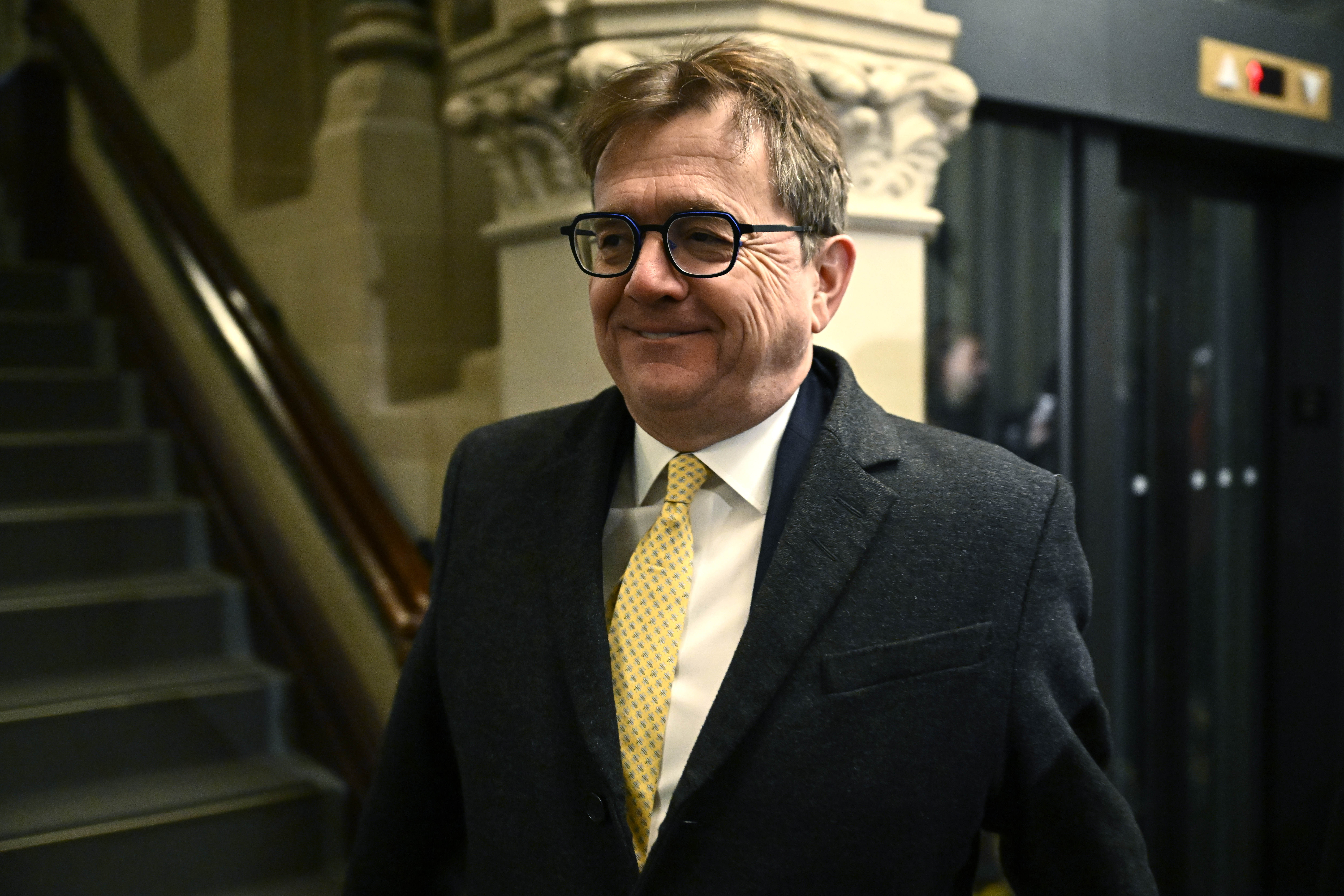
The appointment of Jonathan Wilkinson as Canada’s next ambassador to the European Union represents far more than a routine shuffle of the diplomatic deck. It is a calculated removal of a senior cabinet heavyweight from the domestic front to address a burgeoning crisis in transatlantic trade and energy security. By sending a former Minister of Natural Resources and Energy to Brussels, the Prime Minister’s Office is signaling that the era of "polite diplomacy" is over. Canada is now treating its relationship with the EU as a raw industrial and security necessity.
This move comes at a time when the Comprehensive Economic and Trade Agreement (CETA) is facing death by a thousand cuts in European national legislatures. Simultaneously, the European Union is desperate to de-risk its supply chains from authoritarian regimes, looking toward Canada’s "critical minerals" as a lifeline. Wilkinson is not being sent to host gala dinners. He is being deployed to secure the physical and economic infrastructure that will define the next two decades of the Western alliance.
The Mineral Cold War and the Brussels Mandate
Europe is currently gripped by a frantic realization that its green transition is entirely dependent on supply chains that run through Beijing. The European Critical Raw Materials Act is a reactive attempt to claw back some semblance of autonomy. Wilkinson’s primary objective in Brussels will be to position Canada not just as a friendly neighbor, but as the primary extraction and processing hub for the continent.
Canada holds vast reserves of lithium, nickel, cobalt, and copper—the literal ingredients of the modern world. However, European investors have been hesitant to commit the billions required for North American projects due to regulatory uncertainty and the allure of cheaper, less regulated markets elsewhere. Wilkinson’s deep familiarity with Canada’s regulatory "Impact Assessment Act" and his history of negotiating with provincial premiers makes him the only diplomat capable of explaining to EU commissioners why a Canadian mine takes ten years to open, and how they can help speed it up through joint investment.
He understands the mechanics of the industry. This is a level of technical depth that a career diplomat simply cannot match. If the EU wants Canadian hydrogen or Canadian nickel, Wilkinson is the person who can explain exactly which rail lines need upgrading and which indigenous consultations are currently on the critical path.
The CETA Ghost and the Protectionist Surge
While the mineral trade represents the future, the present reality is that the crown jewel of Canada-EU relations, CETA, is wobbling. Several EU member states, most notably France, have seen fierce domestic opposition from agricultural lobbies who fear Canadian competition. The deal has been "provisionally" in effect since 2017, but full ratification remains a political minefield.
Wilkinson enters this environment as a pragmatist. His task is to navigate the protectionist sentiment rising across the European continent. He must convince European farmers and politicians that Canadian standards are not a threat to their way of life, but a necessary component of a stable food supply in a world where traditional breadbaskets are increasingly volatile.
It is a grueling sell. The political climate in Europe is shifting toward "strategic autonomy," a polite term for looking inward. Canada’s challenge is to prove that it is part of the European "inner circle" despite the geographic distance. Wilkinson’s experience in the private sector, specifically in clean technology, gives him a language that resonates with the European corporate elite who are often more influential than the parliamentarians in Strasbourg.
Energy Security Beyond the Slogans
For two years, the conversation between Ottawa and Berlin about liquefied natural gas (LNG) was a series of missed connections. Canada spoke about carbon intensity; Germany spoke about immediate heating needs. The result was a missed opportunity for Canadian gas to displace Russian influence in the European energy mix.
Wilkinson was at the center of those conversations as Energy Minister. He knows where the friction points are. His presence in Brussels suggests that Canada is ready to revisit the energy export conversation with a more sophisticated lens. This isn't just about shipping molecules; it's about the "Atlantic Bridge" for hydrogen and the long-term integration of electricity grids and carbon capture technology.
The EU’s Carbon Border Adjustment Mechanism (CBAM) is another looming wall for Canadian industry. This "carbon tax at the border" could penalize Canadian steel, aluminum, and fertilizers if the two jurisdictions cannot harmonize their carbon pricing systems. Wilkinson’s background as a former Environment Minister means he is perhaps the most qualified person in the country to argue that Canada’s industrial output should be exempt from these levies. He helped build the system. Now he has to defend it against European bureaucrats who might use it as a protectionist tool.
The Political Cost of the Vacancy
Sending a minister of this caliber to a diplomatic post leaves a massive hole in the federal cabinet at home. It suggests a triage of priorities. The government has decided that the risk of losing the European market or failing to secure mineral partnerships is a greater threat than the political vacuum his departure creates in Western Canada.
Wilkinson was one of the few voices in the Liberal cabinet who could speak to the energy sector in Calgary and Vancouver with a degree of earned respect. By moving him to Brussels, the government is effectively saying that the deals that need to be struck in Europe are more important than the fires that need to be put out in the Canadian West. It is a high-risk gamble.
Breaking the Diplomatic Mold
Traditional diplomacy is often a slow dance of incremental gains. The EU is a notoriously difficult partner, a collection of 27 nations with 27 different sets of anxieties. Most ambassadors spend their time building consensus and reporting back to headquarters.
Wilkinson is expected to operate differently. He is an operator. In his previous roles, he was known for a "get it done" mentality that occasionally rubbed career civil servants the wrong way. In the labyrinth of the Brussels European Quarter, that drive will be tested. He will have to balance the high-level policy goals of the European Commission with the gritty, ground-level interests of individual member states like Poland, Hungary, and Italy.
He is walking into a theater where the United States is also aggressively pursuing the same "green subsidies" and mineral deals through the Inflation Reduction Act. Canada is not just competing against China; it is competing against its closest neighbor for European attention and capital.
The Reality of the "Critical Mineral" Pipeline
To understand why this appointment matters, one must look at the actual numbers. The EU expects its demand for lithium to increase 12-fold by 2030. Currently, they get almost none of it from North America. The infrastructure to move these materials—ports, refineries, and specialized shipping—does not exist at the scale required.
Wilkinson’s job is to secure the "Offtake Agreements." These are the contracts that allow mines to be built. If he can convince European automakers like Volkswagen or Stellantis to sign long-term deals for Canadian-sourced materials, the financing for Canadian mines becomes a certainty rather than a speculative hope.
This is the "how" of the appointment. It is about moving from high-level "Memorandums of Understanding" to hard, enforceable contracts. The move indicates that Canada has realized that being "like-minded" is no longer enough to win in the global economy. You have to be essential.
The European Union is currently a massive regulatory superpower. If you can influence the rules in Brussels, you influence the rules of global trade. By placing a veteran minister in that environment, Canada is attempting to "pre-clear" its exports and ensure that the next decade of European regulation is written with Canadian interests in mind.
The success of this mission will not be measured in friendly press releases or successful summits. It will be measured in the tonnage of ore moved across the Atlantic and the final ratification of trade deals that have sat on the shelf for far too long. Wilkinson is being sent to do the work that a career diplomat cannot: he is there to close the deal.
The era of Canada being a passive observer of European integration is over. The pressure is now on Wilkinson to prove that a politician can thrive in the world’s most complex diplomatic arena. He has to turn a friendship into a functional, industrial alliance before the window of opportunity closes and Europe finds its resources elsewhere.
Success requires more than just showing up. It requires a fundamental shift in how Canada views its role on the world stage. We are no longer just a middle power with good intentions; we are a resource superpower that needs to learn how to use its leverage. Wilkinson’s performance in Brussels will determine if Canada can actually execute that transition. If he fails, CETA may remain a hollow shell, and Canada’s vast mineral wealth will stay buried in the ground while the rest of the world moves on.
The move is a blunt instrument. It is a signal to the world that Canada is finally getting serious about its economic security. Now comes the hard part. The ink on his credentials will barely be dry before the first round of mineral negotiations begins, and the eyes of the global energy sector will be watching to see if he can deliver the results he promised back in Ottawa.
Wilkinson's departure from the domestic stage marks the end of one chapter and the beginning of a much more dangerous one. The transition from minister to ambassador is rarely this significant, but in this case, the stakes are as high as they get. The future of Canada's industrial relevance is being exported to Brussels.
Stop looking at this as a retirement or a graceful exit. This is a deployment to the front lines of the new economic order.