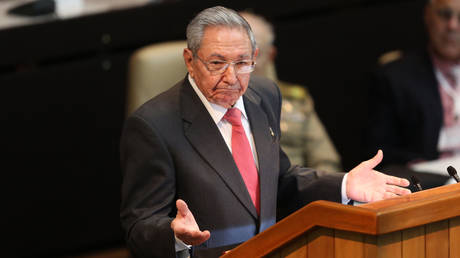
The United States Department of Justice filing of criminal charges against former Cuban President Raúl Castro represents a fundamental shift from judicial accountability to geopolitical leverage. Acting Attorney General Todd Blanche’s announcement in Miami unsealed a grand jury indictment charging the 94-year-old former leader with conspiracy to kill US nationals, murder, and the destruction of aircraft. The charges stem from the February 24, 1996, downing of two civilian planes operated by the exile humanitarian group Brothers to the Rescue.
While framed by the Justice Department as a delayed pursuit of legal justice for the four volunteers killed, an evaluation of the operational timing, systemic precedence, and concurrent economic policies reveals the indictment operates as a formal mechanism for sovereign coercion. It serves as a legal framework designed to force structural regime transition within an economically crippled Cuban state.
The Tri-Pillar Framework of Extraterritorial Indictments
The application of US criminal law against foreign heads of state functions under a distinct three-part operational model. This structure dictates how legal mechanisms are weaponized to achieve foreign policy objectives when physical extraction is hindered by state sovereignty.
       [ Legal Architecture ]
                 │
                 ▼
       [ Economic Attrition ] ──► [ Sovereign Coercion ]
                 │
                 ▼
       [ Kinetic Precedent ]
1. Legal Architecture and Jurisdictional Leverage
The indictment comprises one count of conspiracy to kill US nationals, four counts of murder, and two counts of destruction of aircraft. Because Cuba maintains a strict non-extradition policy regarding its citizens, the direct legal utility of the indictment in securing a trial in federal court remains low.
The primary utility is structural. By processing charges through the U.S. District Court for the Southern District of Florida, the US government establishes an unsealed, permanent criminal designation. This action effectively freezes the international mobility of the target and creates a legal barrier that prevents future US administrations from normalizing diplomatic relations without addressing outstanding federal warrants.
2. Synchronization with Economic Attrition
The indictment does not occur in a vacuum; it acts as an amplifier of economic distress. Following the removal of Venezuelan President Nicolás Maduro, the White House instituted an aggressive fuel and energy blockade on Cuba. Because Venezuela served as Cuba's primary subsidized energy provider, this blockade eliminated the island's primary energy supply chain. This disruption led to systemic blackouts, severe food insecurity, and localized economic contraction.
The legal charge against Castro is timed to exploit these internal vulnerabilities, transforming chronic state stress into acute political instability.
3. Verification through Kinetic Precedent
The structural model for this intervention relies on the January 2026 military extraction of Nicolás Maduro from Caracas. Maduro was similarly indicted by the US on federal criminal charges years prior to his removal. The Trump administration is utilizing that exact operational playbook:
- Establish criminal status via grand jury indictment.
- Impose devastating economic and energy blockades.
- Propose conditional relief or face kinetic intervention.
The historical precedent validates that the US view of foreign leader indictments has evolved from symbolic condemnation to an explicit prelude for regime displacement.
The Asymmetric Escrow Strategy
Concurrent with the judicial action, the US diplomatic apparatus has deployed a strategy of asymmetric leverage, combining punitive restrictions with transactional incentives. Hours prior to the initial disclosure of the indictment plans, a US delegation led by CIA Director John Ratcliffe held direct discussions in Havana with Cuban officials. During these meetings, the US presented a conditional stabilization offer: a $100 million humanitarian and energy assistance package.
The capital injection is strictly contingent upon specific structural adjustments by Havana. The terms require the Cuban government to initiate market-liberalization reforms, open the domestic economy to foreign direct investment, and sever long-standing military and intelligence ties with external adversaries, specifically Russia and China.
Cuban Foreign Minister Bruno Rodríguez and President Miguel Díaz-Canel rejected the proposal, characterizing the offer as an attempt to force submission through economic strangulation. The rejection highlights the mathematical mismatch in the bargaining positions:
$$C_{\text{sovereignty}} > V_{\text{aid}} - C_{\text{blockade}}$$
The strategic calculation by Havana posits that the long-term cost of relinquishing one-party political control ($C_{\text{sovereignty}}$) remains higher than the immediate value of the aid ($V_{\text{aid}}$) minus the compounding losses inflicted by the energy blockade ($C_{\text{blockade}}$).
Internal Stability and the Threat of Kinetic Incursion
The primary risk factor for the US strategy is the unpredictable reaction of Cuba’s domestic security apparatus. President Díaz-Canel warned that any direct US military assault or forced entry into the island would result in a prolonged, asymmetric conflict. This sentiment was echoed by exiled figures such as Alina Fernández, who noted that the Cuban military has operated under a continuous mobilization doctrine for over six decades.
The administrative hierarchy of Cuba presents a distinct bottleneck for US planners:
- The Symbolic Core: Raúl Castro, despite relinquishing the formal leadership of the Communist Party of Cuba in 2021, remains the final arbiter of military loyalty and institutional continuity.
- The Intermediate Envoy: Raúl Guillermo Rodríguez Castro (Castro’s grandson and security chief) acts as the direct channel for back-channel communications with Washington, ensuring that elite factions retain communication lines independent of formal state ministries.
- The Civil Bureaucracy: President Díaz-Canel manages the day-to-day administrative collapse but lacks the historical revolutionary legitimacy required to command total military allegiance during a transition crisis.
This fragmentation creates a structural vulnerability. If the economic blockade completely collapses the civilian infrastructure, the military under the Castro family may prioritize organizational survival over the preservation of the civilian administrative state.
Escalation Matrix and Strategic Directives
The current geopolitical environment indicates that the US policy toward Cuba has moved past containment and into active degradation. The indictment of Raúl Castro serves as the legal mechanism required to legitimize harsher interdiction strategies.
To navigate the next phase of this confrontation, international analysts and regional stakeholders must monitor specific operational indicators:
- Interdiction of Dual-Use Shipping: The US maritime forces will likely expand the current fuel blockade into a comprehensive boarding and inspection regime in the Caribbean Sea, targeting any vessels carrying energy resources or generalized cargo from state actors to Cuban ports.
- The Maduro Trial Progression: The legal handling and intelligence exploitation of Nicolás Maduro in New York will serve as a direct indicator of the treatment prepared for the Cuban leadership, directly influencing Havana's willingness to engage in back-channel negotiations.
- Sovereign Debt Default Repercussions: As the energy blockade accelerates the collapse of Cuba’s productive economy, default on remaining international obligations will trigger foreign asset seizures, further isolating the Cuban state from alternative financial networks.
The primary limitation of the US approach is the potential for generating a chaotic state collapse that triggers a mass migration crisis directly impacting the southern border of the United States. This outcome would counter the domestic security objectives of the administration.
The White House is calculating that the combination of legal delegitimization, intense energy deprivation, and the credible threat of tactical military operations will force the military leadership in Havana to accept a managed market transition before an unmanageable humanitarian collapse occurs.