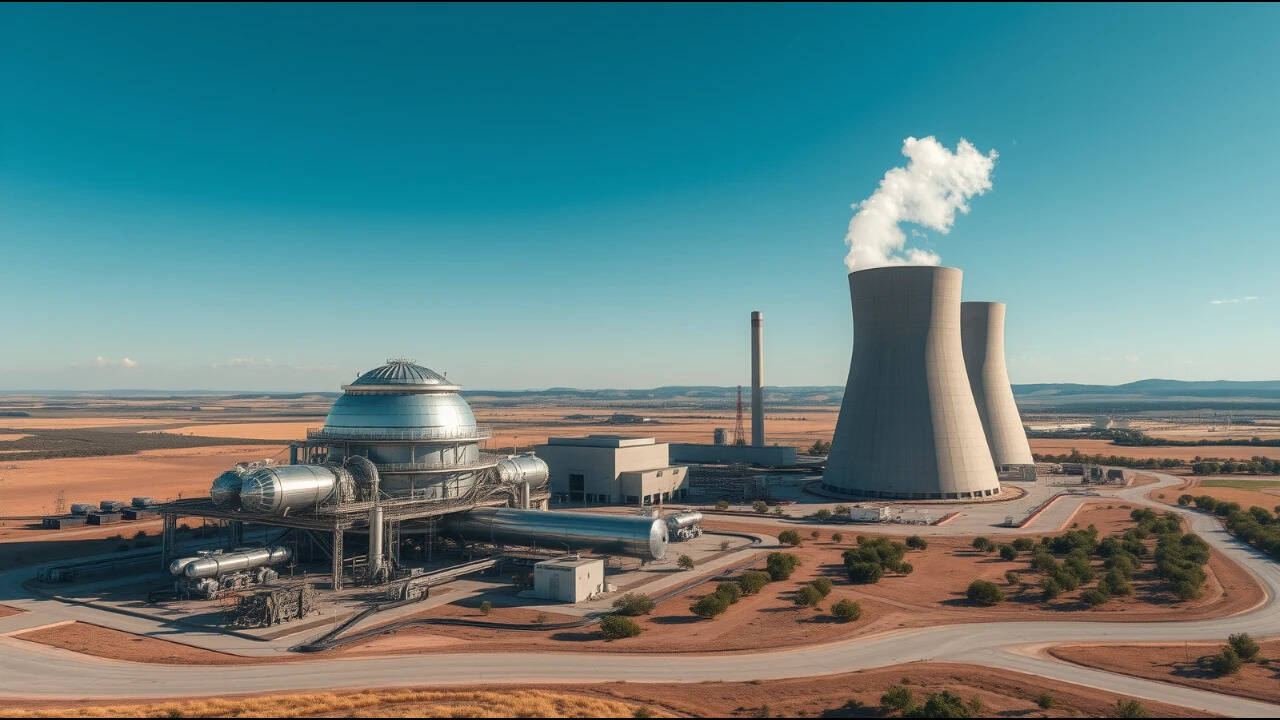
The domestic medical isotope supply chain relies entirely on foreign imports for molybdenum-99, the parent material of technetium-99m used in over forty thousand daily diagnostic procedures across the United States. Recent operational milestones in Lockhart, Texas, where Oklo Inc. achieved first criticality at its Groves Isotope Test Reactor, alter the baseline mechanics of this dependency. Deconstructing this development requires separating regulatory velocity from thermodynamic reality, exposing the structural variables that dictate whether advanced nuclear deployments can scale beyond bespoke engineering exercises.
The Cost Function of Regulatory Compression
Traditional advanced nuclear development operates under a multi-decade capital expenditure cycle dominated by Nuclear Regulatory Commission oversight. The compressed timeline of the Groves facility—moving from a greenfield site to a sustained, self-sustaining nuclear chain reaction in under twelve months—was enabled by bypassing traditional licensing channels through the Department of Energy Reactor Pilot Program.
This pathway allows construction and safety reviews to execute in parallel rather than sequentially. From an economic perspective, this operational shift alters the net present value calculations for small modular reactors. Fixed overhead costs scale inversely with construction velocity. By eliminating protracted administrative drag, the capital cost per megawatt-thermal equivalent drops significantly, reducing the cost of capital during the pre-revenue phase.
However, this compression introduces structural trade-offs. Bypassing standard civilian nuclear frameworks shifts risk management entirely onto internal corporate governance. The strategic efficacy of this model depends on three operational variables:
- Supply Chain Internalization: Manufacturing or commercially procuring every sub-component and fuel element in-house.
- Civil Execution Speed: Executing physical excavation, foundation pouring, and assembly without relying on specialized nuclear tier-one contractors.
- Safety Readiness Validation: Developing startup and operating protocols internally to satisfy departmental readiness reviews without standard procedural precedents.
Isotope Kinetics Versus Energy Generation
A primary misconception in public discourse is treating test reactors as grid-scale power plants. The Groves reactor is a low-power facility engineered explicitly for non-electric applications. Its thermodynamic output is optimized for neutron flux rather than thermal-to-electric conversion efficiency.
The production of molybdenum-99 requires sustained neutron bombardment of target materials within a controlled core environment. Designing a reactor for this purpose creates a distinct engineering profile compared to commercial power production:
- Thermal Output Limits: Low-power test reactors minimize thermal management complexity, reducing the footprint of balance-of-plant infrastructure.
- Core Geometry: Core configurations maximize neutron leakage or specific flux traps rather than uniform heat transfer.
- Fuel Cycle Dynamics: Small fuel loadings reduce the initial fissile inventory requirements, shortening procurement loops.
The limitation of this architecture lies in scale. A test reactor validates the physics and operational workflow, but it does not solve the mass-balance equation required to displace foreign medical isotope imports. Translating a test-bed success into commercial market dominance requires a transition to multi-unit facilities, such as those planned at the Idaho National Laboratory, which face entirely separate licensing hurdles under standard regulatory frameworks.
Systematic Bottlenecks in Commercialization
Achieving first criticality is an operational proof-of-concept, not a commercial product launch. The transition from a test reactor on private land to an operational medical supply vector encounters distinct systemic frictions.
The first bottleneck is fuel supply assurance. Advanced reactor designs often rely on specialized high-assay low-enriched uranium. While the Idaho National Laboratory supplied the initial fuel allocation for the Groves facility, a scaled commercial market cannot rely on national laboratory inventory stockpiles. Commercialization requires an independent, robust front-end nuclear fuel fabrication market that currently remains underdeveloped in the United States.
The second bottleneck is downstream processing infrastructure. Irradiated targets extracted from a test reactor are intensely radioactive and require immediate, specialized radiochemical processing facilities to isolate molybdenum-99 within a tight half-life decay window. Irradiation capacity without matching chemical separation plants creates a localized supply chain impasse, where radioactive material decays before it can be refined into hospital-ready pharmaceuticals.
Strategic Execution Vector
Organizations aiming to replicate this deployment velocity must decouple physical construction from regulatory dependence while institutionalizing supply chain redundancy. Future viability belongs to entities that treat nuclear infrastructure as modular manufacturing assemblies rather than bespoke civil engineering projects. Capital allocation must prioritize parallelized safety verification workflows combined with integrated chemical processing pipelines to capture market share in high-margin medical isotope logistics.