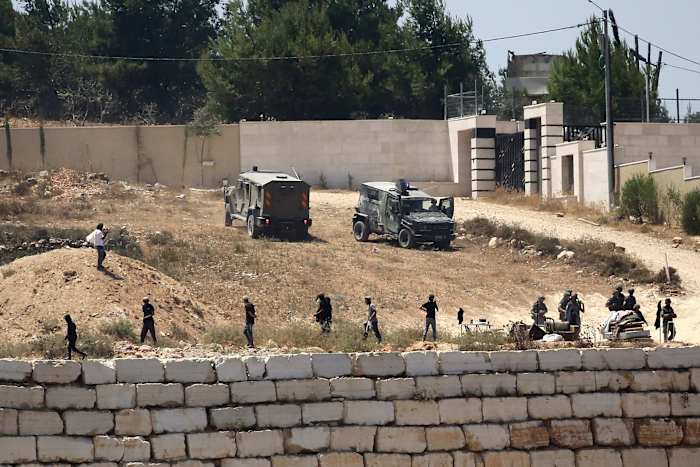
Geopolitical stability in the West Bank relies on a fragile security equilibrium, maintained by an asymmetric distribution of policing authority, administrative zoning, and legal accountability. When localized conflict escalates into organized residential displacement—frequently characterized by settler incursions against Palestinian communities—the event triggers immediate friction across international diplomatic channels. The official condemnation issued by United States Ambassador Jack Lew regarding violent incidents in Jit serves as a diagnostic point for analyzing how localized property destruction and physical coercion translate into diplomatic friction, economic disruption, and security paradigm shifts. To understand this dynamic, one must examine the institutional architecture governing the territory, the cost function of localized escalation, and the systemic incentives driving civilian-perpetrated displacement.
The Jurisdictional Matrix and Security Deficit
The administrative division of the West Bank under the Oslo Accords creates structural vulnerabilities that directly influence rates of localized conflict. Area C, comprising roughly sixty percent of the territory, remains under full Israeli military and civil control, leaving Palestinian residents within those boundaries subject to a security apparatus that frequently diverges from civilian law enforcement norms.
This governance model produces three distinct operational mechanics:
- Enforcement Asymmetry: Palestinian civil police lack jurisdiction in Area C, creating a security vacuum where civilian residents depend on the Israel Defense Forces for immediate intervention against criminal or violent acts.
- Dual Legal Frameworks: Israeli settlers residing in the same geographic vicinity are governed by Israeli civil law and military jurisdiction, whereas Palestinian residents face military court systems. This division complicates rapid accountability for unauthorized actions.
- Response Latency: Due to geographic dispersion and prioritization protocols, military response times to fast-moving civilian confrontations often exceed the window required to prevent property destruction or physical injury.
When state security forces fail to establish immediate deterrence against unauthorized civilian violence, the perceived cost of aggressive action drops for perpetrators. This enforcement deficit forms the foundational vulnerability that enables organized or semi-organized property incursions to escalate without immediate tactical disruption.
The Economic and Strategic Cost Function of Displacement
Settler incursions and localized property destruction do not occur in a vacuum; they operate as functional mechanisms designed to alter demographic facts on the ground through economic attrition. The economic cost function governing rural Palestinian communities in Area C involves distinct variables: asset destruction, agricultural disruption, and capital flight.
Total Economic Loss = (Asset Destruction * Replacement Friction) + (Agricultural Output Drop * Duration) + (Security Overhead * Households)
When livestock, olive groves, and residential infrastructure face systematic targeting, the recovery threshold for local households rises exponentially. Replacement friction is high due to administrative restrictions on construction permits and material imports within Area C. Consequently, repeated property damage creates a cumulative pressure loop:
- Capital Depletion: Families expend liquid savings to repair physical structures or replace agricultural assets rather than investing in productivity.
- Risk Premium: Operating small businesses, herding livestock, or farming near friction points carries an escalating physical risk, driving younger populations toward urban centers.
- Attrition Mechanics: The compounding effect of physical insecurity and economic non-viability forces voluntary or semi-voluntary displacement, achieving strategic territorial consolidation for extremist factions without requiring formal state-directed military campaigns.
Diplomatic Signaling and the Limits of International Condemnation
Official statements from diplomatic representatives, such as Ambassador Jack Lew categorizing specific acts as domestic terrorism, represent attempts to recalibrate the political cost-benefit analysis for the host government. However, the efficacy of diplomatic signaling is bound by institutional constraints and realpolitik calculations.
Diplomatic pressure operates through three distinct transmission channels:
- Normative Deterrence: Public condemnation aims to shame administrative bodies into enforcing existing laws against violent actors, raising the political cost of inaction for governing coalitions.
- Nontransparent Sanction Mechanics: Direct measures, such as visa restrictions or asset freezes targeted at specific individuals involved in West Bank violence, attempt to bypass institutional inertia by imposing personal penalties on non-state actors.
- Strategic Divergence: Despite sharp rhetorical alignment between allied nations regarding the illegality of unauthorized outposts and settler violence, security cooperation on broader regional intelligence objectives often dilutes the enforcement of punitive measures.
When diplomatic friction fails to translate into domestic legislative or prosecutorial changes, the deterrent value of foreign statements approaches zero. Perpetrators calculate that rhetorical condemnation carries no operational consequence, neutralizing the intended signaling effect.
The Systemic Feedback Loop of Retaliatory Escalation
The mechanics of violence in the West Bank follow a cyclical feedback loop where each incident alters the baseline threat perception for both populations, hardening defensive postures and accelerating radicalization dynamics.
The progression typically follows a multi-stage operational sequence:
- Provocation Phase: A small group of ideological actors initiates an incursion into a vulnerable Palestinian hamlet, utilizing property damage or arson as a signaling mechanism to establish territorial dominance.
- Tactical Reaction: Local residents attempt defense using rudimentary means, or military forces intervene primarily to separate combatants rather than arresting perpetrators at the scene.
- Media and Diplomatic Amplification: Documentation of the event circulates globally, drawing condemnation from foreign ministries and domestic opposition figures, transforming a local security failure into an international diplomatic liability.
- Institutional Hardening: Rather than dismantling the underlying permissive environment, security planners increase troop deployments to manage symptoms rather than addressing the structural impunity of ideological bad actors.
This loop guarantees the persistence of conflict, as the underlying drivers—ideological radicalization paired with administrative impunity—remain untouched by reactive policing or diplomatic communiques.
Strategic Outlook and Institutional Reconfiguration
Addressing the structural drivers of West Bank violence requires altering the variables that maintain impunity. Incremental diplomatic appeals to the governing authority have demonstrated limited efficacy due to domestic political constraints within the ruling coalition.
Effective containment requires a fundamental shift in enforcement metrics. The primary operational requirement is the immediate application of civil and criminal law to all residents within Area C, eliminating the dual-system discrepancy that shields ideological bad actors from swift prosecution. Until the risk of apprehension and severe legal penalties outweighs the perceived utility of territorial expansion through intimidation, localized incursions will remain a structural fixture of the security landscape, ensuring continuous friction between field realities and international diplomatic frameworks.