The architecture of the contemporary Middle Eastern diplomatic settlement is defined by an inherent contradiction between political rhetoric and ground-level mechanics. One year after the implementation of the nominal Gaza ceasefire framework—frequently marketed as the Trump administration initiative—the region remains locked in a state of suspended devastation. The designation of a ceasefire without an accompanying reconstruction vector or a durable political transition mechanism has created a structural vacuum. Instead of peace, the intervention produced an equilibrium of attrition: low-intensity kinetic operations persist beneath a diplomatic veneer, reconstruction capital is withheld by international donors wary of institutional instability, and the civilian population absorbs the cost function of a frozen conflict.
To understand why the arrangement failed to alter the trajectory of the enclave, one must deconstruct the primary variables governing the post-conflict landscape: the incentive structures of the governing authorities, the security calculus of external actors, and the economics of urban reconstruction.
The Mechanics of Incomplete Interventions
A ceasefire that lacks a viable enforcement mechanism and a redevelopment roadmap functions merely as a tactical pause rather than a strategic resolution. In conflict analytics, a sustainable cessation of hostilities requires three foundational components: a verifiable monitoring apparatus, an alignment of economic incentives for local stakeholders, and a credible path toward political legitimacy. The framework applied to Gaza omitted all three.
The absence of a monitoring apparatus meant that violations carried no institutional cost. When kinetic exchanges resumed or persisted in localized sectors, neither party faced structural deterrence from international guarantors. Consequently, the operational environment reverted to a baseline of mutual distrust. The political leadership on both sides treated the pause as an opportunity for logistical reconstitution rather than a transition to diplomatic engagement.
Simultaneously, the economic dimension of the intervention suffered from a complete lack of capital sequencing. Reconstruction is not merely a humanitarian imperative; it is a macroeconomic stabilizer. When physical infrastructure—housing stock, water purification facilities, electrical grids, and commercial supply chains—is systematically eradicated, the local economy collapses into complete dependency. The international community, led by traditional donor states in the West and the Gulf, adopted a risk-averse posture. Capital was cordoned off, contingent upon comprehensive political settlements that remained out of reach. This dynamic created an inverse relationship between political progress and economic relief: because there was no peace, there was no reconstruction; because there was no reconstruction, the socio-economic conditions deteriorated further, generating the exact grievances that fuel renewed radicalization and conflict.
The Cost Function of Frozen Conflict
When large-scale kinetic operations are artificially halted without addressing root structural vulnerabilities, the conflict shifts from open warfare to structural strangulation. The daily cost to the civilian population is calculated not solely in casualties from intermittent airstrikes, but in systemic infrastructural decay.
The logistics of survival within the enclave illustrate this dynamic. Basic commodities are subjected to restrictive import controls justified by security protocols, creating artificial scarcity and robust black-market economies. The healthcare system operates at a fraction of its baseline capacity, reliant on depleting stocks of pharmaceuticals and unstable electrical generation. Education, municipal sanitation, and civil administration are reduced to ad-hoc survival mechanisms.
This state of perpetual limbo alters the behavioral economics of the population. In an environment devoid of capital formation, employment, or upward mobility, individual decision-making horizons shrink to immediate physical preservation. Long-term investment in human capital ceases. For external observers evaluating the stability of the enclave, this phase is frequently misinterpreted as a return to relative calm. In reality, it is a period of silent accumulation—where structural pressures build beneath the surface until the threshold of the existing containment model is breached.
The Diplomatic Impasse and the Limits of External Leverage
The diplomatic stagnation is compounded by the structural limitations of external mediation. International initiatives often rely on top-down declarations that ignore the granular realities on the ground. The premise that a high-level diplomatic blueprint can be imposed without aligning the kinetic incentives of local actors is a fundamental analytical error.
External powers frequently suffer from information asymmetries and misaligned priorities. While international stakeholders seek stability and the minimization of geopolitical spillover, local factions operate within survival frameworks where compromise can be existential. When a diplomatic initiative fails to offer a credible guarantee of security and economic viability to all primary factions, it is treated by those factions as a hostile attempt to alter the status quo to their detriment.
Furthermore, the fragmentation of governance within the territory prevents unified administrative action. Without a centralized, internationally recognized authority capable of managing borders, distributing aid, and overseeing technical reconstruction projects, any influx of external assistance risks capture or inefficiency. The institutional machinery required to absorb billions of dollars in international rebuilding funds does not exist in a functional capacity, rendering financial pledges largely theoretical.
Strategic Outlook
The trajectory of the enclave over the coming fiscal and political cycles depends on whether international actors are willing to revise their intervention models. As long as policy remains anchored in short-term containment and conditional freezes, the baseline variables will not change. The illusion of a ceasefire will continue to mask the reality of chronic destabilization.
Breaking this cycle requires moving away from intermittent diplomatic declarations and toward a comprehensive operational framework. Such a framework must decouple humanitarian reconstruction from final-status political negotiations, establish verifiable enforcement mechanisms for security, and inject liquidity directly into foundational civil services under
The Structural Anatomy of a Frozen Conflict The Gaza Deadlock Post Ceasefire
news
Geopolitical stalemates rarely persist due to a lack of diplomatic activity; they persist because the incentives for maintaining the status quo outweigh the costs of operational disruption for every actor involved. A full year following the implementation of a nominal ceasefire framework—frequently cited through the lens of external diplomatic initiatives such as the Trump administration proposals—the reality on the ground in Gaza demonstrates a structural disconnect between high-level diplomatic nomenclature and localized material realities. The absence of active hostilities has not translated into the recovery phase of the conflict cycle. Instead, the enclave exists in a condition of suspended animation characterized by arrested reconstruction, persistent kinetic pressure, and the institutionalization of blockades.
Deconstructing this paralysis requires moving past narrative-driven commentary to examine the economic, logistical, and political mechanics that keep the system locked in a permanent recovery deficit.
The Friction Coefficient of Post Conflict Reconstruction
In standard economic recovery models, the transition from kinetic conflict to reconstruction relies on a predictable sequence: clearance of debris, restoration of critical infrastructure including water, grid electricity, and sanitation, followed by structural rebuilding and private sector capitalization. In Gaza, this sequence faces an engineered friction coefficient designed to prevent systemic recovery.
The primary constraint is not financial capital availability from international donors, but the logistics pipeline control framework. Reconstruction requires three foundational inputs: heavy machinery, specialized engineering materials classified under dual-use restrictions such as cement, steel reinforcement bars, and electronic control systems, and unhindered workforce mobility. When these inputs are subjected to chronic permit bottlenecks, arbitrary seizures, and selective authorization processes, the supply chain efficiency drops close to zero.
[Kinetic Conflict]
       │
       ▼
[Nominal Ceasefire]
       │
       ▼
[Logistical Bottlenecks & Dual-Use Restrictions] ──► [Systemic Recovery Deficit]
       │
       ▼
[Informal Economy & Black Market Inflation] ────────► [Deepening Humanitarian Strain]
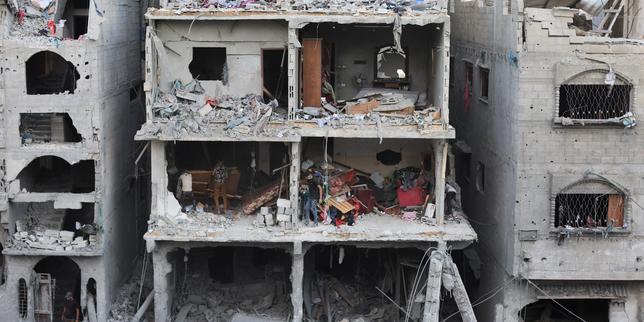
Without a predictable flow of construction aggregates, rebuilding efforts degenerate into patch-and-repair operations using salvaged rubble. This creates a high-entropy environment where structural safety is permanently compromised. Buildings left standing after aerial bombardment retain micro-fractures in load-bearing columns; without replacement materials, subsequent winter storms or low-magnitude seismic shifts trigger progressive structural collapses. The cost function of this restriction policy is clear: by treating basic building materials as high-security munitions, administrative authorities ensure that physical space remains uninhabitable or highly unstable, neutralizing long-term demographic stabilization.
The Political Economy of the Ceasefire Vacuum
A ceasefire that lacks a political horizon or an enforcement architecture is not a peace agreement; it is a tactical pause that calcifies existing asymmetries. Over the past twelve months, the governance vacuum inside the enclave has been managed through competing informal structures rather than institutional rehabilitation.
When formal municipal authorities are starved of tax revenues, customs collection rights, and banking integration, they lose the capacity to deliver public goods. In their place, decentralized patronage networks and grey-market operators step in to allocate scarce essentials such as fuel, cooking gas, and medical supplies. This informalization of the economy shifts power away from transparent administrative bodies toward hyper-localized power brokers who profit directly from scarcity.
International actors often frame this period as a failure of political will, but from a strategic perspective, it represents a rational choice under extreme constraints. External guarantors of the ceasefire framework maintain a policy of containment rather than resolution. Financial aid is delivered through humanitarian drip-feeds designed to prevent catastrophic mortality spikes while avoiding structural investments that would confer sovereignty or economic independence. This creates a moral hazard loop: international donors subsidize the bare-minimum survival of the population, thereby relieving the occupying or blockading power of its legal obligations under international humanitarian law while simultaneously insulating them from the economic fallout of the blockade.
The Kinetic Residual and Asymmetric Pressure
The cessation of large-scale military maneuvers does not mean the cessation of violence; it shifts the conflict into a low-intensity, high-attrition domain. Controlled demolitions, perimeter enforcement zones, naval access restrictions, and targeted kinetic strikes maintain an environment of perpetual insecurity.
This low-level friction serves a specific strategic objective: preventing the psychological reset necessary for long-term capital investment. No private entity will deploy capital into a manufacturing plant, agricultural cooperative, or real estate development when the risk parameter includes the potential for localized kinetic escalation without warning. Consequently, local entrepreneurship is throttled at the ideation stage. Businesses operate strictly on short-term liquidity models, maximizing cash velocity over inventory accumulation or asset-building to protect against sudden asset destruction.
Furthermore, the psychological toll of this chronic uncertainty creates an acute human capital drain. The most mobile and highly skilled segments of the population—engineers, medical professionals, and technologists—continually seek pathways for emigration. This brain drain further impairs the internal capacity for future self-directed reconstruction, ensuring that any eventual international recovery effort will have to import expertise from scratch rather than scaling local institutional knowledge.
Strategic Trajectory
The structural indicators confirm that the current equilibrium is stable precisely because it avoids the political costs of a final-status resolution while containing the security risks of an active war. As long as external actors treat Gaza as an intractable humanitarian logistics problem rather than a systemic political failure requiring structural redress, the architecture of the blockade will outlive any rhetorical framework of peace. The next phase will not be a sudden collapse or a sudden breakthrough, but the deepening entrenchment of a managed dependency model where survival is guaranteed only to the extent that it prevents regional destabilization, leaving the underlying geography permanently broken.