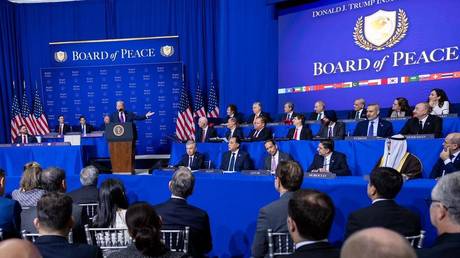
The announcement by the United States administration regarding a mediated agreement on the complete disarmament of militant factions in the Gaza Strip shifts the operational architecture of the post-war enclave from perpetual military containment to a structured sequencing model. Orchestrated via the Board of Peace alongside mediators from Egypt, Qatar, and Turkey, the pact attempts to resolve the foundational security dilemma that has historically crippled multi-party peace efforts: the simultaneous demand for militant surrender and military withdrawal.
To evaluate the structural viability of this arrangement, one must deconstruct its mechanics, isolate the underlying game-theoretic incentives, and map the friction points that threaten execution.
The Sequencing Architecture and Reciprocal Verification
Traditional peace accords frequently fail because they rely on trust rather than verifiable mechanics. The core innovation of the current framework rests on a principle of conditional reciprocity: each operational phase requires a completed, verifiable action from one stakeholder before triggering a corresponding counter-action from the opposing party.
The protocol operates through three distinct operational vectors:
- The Disarmament Vector: Under the guiding tenet of "one authority, one law, one weapon," all heavy arms, localized production facilities, and underground tunnel infrastructure are slated for systematic decommissioning. Concurrently, personal firearms held by combatants or civilians are processed through a structured buy-back mechanism managed via the National Committee for the Administration of Gaza (NCAG).
- The Withdrawal Vector: The Israel Defense Forces execute a phased retrograde movement that directly tracks the verified elimination of militant infrastructure within specific territorial sectors.
- The Stabilization Vector: As areas clear, the International Stabilization Force (ISF)—drawing troop contributions from nations such as Indonesia, Kazakhstan, and Morocco—assumes territorial oversight alongside a newly recruited and trained Palestinian police force.
This architecture transforms a zero-sum political negotiation into a step-function operational timeline. Compliance is enforced not by diplomatic goodwill, but by halting the withdrawal or funding streams upon any deviation from verified metrics.
The Cost Function of Rebuilding and Capital Deployment
The economic variables underpinning the arrangement reveal a severe resource-to-task asymmetry. Credible international estimates place the total cost of physical reconstruction in the Gaza Strip between $70 billion. Against this macro figure, the capital mobilized thus far through the Board of Peace—comprising multi-billion dollar state pledges and initial fund allocations—represents a fraction of total recovery requirements.
Furthermore, the institutional plumbing of these funds introduces administrative vulnerability. Discrepancies between official World Bank tracking mechanisms and decentralized financial channels create opacity in capital flow. For the reconstruction phase to transition from pilot housing projects in areas like Rafah to comprehensive urban rebuilding, the Board of Peace must establish clear auditing standards that satisfy donor states while preventing capital diversion.
Stakeholder Incentive Alignments and Divergences
The durability of the agreement depends on the net utility calculations of the primary actors:
- Militant Leadership: Acceptance of disarmament is driven by the calculus of institutional survival. By engaging with regional mediators and accepting provisions such as targeted amnesty for compliant members, leadership fractions recognize that prolonged military resistance guarantees total asset destruction, whereas conditional compliance shifts the diplomatic pressure directly onto Israel to execute its withdrawal phase.
- The Israeli Security Establishment: Official hesitation stems from the historical hazard of incomplete threat elimination. For the security apparatus to endorse the sequence, the verification mechanism managed by international monitors must prove capable of detecting subterranean reconstruction attempts before they achieve critical mass.
- Regional Mediators: Egypt, Qatar, and Turkey act as structural guarantors. Their operational involvement prevents backchannel communication breakdowns and provides the administrative bridge required to stand up the NCAG and local police cadre.
Execution Bottlenecks and Failure Modes
Despite the precision of the framework, several structural bottlenecks could disrupt implementation. The transition from an interim international stabilization force to a permanent, sovereign governance model requires the establishment of a functional administration that lacks historical precedent in the territory. If the newly designated Palestinian governance structures fail to secure immediate administrative legitimacy, a vacuum will emerge, inviting decentralized insurgent re-emergence.
Additionally, the dual-key nature of the verification process creates inherent drag. If disputes arise regarding what constitutes a "fully decommissioned" tunnel network or a verified weapons handover, the timeline stalls. Because the agreement relies on strict sequencing, a delay in Phase One freezes all subsequent movements across the withdrawal and reconstruction vectors.
To ensure long-term stability, the oversight bodies must prioritize the immediate institutionalization of the local police force under independent administrative monitoring, decoupling day-to-day civil policing from broader geopolitical disputes. The margin for error is constrained by the physical reality of the enclave: security architecture and economic reconstruction must scale concurrently, or neither will survive the transition.