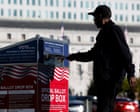
The California ballot initiative requiring photo identification for municipal elections represents a fundamental shift in the state’s electoral architecture, moving from a high-trust, low-friction model to a verification-centric framework. While public discourse often focuses on the ideological friction between disenfranchisement risks and fraud prevention, the actual impact of this measure is best understood through the lens of institutional transaction costs and administrative bottlenecking. The success or failure of this mandate depends not on the moral intent of the law, but on the operational capacity of local governments to manage the transition from signature-based authentication to physical credentialing.
The Triad of Voter Authentication Logic
California’s current system relies primarily on signature verification, a process rooted in historical precedent but increasingly viewed as a technical vulnerability by proponents of photo ID. To analyze the shift proposed for the November ballot, we must categorize voter authentication into three distinct structural pillars:
- Identity Verification (The Credential): The requirement that a voter possess a government-issued document that links a physical likeness to a registered name.
- Eligibility Confirmation (The Database): The backend process where the state confirms the individual is a citizen, a resident, and has not been stripped of voting rights.
- Participation Validation (The Audit): The mechanism that ensures one vote is cast per individual, preventing double-voting or impersonation.
The proposed measure targets the first pillar—Identity Verification—under the assumption that the current signature-matching protocol is insufficient for the modern threat environment. Signatures are variable; they change with age, medical conditions, and even the writing surface. Photo IDs provide a static, biometric-adjacent reference point. However, this shift introduces a new friction point: the Cost of Acquisition. When the state mandates a specific credential, it implicitly shifts the burden of electoral readiness from the registrar to the individual.
The Operational Friction of Municipal Mandates
The specific nature of this California measure is localized, focusing on municipal elections. This creates a fragmented regulatory environment where a voter might face different authentication requirements depending on whether they are voting for a City Council member or a State Assembly representative. This fragmentation introduces Cognitive Load Inefficiency.
When voters encounter varying sets of rules within the same geographic jurisdiction, the likelihood of administrative errors increases. Poll workers must be trained on dual tracks, and ballot sorting becomes a multi-layered verification process. The "hidden cost" of this measure is not the price of the IDs themselves, but the expansion of the "Rejected Ballot" category. In high-friction systems, ballots are often discarded not due to fraud, but due to technical non-compliance—a voter who has the right to vote but fails the specific procedural hurdle of the moment.
The Economic Barrier of Proportional Impact
While the state may argue that IDs are widely available, a data-driven analysis must account for the Time-Value of Access. For a high-income professional, the two hours spent at a Department of Motor Vehicles (DMV) represents a minor inconvenience. For an hourly-wage worker in a rural or underserved urban area, those same two hours represent a direct loss of income, compounded by potential transportation costs and the bureaucratic difficulty of obtaining underlying documents like birth certificates.
The implementation of this measure creates a socio-economic filter. We can model this using a simple participation function:
$$P = V - (C_t + C_p)$$
Where $P$ is the probability of participation, $V$ is the perceived value of the vote, $C_t$ is the transaction cost (time/effort), and $C_p$ is the procedural cost (ID acquisition). If $(C_t + C_p)$ exceeds $V$ for a significant portion of the population, the mandate acts as a de facto contraction of the electorate, regardless of whether that was the intended policy outcome.
The Vulnerability of Signature-Based Systems
To remain objective, one must acknowledge the technical debt inherent in the status quo. Signature verification is a subjective science. California’s move toward universal mail-in balloting has placed immense pressure on signature-matching software and human auditors.
The primary vulnerabilities in the current system include:
- Signature Decay: As more interactions occur digitally, younger voters are not developing consistent physical signatures, leading to higher mismatch rates.
- Adversarial Matching: A dedicated actor can mimic a signature with higher success rates than they can forge a holographic, state-issued photo ID.
- Processing Latency: Manually verifying 10 million signatures takes significantly longer than scanning 10 million barcodes on the back of an ID, creating a bottleneck in the reporting of results.
Proponents of the November measure argue that the photo ID requirement is a necessary infrastructure upgrade to handle the volume of modern elections. By shifting to a physical credential, the state can theoretically automate the first stage of verification with higher precision, reducing the "human error" variable in the tallying process.
Strategic Divergence: Security vs. Scalability
There is a fundamental tension between the Security Threshold and System Scalability. A system that is 100% secure but permits only 10% participation is a failure of democratic design. Conversely, a system with 100% participation but 5% fraudulent activity loses its institutional legitimacy.
The California measure attempts to recalibrate this balance toward the Security Threshold. However, the measure lacks a corresponding "Accessibility Subsidy." In states where photo ID mandates have been successfully integrated without significant litigation or drop-off, the transition was usually accompanied by:
- Mobile ID Units: State-funded vehicles that go to high-density, low-access areas to issue credentials.
- Automatic Provisioning: Linking ID issuance to other state services (e.g., healthcare or social security) so the credential is a byproduct of existence, not a separate task.
- Provisional Buffer Zones: Allowing voters without IDs to cast a ballot that is "cured" later via a digital upload or a secondary verification method.
Without these mitigating factors, the California measure is an "Unfunded Mandate on the Citizen." It requires a result (verification) without providing the necessary tools to achieve that result across all demographic tiers.
The Burden of Proof and the Ghost of Fraud
A critical gap in the logic of the proposed measure is the lack of quantified "Identity Fraud" data in California municipal elections. In a data-driven strategy, one does not deploy a high-cost solution without first defining the magnitude of the problem it solves.
If we categorize election threats, we find:
- Retail Fraud: Single individuals voting twice or impersonating another. (Statistically rare and difficult to scale).
- Wholesale Fraud: Hacking a database or physical tampering with bulk ballot boxes. (High impact, but photo ID does not address this).
- Administrative Error: Valid voters being removed from rolls or ballots lost in transit. (The most common source of "lost" votes).
Photo ID mandates are a specific solution for Retail Fraud. If Retail Fraud accounts for 0.001% of the margin of error, but the mandate causes a 2% drop in participation due to friction, the "cure" results in a larger distortion of the democratic outcome than the "disease."
The Technological Pivot: Digital IDs
The long-term resolution to this conflict lies in the transition to Mobile Driver's Licenses (mDLs) and blockchain-verified identities. California has already begun testing digital IDs within the DMV ecosystem. If the November measure passes, the focus must shift immediately from physical cards to digital credentials.
Digital IDs solve the Acquisition Cost problem by allowing voters to verify their identity through their smartphones, using biometrics (FaceID/TouchID) that are far more secure than a plastic card or a handwritten signature. However, this creates a secondary "Digital Divide" bottleneck, where elderly or low-income voters without smartphones are further marginalized.
The move toward photo ID is a symptom of a larger trend: the "Hardening" of institutional interactions. In an era of deepfakes and mass data breaches, "knowing your customer" (KYC) principles are migrating from banking into the civic sphere.
Implementation Trajectory and Institutional Stress
Should the measure pass in November, the immediate impact will be felt by municipal clerks who must redesign their operational workflows. The "Implementation Gap"—the time between a law being passed and the infrastructure being ready—is where the greatest risk of disenfranchisement occurs.
Local jurisdictions will need to:
- Redesign ballot envelopes to accommodate ID number fields without compromising privacy.
- Procure scanning hardware for every physical polling location.
- Launch massive public information campaigns to ensure voters don't arrive at the polls unprepared.
The success of the mandate will be measured by the "Cure Rate." If a voter forgets their ID, how many actually return within the legal window to verify their ballot? If that rate is low, the law is effectively a turnout suppressor. If the rate is high, the law is a successful security upgrade.
The Strategic Path Forward
To navigate the implementation of a photo ID mandate without triggering a systemic failure in voter participation, the following framework must be adopted:
1. The Credential Parity Protocol
The state must accept any document that is already used for government interaction. If a student ID is sufficient for a state university, or a VA card is sufficient for medical care, it must be sufficient for the ballot. Restricting the list of acceptable IDs is a move toward exclusion, not security.
2. The "Default-In" Verification Model
Rather than requiring voters to find their ID number, the state should use existing backend data (like DMV records) to pre-verify as many voters as possible. The photo ID at the poll should be the "Exception Handler," not the primary gate.
3. The Administrative Grace Period
A phased rollout—applying the mandate to minor municipal elections before moving to high-stakes general elections—allows for the identification of systemic bottlenecks.
The November ballot measure is a stress test for California’s electoral resilience. It forces a choice between a high-friction, high-certainty model and a low-friction, high-trust model. The outcome will likely hinge on whether the public views the current signature-based system as an antiquated relic or a vital protection against the rising costs of civic participation.
The strategic play for municipal leaders is to treat the ID requirement not as a barrier to be overcome by the voter, but as a data-integration challenge to be solved by the state. The goal should be a "Zero-Friction Identity" where the act of being a registered, living resident is synonymous with having the necessary credentials to vote. Anything less is an admission of administrative inefficiency.