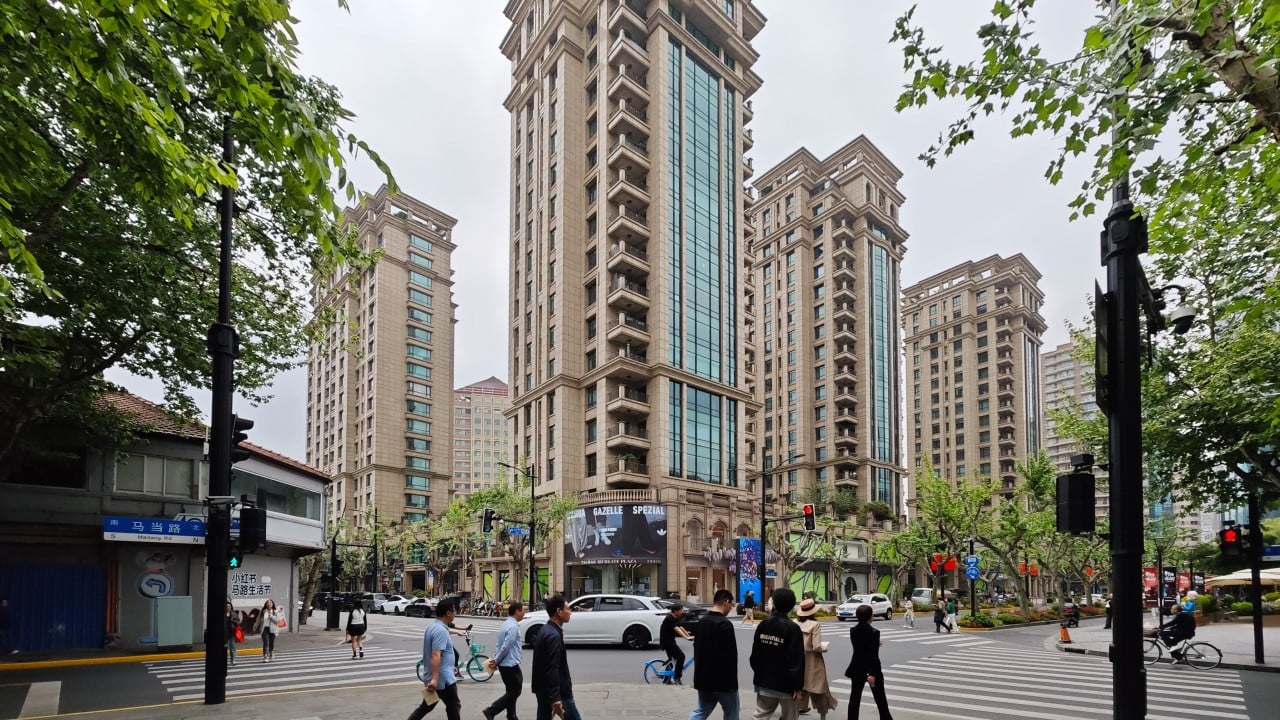
High-end residential assets in mainland China display a bifurcated trajectory, characterized by localized liquidity bursts in Tier-1 core districts alongside persistent, structural stagnation in the broader property market. Surface-level reporting frequently characterizes this phenomenon as an isolated rebound. A rigorous inspection of macroeconomic transmission channels, household balance sheet contraction, and wealth distribution mechanics reveals a different reality. This divergence is not a broad market recovery; it is a defensive capital preservation cycle executed by high-net-worth individuals within a tightening financial ecosystem.
The Dual-Market Divergence Mechanism
Understanding why prime properties in urban cores experience transaction velocity while secondary and tertiary markets languish requires examining liquidity velocity and asset class alternatives. In conventional economic cycles, housing market recoveries exhibit a trickle-down diffusion pattern. Capital enters prime real estate, saturates that tier, and systematically flows downward into middle-income housing assets.
In the contemporary mainland economy, this diffusion channel is blocked by structural credit constraints and shifting risk appetites.
Macroeconomic Environment (Credit Contraction & Wealth Re-concentration)
  │
  ├──► Tier-1 Core Core Assets (High-Net-Worth Capital Flight to Safety)
  │      └──► Transaction Volume & Price Resilience (Localized Liquidity)
  │
  └──► Broader Residential Market (Income Stagnation & Developer Insolvency)
         └──► Sustained Inventory Glut & Valuation Correction
High-net-worth capital is not expanding the aggregate housing footprint. Instead, it is contracting into a hyper-narrow asset class capable of withstanding systemic currency and credit shocks. Tier-1 luxury transactions function as a domestic offshore account. When alternative domestic investment vehicles—such as domestic equities, trust products, and corporate private equity—present elevated regulatory and counterparty risks, prime urban real estate operates as a tangible store of value.
Conversely, the broader market remains anchored by developer insolvency risks, extended delivery timelines for pre-sold units, and subdued household income expectations. The fundamental driver of the mass market is employment security and wage growth. Neither variable supports expansion. Consequently, analyzing aggregate sales figures without disaggregating transaction values by district and asset quality produces a distorted view of economic reality.
Capital Concentration and Wealth Preservation
The concentration of luxury transactions in gateway cities like Shanghai, Shenzhen, and Beijing reflects a strategic reallocation of private wealth rather than renewed confidence in residential property development as an industry.
Several variables dictate this behavioral shift:
- Yield Compression vs. Preservation Priority: Rental yields in premier districts remain low, frequently falling below domestic sovereign bond yields. Buyers in this segment are optimizing for capital preservation and downside protection, not yield generation.
- Leverage De-escalation: Unlike past property cycles fueled by aggressive mortgage expansion and developer-backed shadow financing, current high-end purchases feature significantly higher cash components or conservative loan-to-value ratios.
- Asset Quality Flight: Buyers exhibit zero tolerance for execution risk. Properties completed by distressed developers are avoided entirely, even at steep discounts, in favor of existing developments with established management and clear title histories.
This dynamic explains why overall market recovery remains elusive. A recovery implies self-sustaining momentum driven by broad-based demand, healthy credit creation, and improving asset values across multiple tiers. What is observed instead is a closed-loop liquidity event. Wealth generated in prior cycles is rotated out of vulnerable commercial and industrial ventures and locked into concrete assets that possess structural demand inelasticity.
Supply-Side Constraints and Inventory Asymmetry
The supply side of the luxury segment differs fundamentally from the mass market. While mid-market and affordable segments struggle with massive overhangs of unsold inventory and stalled construction sites, prime luxury land supply in tier-one urban cores is mathematically zero-sum.
Local governments control the release of prime land parcels through rigid auction mechanisms. In periods of fiscal constraint, municipal authorities ration prime land supply to support floor prices and protect land sales revenue. This creates an artificial supply constriction that protects existing luxury asset valuations against broader market declines.
When a limited number of ultra-prime developments launch, pent-up capital from domestic entrepreneurs and multi-generational family offices converges on these projects. The resulting high initial absorption rates generate misleading headlines regarding a sector-wide rebound. In economic terms, this is price-inelastic demand meeting a state-administered supply ceiling. It provides zero directional signal for the millions of square meters of unfinished housing inventory sitting in suburban peripheries.
Macroeconomic Transmission and Policy Limitations
Monetary easing measures implemented by central authorities have failed to trigger a broad residential recovery due to balance sheet recessions at the household level. When households prioritize debt reduction over debt accumulation, interest rate cuts lose their potency.
The transmission mechanism breaks down at the commercial banking level. Banks apply stringent risk assessments to property developers and prospective home buyers alike. While reserve requirement ratios and mortgage floors are adjusted downward, commercial lenders remain risk-averse toward any entity outside the highest credit tier. This creates a liquidity paradox: capital is abundant in the interbank market, but it fails to reach the entities that require restructuring capital.
Luxury buyers bypass this transmission bottleneck entirely because they operate on internal cash flows, international asset arbitrage, or unencumbered domestic liquidity. They do not depend on newly minted mortgage credit. Therefore, the uptick in luxury transactions is structurally decoupled from monetary policy efficacy. It measures the volume of trapped domestic capital seeking safe harbor, not the health of the credit transmission mechanism.
Forward Execution Playbook for Capital Allocation
Market participants attempting to model mainland Chinese property trends must discard aggregate statistical reporting in favor of granular, tier-specific liquidity tracking. Treating the Chinese residential market as a monolith guarantees analytical failure.
Capital allocators must evaluate risk through a tripartite lens:
- Counterparty Solvency: Exclude any enterprise with direct exposure to offshore debt restructuring or complex shadow banking obligations, regardless of asset backing.
- Liquidity Localization: Separate core urban residential value from suburban commercial and residential inventory. The former functions as a private wealth vault; the latter operates under standard supply-demand laws subject to demographic contraction.
- Policy Sensitivity: Monitor municipal land auction rules rather than national monetary announcements. Local government fiscal pressures dictate the actual supply constraints that govern high-end price floors.
The persistent stagnation of the broader market will continue until household income growth re-accelerates and structural defaults are fully cleared through bankruptcy courts. Until those baseline conditions change, high-end transaction spikes will remain statistical anomalies driven by defense, not expansion.