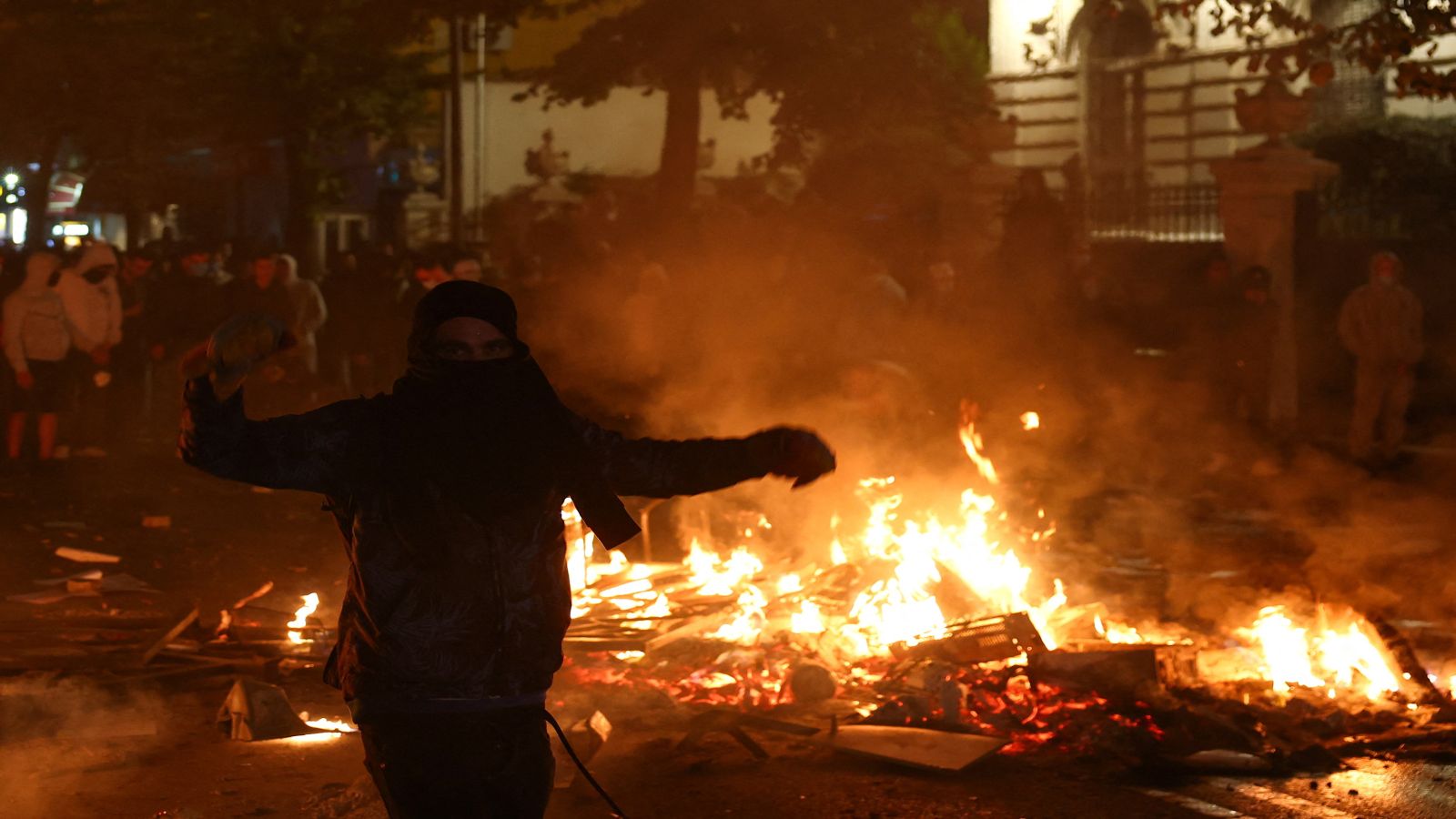
Civil unrest rarely materializes as a spontaneous emotional outburst. It functions as a lagging indicator of systemic friction, economic resource scarcity, and institutional unresponsiveness. When student demonstrations in Tirana transitioned into direct kinetic conflict involving tear gas and water cannons, observers witnessed the predictable intersection of unaddressed structural grievances and a rigid state response mechanism. To understand this escalation, one must examine the baseline operational constraints facing higher education in Albania, the cost-benefit calculus of public dissent, and the systemic feedback loops that turn policy failures into street-level confrontations.
The Cost Function of Higher Education and Institutional Friction
The primary catalyst for sustained student mobilization centers on the marginal utility of institutional investment versus structural returns. Public higher education systems operating under tight fiscal constraints face a severe resource allocation problem. Infrastructure degradation, underfunded administrative frameworks, and high faculty-to-student ratios create a degraded product for participants who view degrees as a primary vehicle for upward economic mobility.
When tuition costs, facility fees, or living expenses rise without a corresponding increase in educational quality or graduate employment prospects, the cost function shifts abruptly. The student body experiences an invisible tax on their human capital development.
- Tuition and Maintenance Fees: Direct financial inputs required from students outpace median household income growth.
- Infrastructure Deficits: Deteriorating campus facilities, outdated libraries, and unheated lecture halls lower the perceived value of institutional compliance.
- Labor Market Misalignment: The structural gap between graduation rates and entry-level remuneration creates a high-risk scenario for young adults entering the domestic workforce.
These pressures build a latent energy within the demographic segment. When institutional channels for grievance resolution lack responsiveness, this energy seeks alternative distribution networks.
The Escalation Curve: From Petition to Street-Level Conflict
Understanding how a peaceful demonstration evolves into a tactical engagement with law enforcement requires mapping the stages of tactical escalation. This transition is governed by institutional signaling and spatial politics.
[Latent Grievance]
       │
       ▼
[Institutional Deadlock]
       │
       ▼
[Spatial Concentration (Tirana Center)]
       │
       ▼
[Tactical Friction (Police Perimeter)]
       │
       ▼
[Kinetic Engagement (Tear Gas / Water Cannons)]
When protesters occupy primary administrative nodes or transport arteries, such as government boulevards in central Tirana, they impose an immediate transaction cost on the state. The state apparatus, optimized for administrative continuity and public order, responds through a pre-determined playbook of crowd management.
The deployment of chemical irritants like tear gas and high-pressure water cannons represents a calculated attempt to re-establish spatial monopoly. However, this kinetic intervention alters the psychological calculus of the crowd.
- The Deterrence Hypothesis: State actors deploy force to raise the cost of participation, assuming marginal protesters will disperse to avoid physical harm.
- The Backfire Effect: Under specific conditions of high collective grievance, state violence lowers the psychological barrier to escalation. It validates the narrative that institutional systems are oppressive rather than merely indifferent.
Physical confrontation transforms the objective of the protest. It shifts the focus from narrow policy demands—such as fee reductions or administrative resignations—to a broader indictment of state legitimacy.
Information Asymmetry and State Signaling
A critical variable in urban unrest is the information loop between institutional decision-makers and the mobilized populace. Traditional governance models rely on bureaucratic delays to dissipate public anger. Committees are formed, timelines are extended, and reform proposals are drafted across multi-year horizons.
For student populations operating on a condensed timeframe—typically a three-to-five-year academic lifecycle—bureaucratic delay is functionally indistinguishable from outright rejection. A delay that spans two academic semesters effectively disenfranchises the specific cohorts leading the movement, rendering policy concessions irrelevant to the actors bearing the current cost.
When state communication relies on generic dismissals or portrays protesters as manipulated political actors, it commits a structural error in stakeholder management. It misdiagnoses systemic economic friction as an external security threat. This analytical failure guarantees that subsequent negotiations will stall, as the state attempts to solve a structural resource allocation problem through tactical crowd control.
Systemic Outcomes and the Policy Equilibrium
The aftermath of kinetic interventions in urban centers creates a temporary policy equilibrium characterized by institutional hardening. Neither side achieves complete victory. The state secures physical control of the streets through superior coercive capacity, while the student coalition internalizes the reality that conventional petitions yielded minimal structural reform.
This dynamic leaves the underlying economic drivers intact. Unless the fiscal model of higher education is restructured to address the core mismatch between operational costs and graduate earning potential, the latent energy remains stored within the system. The next iteration of mobilization will inherit the tactical lessons of previous engagements, exhibiting higher organization, sharper spatial focus, and reduced reliance on institutional moderation.
Future stability in this sector depends entirely on the state's capacity to transition from reactive tactical containment to proactive financial restructuring. Until the marginal return on education justifies the investment for the average student, the threshold for renewed civil friction will remain low.