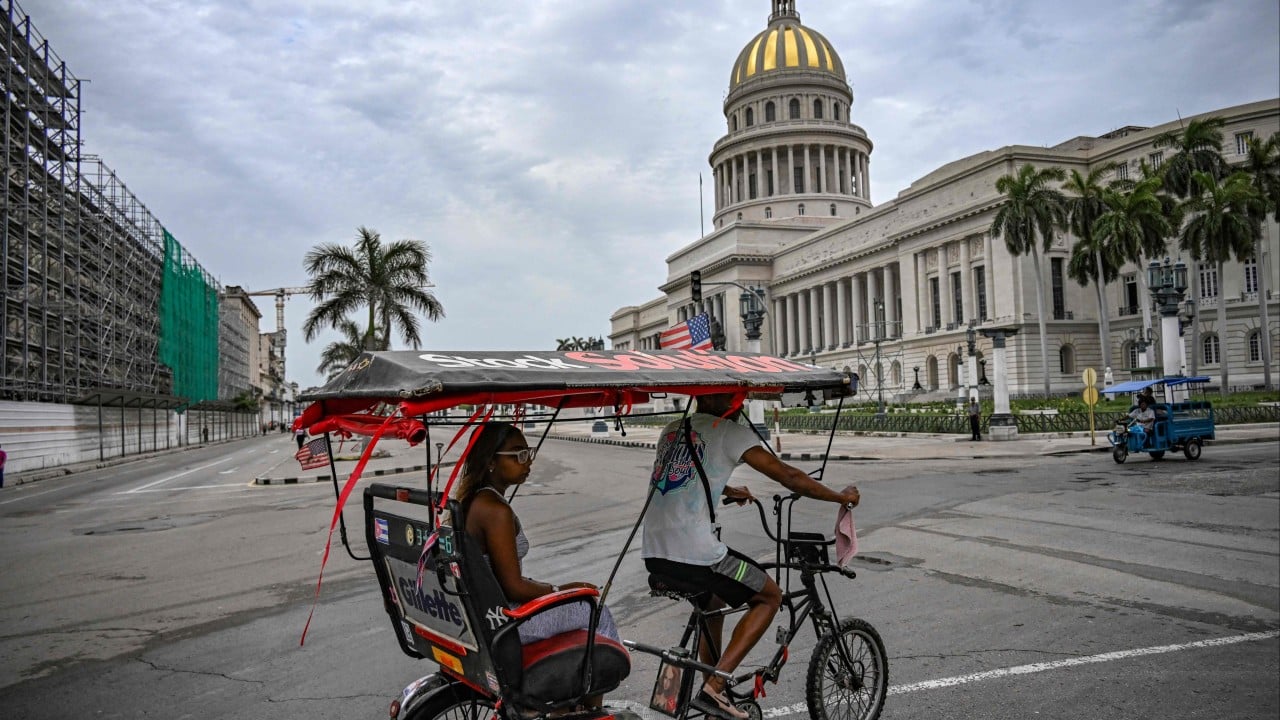
An economy cannot sustain an external shock when its primary hard-currency generation engine is choked by simultaneous supply-side restrictions and legislative penalties. Cuba's tourism apparatus has transitioned from acute distress into terminal structural contraction, with government officials acknowledging that nearly seventy-three percent of the island's hotels are shuttered. Understanding this collapse requires moving past superficial summaries of bad weather or seasonal slumps. The failure of the Cuban hospitality market operates as a case study in feedback loops, where regulatory pressure, energy scarcity, and corporate risk aversion reinforce one another until operational viability hits zero.
To deconstruct the collapse, one must examine the baseline macroeconomics of the sector. For decades, foreign exchange derived from international visitors served as the primary mechanism for importing baseline goods, raw energy inputs, and foodstuffs. When visitor arrivals dropped fifty-eight percent between January and June compared to the prior year, the shock extended far beyond hotel balance sheets. It triggered a systemic liquidity drain that disabled the state's capacity to procure imported fuel.
The first core vector of the crisis is the energy-transport nexus. International travel relies on predictable logistics: aviation fuel availability, stable regional electricity grids, and continuous vehicular transport. Early in the year, severe domestic aviation fuel deficits forced carriers from Canada, Russia, and Europe to suspend routes or reduce frequency. This created a classic demand-destruction feedback loop. As flights were pulled, load factors for remaining routes turned uneconomical, prompting further cancellations. On the ground, rolling power outages and chronic fuel shortages degraded the standard of service to a level that violated the baseline value proposition expected by international travelers. Properties could not guarantee air conditioning, water pressure, or basic refrigeration, rendering all-inclusive resorts commercially unviable.
The second core vector is regulatory compliance architecture and legal exposure. Foreign hospitality management groups, most notably Spanish giants like Meliá and Iberostar alongside various Canadian operators, historically managed properties through joint ventures or service contracts tied to state and military-linked entities, specifically the enterprise group GAESA and its tourism subsidiary Gaviota. When Washington expanded sanctions targeting corporate entities tied to military conglomerates, the risk calculus for international operators shifted instantly.
The cost of non-compliance under updated United States jurisdiction involves severe financial penalties and secondary sanctions that threaten global asset portfolios. For a publicly traded multinational hotel corporation, maintaining a management agreement in Cuba ceased to be a minor political headache and became an existential legal hazard. When compliance departments run a risk-reward matrix where the revenue generated from a portfolio of Cuban resorts is vastly outweighed by the potential exclusion from Western banking and equity markets, the outcome is predetermined. Major brands executed rapid corporate withdrawals, terminating management, marketing, and brand services. This stripped the properties of international reservation systems, global loyalty networks, and operational know-how, stranding physical assets in a vacuum of administrative capacity.
The third core vector involves the destruction of transactional infrastructure. Tourism functions on fluid payments. When international credit card processing, digital settlement layers, and foreign banking channels are restricted or complicated by extraterritorial enforcement, the frictionless movement of tourist capital halts. Visitors faced a destination where traditional payment methods failed, compounding the friction of reaching the island. Without cash liquidity or working payment rails, even the remaining independent private operators in the local economy found themselves starved of consumer spending.
The operational fallout of these combined forces manifests in the displacement of approximately twenty-five,000 direct hospitality workers and a broader labor shock affecting over three hundred thousand people historically supported by the vertical supply chains of tourism. Valet drivers, tour guides, agricultural suppliers who provisioned resort kitchens, and private home-rental operators experienced an absolute evaporation of income. The classic American automotive fleet in Havana, reliant on continuous tourist engagement and specialized gasoline inputs, vanished from central squares because the operational cost of running the vehicles exceeded any realistic fare revenue.
Evaluating the structural limitations of the current environment reveals why standard macroeconomic interventions will fail to reverse the trend. Short-term state subsidies cannot inject fuel that is blocked by external logistical choke points. Promotional campaigns cannot restore consumer confidence when physical infrastructure fails basic habitability tests. Most critically, domestic policy adjustments cannot alter the external regulatory penalties that deter foreign capital from re-entering joint ventures with state-controlled conglomerates.
Reversing structural economic atrophy of this magnitude requires a fundamental realignment of property rights, asset ownership models, and international legal frameworks that goes far beyond cosmetic tourism rehabilitation. Until the underlying vectors of legal exposure, energy scarcity, and logistical isolation are resolved simultaneously, the seventy-three percent closure rate represents not a temporary cyclical bottom, but the new baseline structural capacity of an isolated market.
Decouple state operational monopolies from foreign management assets by permitting autonomous, direct private equity structures that fall entirely outside military-linked conglomerates to bypass secondary sanction triggers.