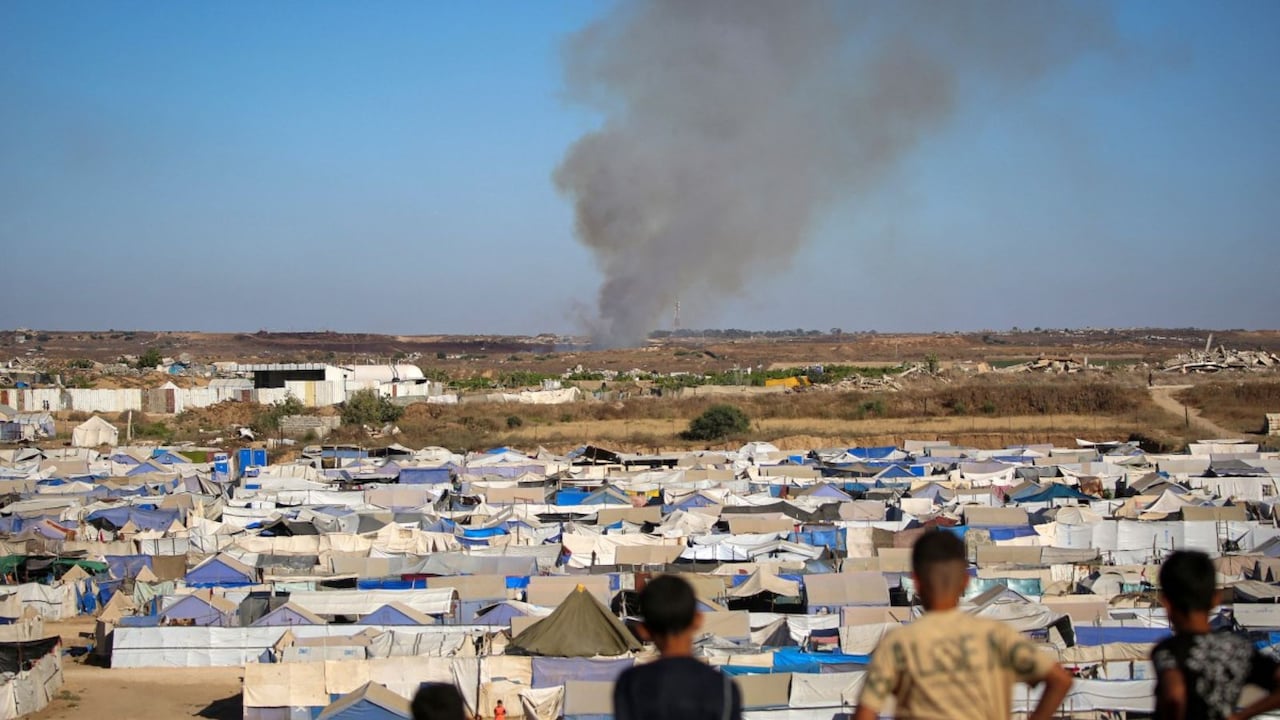
The ongoing accumulation of casualties under an active cessation agreement exposes a fundamental structural paradox: operational definitions of peace often diverge entirely between military command structures and civilian populations on the ground. When health officials in the Gaza Strip report fatalities resulting from targeted strikes—such as the recent deaths recorded in Khan Younis and the Bureij refugee camp—mainstream reporting frequently treats these incidents as anomalous policy violations. A rigorous analytical breakdown reveals that these events are not random deviations, but rather predictable outputs of an asymmetrical enforcement mechanism built into the current diplomatic framework.
To understand why a truce framework permits continuous attrition, one must deconstruct the architecture of the agreement brokered by international mediators. The arrangement relies on a segmented compliance model rather than a total cessation of hostilities.
The Tripartite Failure Vector of Fragmented Truces
The friction points sustaining the current casualty cycle operate across three distinct operational layers:
- Territorial Enforcement Boundaries: Military forces maintain physical control over extensive administrative zones, utilizing designated boundary markers often described by local monitors as yellow blocks. The security protocol dictates a strict kinetic response to any civilian or militant trespass across these invisible or physically demarcated lines. Consequently, freedom of movement is effectively criminalized by proximity, transforming ordinary civilian transit into a high-risk security vector.
- Asymmetrical Intelligence Thresholds: Operational clearance for kinetic strikes relies on real-time threat identification managed via aerial surveillance and ground sensors. Because the governing military authority retains broad discretion to classify targets as active combatants or tactical threats, kinetic actions frequently occur without prior public warning. This eliminates the predictive window necessary for civilian avoidance.
- Disarmament and Governance Stalling: Diplomatic talks mediated in capitals such as Cairo remain deadlocked over the sequencing of authority transition, asset decommissioning, and civilian administration. When macro-level political negotiations stall, tactical units on the ground default to localized deterrence operations, increasing patrol friction and localized engagements.
The Cost Function of Retaliatory Logic
The systemic persistence of violence is driven by an escalatory feedback loop. Each kinetic action is justified through a transactional ledger: military authorities attribute strikes to preemptive defense against infiltration or localized cell formation, while civilian administrative bodies record the cumulative human cost.
Because the baseline political settlement lacks enforcement teeth for micro-violations, small-scale engagements do not trigger a total collapse of the diplomatic track; instead, they are absorbed as operational noise. This creates a dangerous equilibrium where high-level peace talks proceed concurrently with daily tactical attrition. Mediators attempt to negotiate long-term phase implementations while the structural conditions on the ground ensure that trust remains mathematically near zero.
Strategic Trajectory and Systemic Outlook
Resolving this operational friction requires moving past the binary premise that a ceasefire is a static event rather than a managed process. Permanent cessation cannot be achieved while territorial partition lines restrict basic civilian survival resources and incentivize kinetic enforcement.
The structural path forward hinges on altering the incentive matrix for localized military engagement. Unless third-party mediators establish an independent verification mechanism to arbitrate boundary infractions and decouple civilian movement from military threat categorization, low-intensity attrition will persist indefinitely beneath the diplomatic surface of any formal accord.