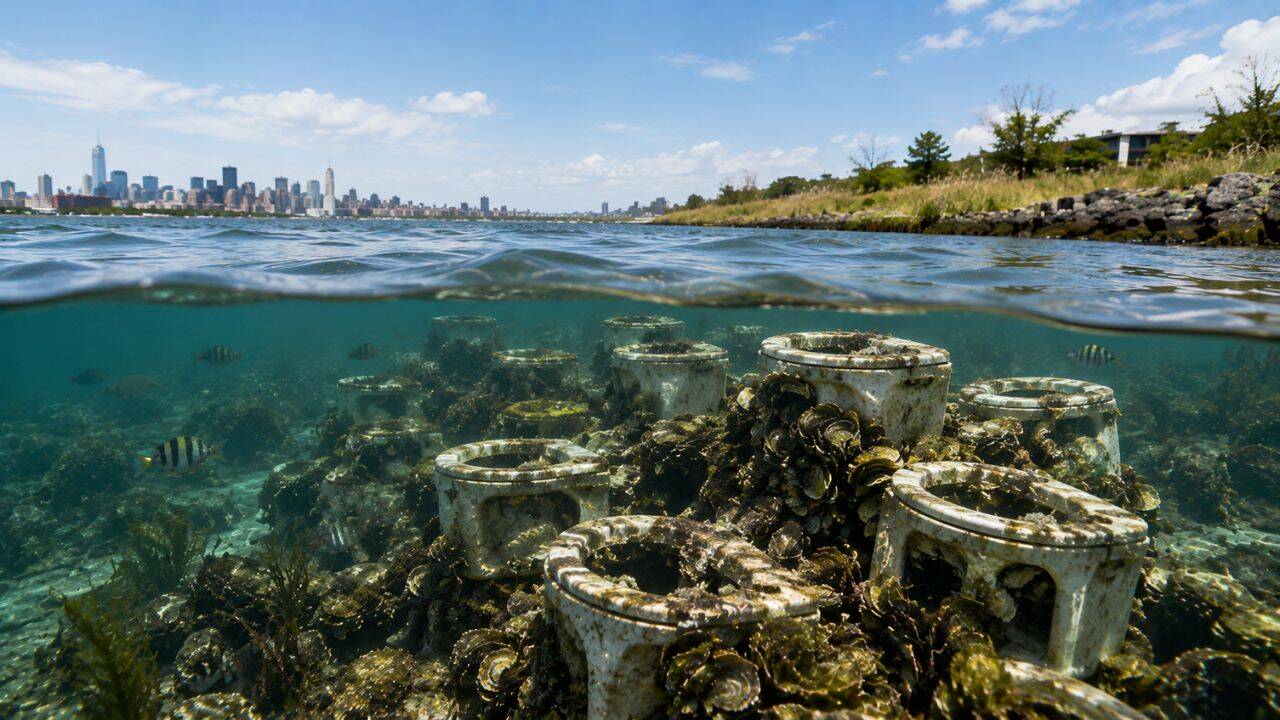
Urban ecological engineering often founders on material acquisition costs and structural durability. When New York authorities deployed 5,000 discarded porcelain toilets into the marine ecosystem beneath Jamaica Bay, they executed an ad hoc solution to a classic resource allocation problem. The municipal waste stream produced a high-volume, calcium-resistant substrate at zero raw material cost, while local estuarine restoration initiatives required hard surfaces to anchor larval bivalves.
Evaluating this intervention requires stripping away the novelty of porcelain plumbing fixtures and examining the underlying bio-mechanical parameters. The primary bottleneck in estuarine recovery is not water quality alone, but the absence of vertical relief and stable calcium carbonate surfaces required for Crassostrea virginica—the eastern oyster—to settle, metamorphose, and build structural reefs.
The Material Economics of Municipal Waste Substrates
Traditional ecological restoration projects rely on quarried stone, bagged shell, or engineered concrete modules. Each standard material introduces specific economic and logistical frictions:
- Quarried rock demands heavy diesel transport, high quarrying fees, and intensive labor for placement, generating a heavy carbon footprint per ton deployed.
- Bagged oyster shell relies on the commercial seafood supply chain, creating supply volatility and scaling ceilings that match restaurant output rather than ecological deficits.
- Pre-cast concrete requires dedicated formwork, chemical curing agents, and energy-intensive cement production, which accounts for a significant share of global industrial emissions.
Discarded toilets bypass these friction points by utilizing an existing urban inventory. Porcelain is vitrified ceramic fired at high temperatures, rendering it chemically inert, structurally rigid, and practically non-degradable in marine environments. The glaze provides a hard finish, while broken internal chambers, traps, and rims create interstitial spaces. These cavities mirror the complex micro-topography of natural oyster reefs, offering spatial refuge from predators for juvenile fish and crustaceans.
The acquisition cost approaches zero because municipal sanitation departments already collect and crush porcelain during demolition and bathroom renovation cycles. The operational expense shifts entirely from material procurement to sterilization, sorting, and precision deployment logistics.
Fluid Dynamics and Sediment Dynamics in Jamaica Bay
Jamaica Bay is a heavily modified urban estuary characterized by eutrophication, hypoxic zones, altered tidal prisms, and high sediment loading. Placing heavy substrates onto soft, silty benthic zones without structural calculation leads directly to substrate subsidence. Heavy porcelain fixtures will sink into anoxic mud unless deployed with engineered ballast or interlocked arrays that distribute weight evenly across the sediment interface.
Oyster reefs function as natural breakwaters. By interrupting wave energy and dampening tidal velocity, they reduce shoreline erosion and promote local particulate settling. When porcelain units are stacked or scattered in high-energy tidal channels, they alter localized shear stress. The irregular geometry of a broken toilet bowl forces water flowing over it to detach and create turbulent wakes. This turbulence prevents fine silts from blanketing the hard surfaces, maintaining the clean substrate necessary for settling oyster spat.
However, improper spatial configuration creates dead zones of stagnant water behind large objects, accumulating organic muck that accelerates localized hypoxia. Effective deployment requires distributing the load across a gradient rather than dumping monolithic mounds, matching the structural footprint to the local tidal velocity vector.
Biological Recruitment and Settlement Mechanics
The success of an artificial reef depends on larval recruitment efficiency. Eastern oyster larvae, or veligers, swim freely in the water column for two to three weeks before seeking a hard substrate. Their settlement decisions are governed by chemical cues, surface texture, and micro-habitat lighting conditions.
Porcelain surfaces, particularly unglazed fractures where the ceramic body is exposed, provide microscopic roughness that enhances settlement success compared to smooth plastics or polished metals. Furthermore, calcium ions leaching from nearby concrete or lingering mortar residues on salvage fixtures can act as positive chemical attractors.
Once attached, the biological timeline follows a strict growth curve:
- Spat Settlement: Veligers cement their left valve to the porcelain matrix, transitioning to a sessile benthic existence.
- Biogenic Accretion: As individual oysters grow, they cement themselves to neighboring individuals, forming clusters that overlay and eventually obscure the underlying porcelain substrate.
- Matrix Self-Sustenance: After three to five generations, the artificial foundation is entirely superseded by biogenic calcium carbonate produced by the living reef. The original toilet ceases to be the structural support and merely serves as the deep foundation anchor.
Scaling Limits and Contamination Protocols
Deploying municipal waste into a marine sanctuary introduces vector risks regarding chemical and heavy metal contamination. Modern plumbing fixtures are composed of porcelain, but internal mechanisms, fittings, bolts, and wax rings frequently contain lead, brass, plastics, and petroleum derivatives.
Rigid protocol mandates mechanical stripping prior to deployment:
- Removal of all brass components, copper lines, and stainless steel fasteners to prevent galvanic corrosion and copper toxicity in larval organisms.
- Stripping of rubber gaskets, wax seals, and plastic flappers to prevent microplastic shedding into the estuarine food web.
- Power washing and chemical sterilization to remove organic residues, domestic cleaners, and urban surface pollutants that could alter local microbial communities.
The scaling ceiling for this methodology is governed strictly by the supply chain of demolition waste rather than ecological carrying capacity in the short term. Because bathroom renovations occur continuously in metropolitan centers, the supply is steady. However, processing velocity—crushing, stripping, and sorting manually or semi-mechanically—creates a labor bottleneck that prevents rapid, massive expansion without automated sorting facilities.
Strategic Allocation of Urban Waste in Coastal Defense
The conversion of porcelain fixtures into marine habitat validates a broader thesis in municipal asset management: the intersection of waste minimization and coastal resilience. Cities facing sea-level rise and degraded shorelines can no longer afford the financial or environmental cost of importing virgin riprap.
To maximize return on investment, municipal planners must integrate sanitation tracking with marine habitat mapping. By geolocating demolition permits in high-density urban cores alongside degraded estuarine zones with high tidal flushing, agencies can minimize transport logistics.
Establish high-volume processing yards where porcelain is systematically fractured into consistent geometric dimensions—maximizing surface area-to-volume ratios—before staging deployment barges. Treat the urban interior as an upstream quarry for marine restoration, transforming demolition liabilities into permanent structural breakwaters.