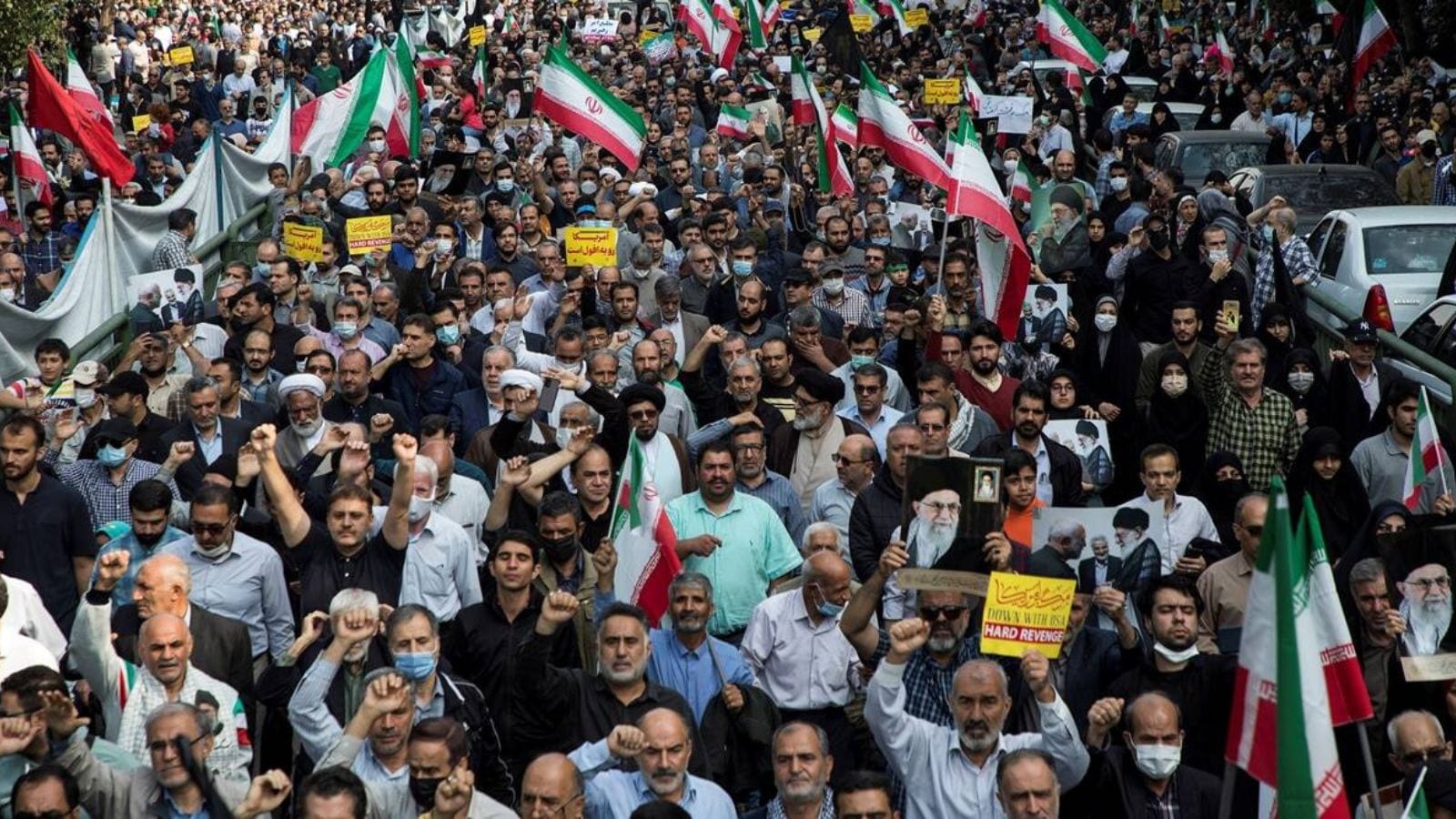
The cessation of active street protests in Iran does not indicate a return to equilibrium; it marks the transition of the conflict from a kinetic phase to a structural one. In high-autocracy environments, the absence of visible unrest is often miscalculated as stability. However, the "Woman, Life, Freedom" movement fundamentally altered the cost-benefit analysis of state compliance for the Iranian populace. To understand why the "anger and pain" persist, one must deconstruct the Iranian state's current position through three specific analytical lenses: the breakdown of the social contract, the failure of the "Securitized Economy," and the shift in demographic leverage.
The Disintegration of the Social Contract
The legitimacy of the Islamic Republic has historically rested on a dual-pillar foundation: ideological alignment and distributive justice. Both pillars have collapsed.
- The Ideological Deficit: The state’s insistence on mandatory hijab and strict social codes was once a tool for identifying and rewarding a loyalist base. It has now become a point of friction that spans socio-economic classes. When a state's primary identity markers become the source of universal grievance, the state loses its ability to segment and pacify different interest groups.
- The Distributive Failure: In exchange for political passivity, the state previously provided subsidies and a semi-functional middle-class path. The current inflationary environment—with the rial's value in a sustained freefall—means the state can no longer buy the silence of the "gray layer" (the politically unaligned middle class).
The "pain" described in qualitative reports is, in quantitative terms, a massive transfer of wealth from the populace to state-linked entities (bonyads and the IRGC) via inflation and currency devaluation. This creates a Negative Feedback Loop of Governance: the more the state spends on its security apparatus to suppress dissent, the more it must print money or tax an exhausted private sector, which in turn fuels the very economic desperation that necessitates more suppression.
The Securitized Economy and the Bottleneck of Reform
The Iranian economy is not a traditional market but a "securitized" one, where the Islamic Revolutionary Guard Corps (IRGC) and affiliated foundations control an estimated 30% to 50% of the GDP. This structure creates an insurmountable barrier to the "reforms" that many external analysts suggest could pacify the population.
- Institutional Rigidity: Any meaningful economic liberalization would require transparent bidding, the removal of IRGC monopolies, and adherence to FATF (Financial Action Task Force) standards. Because these reforms directly threaten the revenue streams of the security apparatus, they are structurally impossible under the current regime.
- The Capital Flight Variable: Trust in the domestic banking system has eroded to the point where any surplus capital is immediately converted into hard assets (gold, real estate) or moved abroad. This prevents the capital formation necessary for infrastructure or job creation, leaving the youth population in a state of "waithood"—a prolonged period of being unable to achieve the financial milestones of adulthood.
This stagnation transforms the "anger" from a temporary emotional response into a permanent feature of the demographic profile. The state is no longer competing with an ideology; it is competing with the survival instincts of its citizens.
The Demographic Leverage Shift
The demographic reality of Iran is its most volatile variable. The "Gen Z" cohort (born roughly between 1997 and 2012) is fundamentally different from previous generations in two critical ways: digital native status and the lack of a revolutionary memory.
- Digital Transversality: Despite the "Filternet" and frequent internet shutdowns, the Iranian youth are globally integrated. They do not compare their quality of life to their parents' past, but to the current reality of peers in Dubai, Istanbul, or Berlin. This creates an Aspirational Gap that no amount of state propaganda can bridge.
- The Erosion of Fear: The 2022-2023 protests demonstrated a shift in the "fear threshold." In previous cycles (2009, 2017, 2019), the state could rely on the memory of the 1980s Iran-Iraq war or the 1979 Revolution to frame stability as the ultimate good. For the current youth, the status quo is perceived as more dangerous than the uncertainty of change.
The Mechanism of Attrition
The current period of "quiet" is a phase of tactical recalibration for both the state and the dissidents. The state has moved toward "Soft Suppression"—using facial recognition technology, bank account freezes, and judicial pressure to target individuals without the optical cost of mass street violence.
Conversely, the opposition has moved toward "Civil Disobedience as an Infrastructure." The widespread refusal to wear the hijab is not just a cultural statement; it is a daily, low-cost challenge to state authority that forces the security apparatus to choose between a full-scale crackdown (which risks reigniting mass protests) or a gradual surrender of its primary identity markers.
The second limitation of this state strategy is its reliance on a shrinking pool of ideologically committed enforcers. As the economic crisis hits the families of rank-and-file police and Basij members, the internal cohesion of the security forces becomes a liability. The state is currently over-leveraged on its "coercion assets" while its "legitimacy assets" are effectively zero.
The Asymmetric Conflict Strategy
The persistence of unrest in Iran is best modeled as a High-Entropy System. The state is attempting to impose order through external force, but the internal energy of the system (economic despair, social alienation) is rising.
- The Threshold of Ignition: Future protests will likely be triggered by "micro-shocks"—a localized environmental crisis (water shortages in Khuzestan), a specific instance of police brutality, or a sudden spike in the price of a staple good.
- The Decentralization Factor: The 2022 protests lacked a singular leader, which made them difficult to decapitate. This "leaderless" model is now being refined into "local nodes" of organization. This makes the movement resilient but complicates its ability to present a unified political alternative.
The strategic reality is that the Iranian state has entered a terminal phase of governance where it can maintain control but cannot govern. It is a distinction between Dominance (the ability to suppress) and Authority (the ability to lead).
For international stakeholders and strategic observers, the metric of focus should not be the number of people in the streets on a given Tuesday. Instead, track the following three variables to predict the next kinetic eruption:
- The Rial-to-USD Convergence: The point at which the unofficial exchange rate triggers a 50% or higher increase in the price of bread or fuel.
- The Security Defection Rate: Any indication of "selective enforcement" or refusal to engage in localized skirmishes by the Law Enforcement Forces (Faraja).
- The Succession Logic: The interplay between the IRGC and the clerical establishment as they prepare for a post-Khamenei transition.
The current state of "pain and anger" is the psychological manifestation of a structural dead-end. The regime's inability to reform its economic model or its social restrictions ensures that the next wave of unrest will not be a repetition of the last, but an escalation of it, driven by a population that has concluded that the cost of silence is now higher than the cost of rebellion.
Monitor the "gray layer" of the middle class. When their survival strategy shifts from "capital preservation" to "active disruption," the state's current model of high-cost suppression will become fiscally and operationally unsustainable. Focus on the localized labor strikes in the energy sector—specifically the South Pars gas fields—as these are the primary arteries of state revenue. A sustained disruption there, combined with the existing social friction, represents the most significant threat to the regime's structural integrity.
Would you like me to analyze the specific impact of the IRGC's economic monopolies on current Iranian labor strike trends?