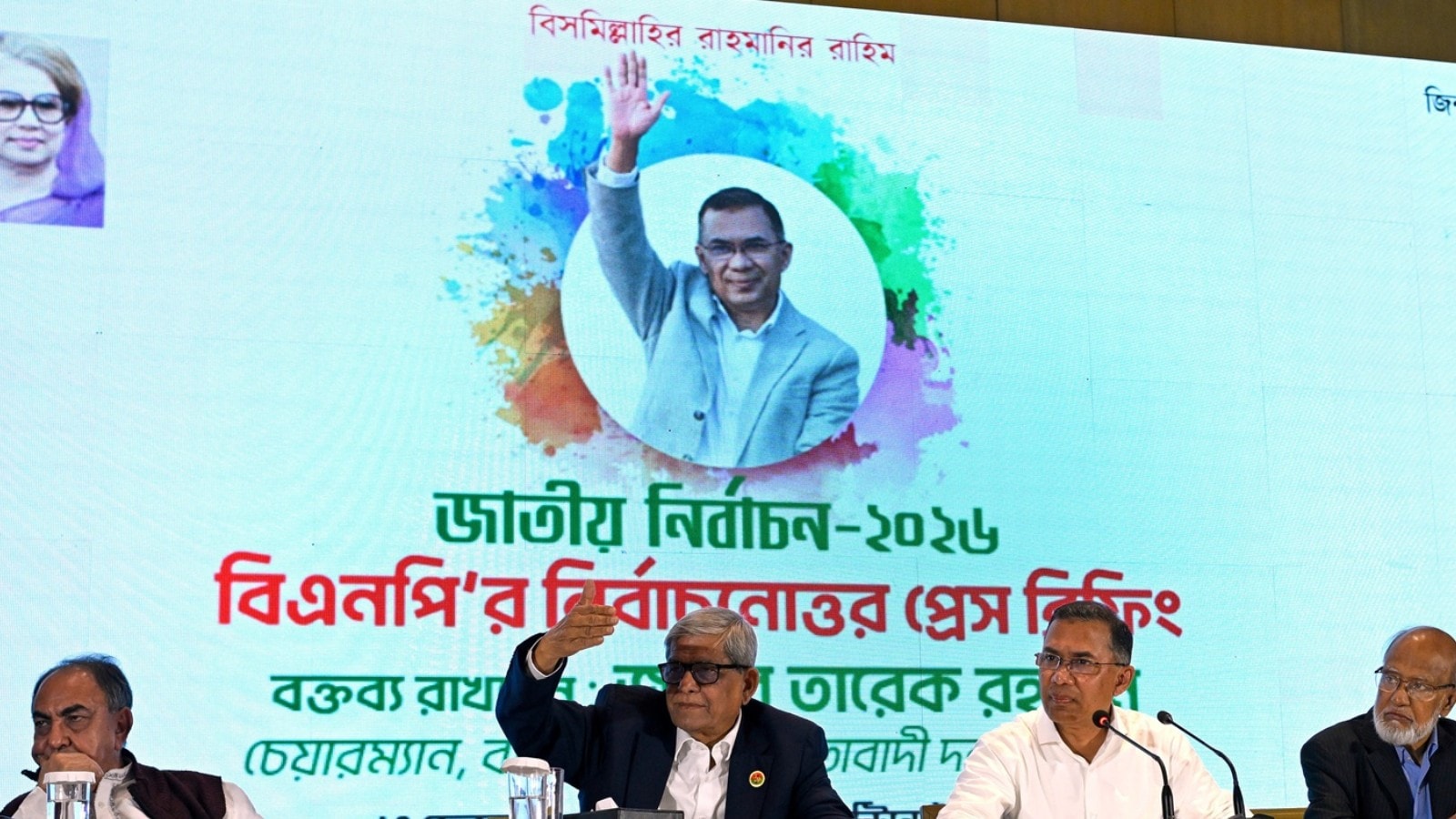
The swearing-in of the 2026 Bangladesh Parliament marks the definitive termination of a thirty-year duopoly characterized by dynastic matriarchy. This transition is not merely a change in personnel; it is a fundamental shift in the state's operating system. By installing Tarique Rahman and a new cohort of Members of Parliament, the nation is attempting to move from a personalized executive model toward a parliamentary structure that must now reconcile decades of institutional erosion with the immediate demands of global capital markets and domestic stability.
The failure of the previous administration to maintain the "Social Contract of Development" resulted in a systemic collapse where economic growth no longer compensated for the deficit in political franchise. The 2026 inauguration functions as a reset of the National Legitimacy Function, where $L$ (Legitimacy) is no longer derived from historical legacy but from the restoration of the $C$ (Constitutional) order and $E$ (Economic) predictability.
The Anatomy of Power Transition: From Dynastic to Procedural
The return of a male Prime Minister after three decades is the most visible metric of change, yet it remains the least significant from a structural perspective. The critical shift lies in the dismantling of the "Two Begums" era, which had centralized power within two competing family offices. This centralization created a Single Point of Failure in the Bangladeshi political economy. When the executive branch operates as a family estate, institutional checks—the judiciary, the Election Commission, and the civil service—become appendages of the dynasty rather than independent regulators.
The 2026 swearing-in ceremony validates three specific systemic shifts:
- The Re-establishment of Parliamentary Supremacy: For the first time in a generation, the Jatiya Sangsad is positioned as a deliberative body rather than a rubber-stamp assembly. The diversity of the newly elected MPs suggests a broader coalition of interests, including technocrats and business leaders who prioritize market stability over partisan vendettas.
- The Professionalization of the Executive: Tarique Rahman’s ascent, despite years of exile, necessitates a governance style based on consensus-building rather than the absolute fiat practiced by his predecessors. He inherits a state apparatus that is both bloated and fragile.
- The Normalization of Political Succession: The act of taking the oath signifies a return to proceduralism. In a healthy republic, power transition is a boring, bureaucratic event. The 2026 ceremony's relative orderliness suggests a desire among the elite to move away from the "politics of the street" toward a "politics of the chamber."
The Economic Cost of Political Monopolies
The outgoing regime operated under a model of Crony-Led Export Growth. While the Ready-Made Garment (RMG) sector flourished, the banking and energy sectors suffered from massive capital flight and non-performing loans (NPLs). The political monopoly of the last decade allowed for the systematic extraction of wealth, where infrastructure projects were frequently used as vehicles for rent-seeking rather than utility maximization.
The new administration faces a "Trilemma of Recovery":
- Stabilizing the Taka: Reversing the depreciation of the currency while managing dwindling foreign exchange reserves.
- Energy Security: Renegotiating lopsided power purchase agreements (PPAs) that have drained the treasury.
- Institutional De-politicization: Rebuilding the creditworthiness of the banking sector by removing political appointees from board positions.
The cost of the previous "stability-at-all-costs" approach was a stagnant private sector. Investors demand Rule of Law, which is functionally defined as the predictable application of rules regardless of political affiliation. The 2026 MPs must transition from being "distributors of patronage" to "architects of policy." Failure to do so will result in a liquidity crisis that no amount of political rhetoric can mask.
The Geopolitical Calibration: The India-China-West Triangle
Bangladesh occupies a strategic pivot point in the Indo-Pacific. The previous administration maintained a precarious balance by offering infrastructure access to China while maintaining security and cultural ties with India. However, this balance became skewed toward authoritarian protectionism, which alienated Western trade partners—specifically the US and EU—who are the primary consumers of Bangladeshi exports.
The new government must navigate a Three-Front Diplomatic Constraint:
The Delhi Dilemma
India viewed the previous regime as a guarantor of security on its eastern border. The 2026 government must convince New Delhi that a democratic Bangladesh is a more stable long-term partner than a managed autocracy. This requires transparent cooperation on counter-terrorism and transit rights without appearing subservient to Indian interests, which would trigger domestic backlash.
The Beijing Balance
China remains the primary source of hard infrastructure financing. The Tarique Rahman administration cannot afford to decouple from Chinese investment, but it must shift the terms from "debt-heavy infrastructure" to "industrial capacity building." This involves moving beyond bridges and tunnels toward digital infrastructure and manufacturing zones.
The Western Re-engagement
Restoring Generalised Scheme of Preferences (GSP) plus status and improving labor rights are non-negotiable requirements for continued access to European markets. The 2026 Parliament is under immediate pressure to pass legislation that aligns with international labor standards to protect the $45 billion RMG export engine.
The Risks of Revanchism and Policy Overhang
A significant risk to the 2026 transition is Political Revanchism—the urge to systematically dismantle and persecute the remnants of the former regime. While accountability for past corruption is necessary for public trust, a scorched-earth policy would lead to:
- Bureaucratic Paralysis: Civil servants, fearing future prosecution, will refuse to sign off on necessary projects or procurement.
- Capital Flight: Remaining domestic investors may move assets offshore to avoid seizure.
- Social Fragmentation: Deepening the "Us vs. Them" divide that has hampered Bangladeshi social cohesion since 1971.
The administration must instead focus on Asset Recovery and Institutional Reform. Instead of personal vendettas, the focus should be on the independence of the Anti-Corruption Commission (ACC) and the formalization of the informal economy.
Strategic Forecast: The 18-Month Window
The new government has an 18-month window of public and international goodwill. During this period, the following actions are critical for survival:
First, a comprehensive Audit of the Banking Sector. The state must identify the exact volume of "lost" capital and initiate legal proceedings to recover assets from offshore jurisdictions. This is not just a moral imperative; it is a fiscal necessity.
Second, the Decentralization of Power. The Prime Minister’s Office (PMO) in Bangladesh has historically held more power than the combined cabinets of most Western democracies. Transferring authority back to individual ministries and local government bodies will reduce the "Bottleneck of One" that leads to systemic inefficiency.
Third, Diversification of the Export Base. Dependence on low-value textiles is a vulnerability in an era of automation. The 2026 Parliament must incentivize the IT and pharmaceutical sectors through tax rationalization rather than direct subsidies.
The 2026 swearing-in is not a victory lap; it is a salvage operation. The transition from a "Female PM Era" to a "Male PM Era" is a superficial narrative that masks the deeper, more urgent transition from a Command-and-Control Autocracy to a Competitive Parliamentary Democracy. The success of this administration will be measured not by the rhetoric of its leaders, but by the stability of its currency and the independence of its courts.
The primary strategic move now is the immediate appointment of an independent, technocratic board to the Central Bank. This signal will do more to stabilize the economy than any legislative speech. By ceding control over the money supply to experts, the new government can prove it values institutional integrity over the levers of patronage. This is the only path toward breaking the cycle of dynastic collapse and building a resilient state.
Would you like me to analyze the specific cabinet appointments and their projected impact on the Bangladesh-IMF loan conditions for the upcoming fiscal year?