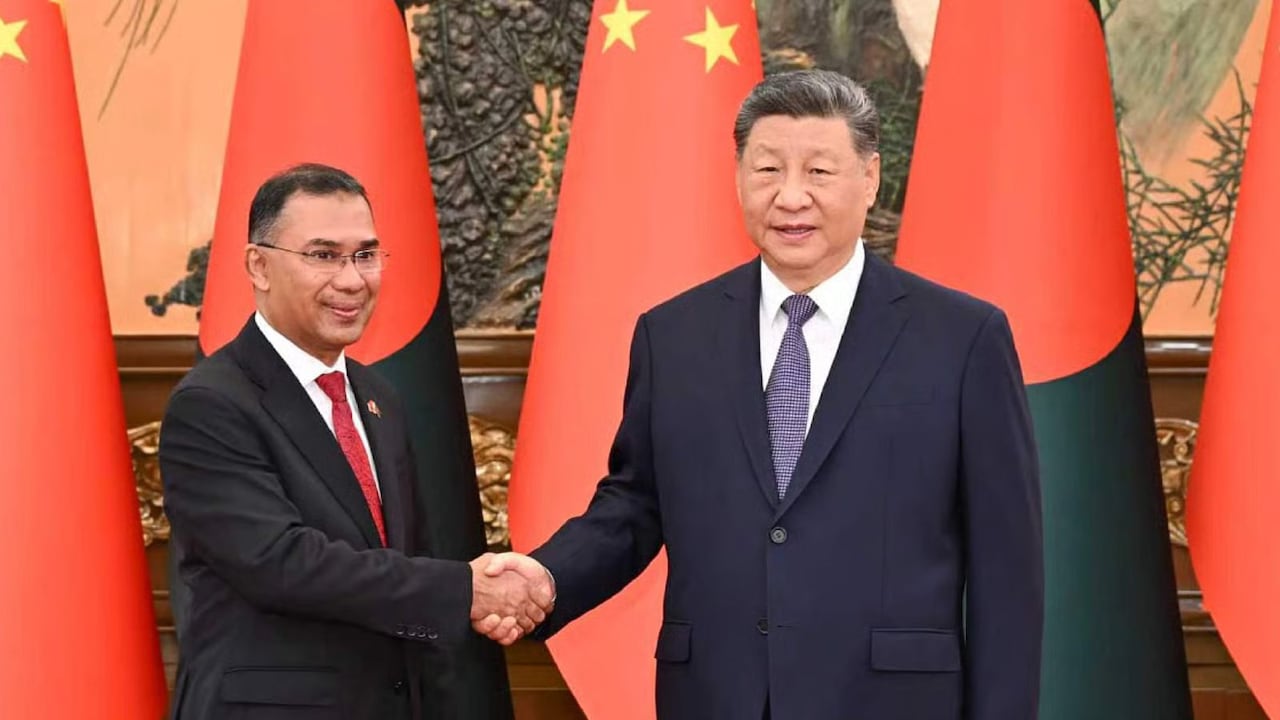
Foreign policy formulation for states situated at strategic geographic chokepoints requires a precise calculation of trade-offs rather than reliance on diplomatic rhetoric. When Dhaka officials reject simplistic domestic analogies to describe their foreign relations, they are masking a complex optimization problem. Bangladesh does not manage its ties with India, China, and the United States through emotional alignments. Instead, it operates within a structural trilemma defined by geography, industrial supply chains, and security architecture.
To decode how Dhaka navigates this triad, one must analyze the distinct inputs, outputs, and constraints each superpower introduces into the domestic economy and regional security matrix.
The Geographic and Security Imperative with New Delhi
India represents an inescapable structural reality for Bangladesh. Encircled on three sides by Indian territory and sharing a porous land border spanning over four thousand kilometers, Dhaka cannot decouple its national security calculus from New Delhi.
The economic and operational mechanics governing this bilateral corridor focus primarily on infrastructure connectivity, transshipment rights, and border management. India views its northern and eastern security through the stability of its immediate neighborhood, making cross-border counterterrorism cooperation and transit routes to India's landlocked northeastern states critical deliverables.
[ India ] <---> (Land Border / Transshipment) <---> [ Bangladesh Economy ]
   |                                                        ^
   +--- (Security Interdependence & Water Sharing) ---------+
Yet, this relationship contains an inherent asymmetry. India is both an immediate market and a security arbiter, but historical over-reliance has previously generated domestic political friction within Bangladesh. The strategic constraint for Dhaka lies in maintaining functional security cooperation while preventing asymmetric economic dependency that restricts sovereign decision-making.
Pragmatic diplomacy requires drawing firm red lines on sovereignty, border incidents, and equitable river water-sharing. When New Delhi and Dhaka align their energy grids and transport links without politicizing operational coordination, both states capture efficiency gains. However, any perception of regional hegemony triggers immediate domestic political pushback, narrowing the window for bilateral integration.
The Capital and Industrial Integration with Beijing
While India provides geographic and historical proximity, China functions as Bangladesh's primary engine for heavy industrial capital, infrastructure financing, and defense procurement.
The financial mechanics of the Sino-Bangladeshi partnership rest on large-scale development lending and trade imbalances. Beijing has committed billions of dollars through infrastructure investments, positioning itself as a dominant provider of heavy machinery, raw materials for the garment sector, and defense hardware.
- Defense Procurement: A substantial majority of Bangladesh's military hardware imports originate from Chinese state enterprises, establishing deep institutional links between the armed forces of both nations.
- Commercial Exchange: China displaced India as Bangladesh's largest trading partner by volume, fueled by bilateral trade agreements and duty-free market access for a vast percentage of Bangladeshi exports.
- Infrastructure Financing: Long-term loans underwrite critical transit, power generation, and port expansion initiatives that domestic tax revenues cannot immediately support.
This high level of economic exposure creates a distinct vulnerability. Debt sustainability metrics and the long-term viability of foreign-financed megaprojects dictate that Dhaka must manage Beijing's advances with rigorous financial oversight. Accepting infrastructure financing without competitive bidding or transparent terms risks triggering debt-servicing bottlenecks. Consequently, Bangladesh's strategy with China is heavily transactional, designed to extract capital goods and industrial inputs without conceding strategic naval or military access that would alarm regional and global competitors.
The Diplomatic and Market Leverage of Washington
The United States operates within this triangle as a consumer market of last resort, a diplomatic weight in multilateral financial institutions, and an advocate for Indo-Pacific strategic alignment.
The primary vector connecting Dhaka to Washington is commercial: the United States remains the single largest export destination for Bangladeshi ready-made garments. This economic lifeline ties domestic employment and foreign exchange reserves directly to American retail demand and regulatory compliance standards.
Beyond commerce, Washington seeks to integrate Bangladesh into its broader Indo-Pacific architecture to counter the expansion of Chinese maritime and technological influence. This introduces friction. American foreign policy priorities emphasize labor rights, democratic governance, and defense diversification away from Chinese systems.
For the administration in Dhaka, navigating Washington requires satisfying compliance benchmarks on labor and green production standards without alienating alternative security and infrastructure partners. Accepting targeted Western investments and security dialogues provides Dhaka with a diplomatic counterweight, preventing either Beijing or New Delhi from exercising absolute leverage over its foreign ministry.
The Optimization Engine of Strategic Autonomy
A state caught among three competing major powers cannot survive by picking a permanent camp. Doing so invites economic coercion from the excluded parties. Instead, Bangladesh executes a policy of multi-alignment, optimizing its utility function across distinct domains:
- Compartmentalization: Economic and trade negotiations are decoupled from security and defense procurement to prevent single-issue deadlocks from paralyzing the entire state apparatus.
- Institutional Diversification: Seeking capital from multiple sources—balancing Chinese infrastructure loans with Western market access and Indian regional connectivity—minimizes systemic financial risk.
- Institutional Non-Exclusivity: Rejecting permanent military basing rights or formal security blocs ensures that foreign bases never convert sovereign territory into a proxy theater for great power conflict.
The structural success of this foreign policy architecture depends entirely on internal political stability and export competitiveness. By tying its external posture directly to economic diversification, labor compliance, and regional trade in the Bay of Bengal, Dhaka transforms its geographic vulnerability into negotiating leverage.
To sustain this equilibrium, future diplomatic maneuvers must continuously calibrate economic dependency thresholds. The primary strategic play for Dhaka is to institutionalize transparent multilateral frameworks where India provides immediate regional connectivity, China underwrites industrial capital, and the United States secures export markets and regulatory modernization, leaving Bangladesh firmly at the center of its own balance sheet.