Morning on the river arrives as a slow, deliberate bruising of the fog. Long before the sun clears the tree line along the Arkansas River, the moisture hangs heavy, smelling of damp mud, decaying oak leaves, and the sharp, metallic tang of industrial history. If you stand on the banks near Toad Suck Ferry on a quiet morning, you can almost hear the ghosts of horses and steam whistles.
For nearly a century, that stretch of water carried the weight of commerce, sweat, and movement. And holding it all up, spanning the stubborn current like a rusted spine, was the old Toad Suck Ferry Lock and Dam bridge. Ninety-three years. Think about that number. Through World War II, through the civil rights movement, through countless floods that swallowed the lowlands and turned pastures into inland seas, that span stood. It absorbed the thunder of heavy trucks, the rattling bounce of family station wagons, and the silent, patient footsteps of generations of local teenagers looking for a place to throw rocks at the water.
Steel gets tired. It remembers every load it ever carried.
By 2016, the bridge was old. Not historic in the preserved-in-amber museum sense, but obsolete. A new, wider, safer span had risen just upstream, carrying the modern flow of Highway 60. The old bridge had become a ghost in waiting. A liability. An aging giant that needed to be cleared away so the river could breathe without obstruction.
Demolition crews arrived with the cold, detached efficiency of surgeons. They didn't see a monument; they saw a puzzle box of rivets, girders, and reinforced concrete. They planned to end its tenure the way modern engineering usually solves such problems: quickly, loudly, and with absolute finality.
Explosives.
I remember the first time I watched a bridge come down. It was a smaller span over a dry creek bed, but the feeling was the same. You stand a half-mile back behind yellow caution tape. You feel the countdown in your teeth before you hear it in your ears. There is a strange, collective silence in the crowd right before the button is pushed—a weird kind of reverence for something humanity built that is about to be unbuilt by its own clever hands. You expect gravity to cooperate. You expect physics to follow the script.
The scriptwriters at Toad Suck Ferry miscalculated.
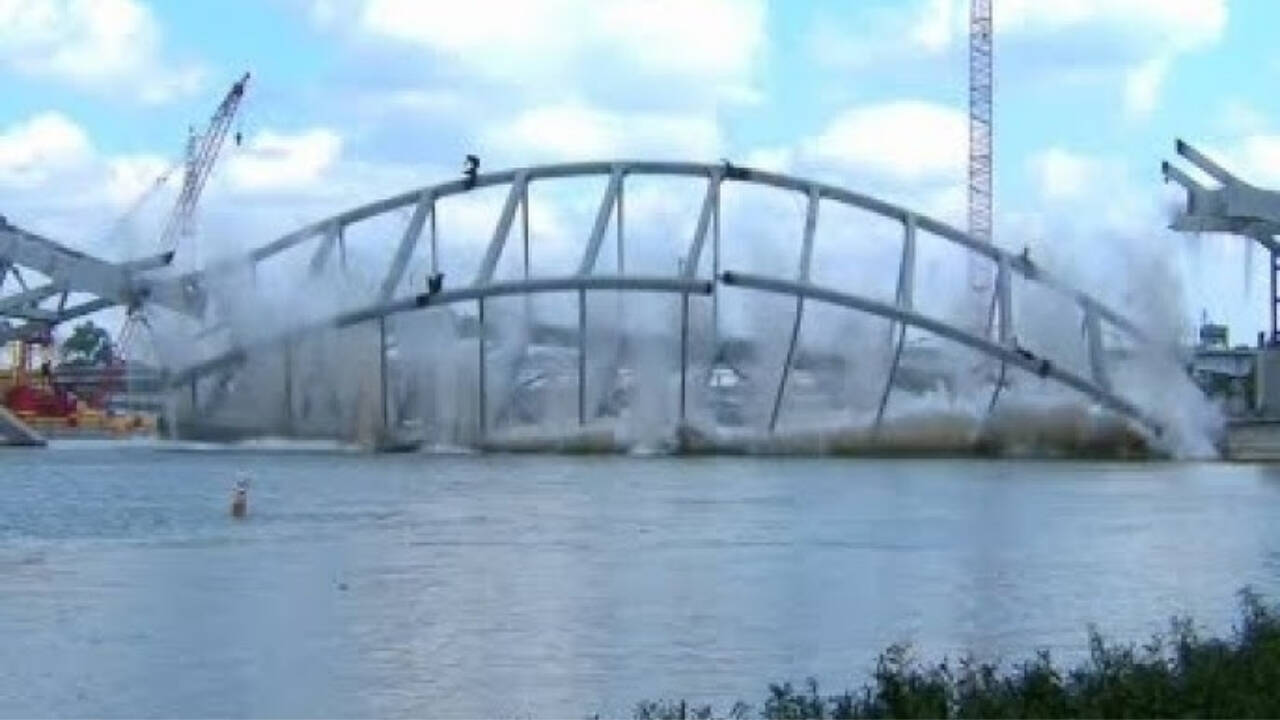
On a crisp day in 2016, the charges were wired. The sequence was set. The explosive collar charges wrapped around the steel legs were designed to blow in a millisecond choreography, snapping the structural integrity of the span and letting the heavy deck drop cleanly into the muddy water below for easy retrieval.
The button was pushed.
The roar rolled across the Arkansas River, shaking the windows of nearby farmhouses and sending flocks of startled egrets into the gray sky. Smoke billowed, thick and white and sulfurous.
When the smoke cleared, the bridge was still there.
Not sagging. Not leaning. It sat upon its masonry piers with an almost defiant stillness, as if it had merely shrugged off a bad night's sleep. Sure, a few peripheral beams were bent. Concrete had spattered like shrapnel. But the core of the bridge—the ancient, riveted iron framework forged in an era when engineers built things with a margin of safety that borders on reckless optimism—refused to yield.
It was an embarrassment for the demolition team, but to anyone who has ever lived in the river valleys of America, it felt entirely right.
We live in a culture obsessed with planned obsolescence. We buy things knowing they will break in three years. We build digital infrastructures that rot the moment an update is missed. We expect our world to be fragile, disposable, and temporary.
That bridge was built in 1923. It was constructed by men who wore wool trousers in August and drove rivets with pneumatic hammers while balancing on narrow steel beams high above a freezing, churning river. They didn't have computer-aided design software or stress-test algorithms. They had slide rules, heavy iron, and an unspoken ethos that whatever they made had to outlive them.
The engineers went back to the drawing board. They brought in heavier equipment, clawed at the stubborn metal with hydraulic shears, and eventually dismantled the stubborn veteran piece by agonizing piece. They won, of course. Modern machinery always wins in the end through sheer, brute persistence.
Yet, as the last rusted beam was hoisted onto the back of a flatbed truck, something had shifted in the air along the river.
The river didn't care about the schedule. The egrets returned to the shallows. And the water kept flowing past the empty concrete piers, which still anchor themselves deep into the bedrock, refusing to let go of the ground beneath them.
We tear down what we build to make room for what comes next. That is the rhythm of progress. But every once in a while, an old structure rises up to remind us what endurance actually looks like. It is not about being modern. It is not about being efficient.
It is about holding your ground when the world tries to blow you away.