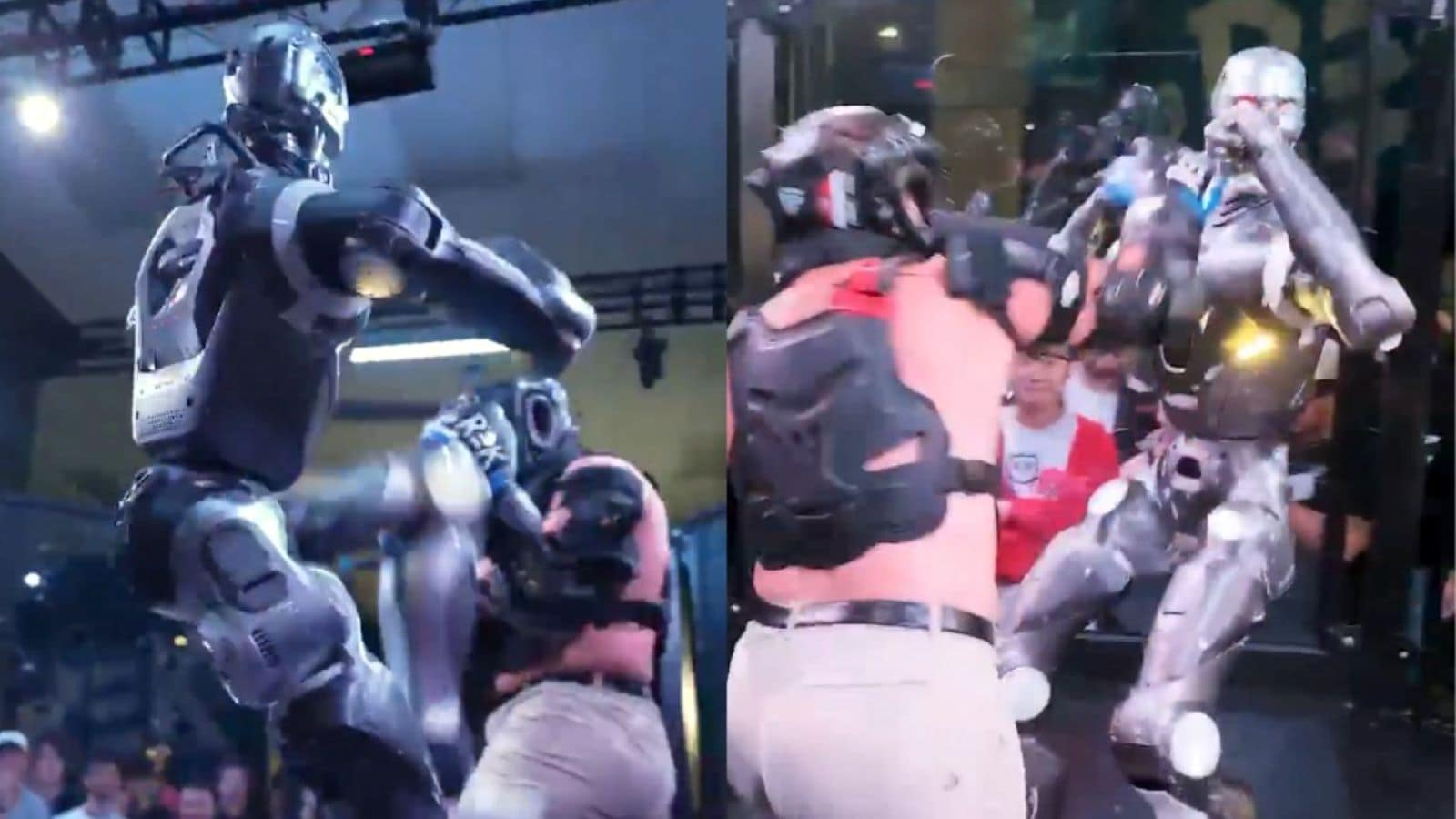
On September 18, 2026, social media creator Frankie LaPenna stepped into a caged enclosure in San Francisco to face a six-foot, 176-pound humanoid machine known as the EngineAI T800. Billed by robotics startup REK as the first human versus Terminator robot fight, the exhibition instantly exploded across digital feeds, racking up tens of millions of views within days. Viewers watched a familiar internet personality throw initial punches only to be met by a mechanical counter-offensive that ended with a brutal, flying switch kick sending him sprawling across the mat. Beneath the viral entertainment and the dystopian commentary filling comment sections, the spectacle laid bare the actual state of modern bipedal robotics, separating marketing hype from engineering reality.
The Engineering Behind the Cage
For decades, popular culture trained audiences to anticipate a specific flavor of automation. Hollywood promised autonomous killing machines capable of independent tactical thought, malice, and strategic adaptation. The San Francisco cage match delivered a striking visual manifestation of that fiction, yet the machinery operating inside the enclosure functioned under a vastly different operational reality. The T800 unit was not running neural networks designed to destroy an opponent out of spite or survival instinct.
Instead, the machine relied on teleoperation. A human pilot managed the high-level movement commands while onboard stabilization software handled the complex physics of bipedal balance, keeping the heavy metallic frame upright under impact. When LaPenna landed his initial blows, the machine absorbed the kinetic energy through its rigid chassis before executing pre-programmed or operator-driven counter-strikes.
This distinction matters because it separates science fiction from mechanical engineering. Building a bipedal robot that can stand upright on uneven flooring is an immense scientific hurdle. Building one that can absorb a human fist and retaliate with a balanced, high-velocity kick requires precise actuator control, high-torque motors, and rapid sensory feedback loops. The machine did not win because it was sentient. It won because steel, carbon fiber, and high-output electric motors possess a baseline durability and force output that human bone and muscle struggle to match in a direct exchange of kinetic energy.
To understand why this exhibition resonated so widely, one must examine the history of human-machine physical demonstrations. For years, roboticists relied on static trade shows or carefully choreographed video loops released by well-funded research laboratories. These sanitized presentations showed machines jogging lightly through open fields or performing awkward backflips in pristine testing environments. While impressive to engineers, those clips failed to engage the wider public imagination. They looked staged because, in many ways, they were.
The REK exhibition abandoned the laboratory aesthetic entirely. By introducing an unscripted human element—an influencer with zero professional fighting experience taking physical blows from a metal frame—the organizers bridged the gap between sterile industrial engineering and visceral spectator sport. The friction between biological fragility and mechanical resilience created immediate drama.
The Economics of Viral Hardware Promotion
Hardware startups face a brutal marketing problem. Building functional humanoid robots requires millions of dollars in venture capital, years of research and development, and exhaustive component testing. Yet, ordinary consumers rarely care about joint torque specifications, battery chemistry, or inverse kinematics equations. Traditional press releases detailing motor efficiency do not capture public imagination or attract investor attention in a crowded media market.
Enter the internet influencer. By pairing a high-end, industrial humanoid chassis with a recognizable creator known for comedic stunts, REK achieved immediate global saturation. The partnership bypassed traditional technology journalism entirely, landing the company straight into mainstream social feeds, late-night video roundups, and viral debate forums.
The strategy highlights a changing approach to hardware launches. Traditional product demonstrations take place in sterile laboratories or controlled convention centers where machines perform predictable tasks like walking across flat carpets or sorting plastic blocks. Those demonstrations bore the general public. Placing a six-foot machine inside a fighting ring and letting it kick an internet personality changes the dynamic completely. It transforms dry engineering metrics into visceral theater. Viewers stopped scrolling not because they understood robotics, but because the sight of a mechanical skeleton striking a human triggered primal anxieties about displacement and dominance.
Furthermore, this form of marketing shifts the financial risk profile of hardware promotion. Venture capitalists financing robotics ventures demand proof of market interest. A viral stunt generating forty-five million views provides immediate quantitative proof of brand awareness that traditional advertising agencies could never replicate on a comparable budget. It signals to investors that the public is ready for humanoids to enter cultural mainstream consciousness, even if that entry occurs via novelty cage matches rather than warehouse deployment.
Decoding the Physics of Robotic Combat
Analyzing the physical exchange reveals why the outcome felt so shocking to spectators. Human fighters rely on fluid muscle contraction, reflexive tendon tension, and biological fatigue. A machine operates under entirely different physical constraints. The structural integrity of a humanoid robot relies on rigid frames and servo-driven joints capable of instantaneous acceleration without warm-up periods or lactic acid buildup.
When the T800 launched its decisive kick, it did not suffer from hesitation or improper weight distribution. The onboard computers calculated the trajectory based on the operator's input, delivering maximum torque directly through the point of impact. The human body absorbs blunt force trauma by flexing tissue and distributing shock through muscle groups, but a direct collision with heavy industrial actuators introduces forces that far exceed normal athletic thresholds.
Reports following the event noted discussions regarding joint torque metrics, specifically figures around four hundred fifty newton-meters. Experts immediately pointed out that joint torque specifications measure rotational force at the motor axis rather than the direct impact energy delivered at the foot. Yet, even without precise impact ratings, the visual evidence spoke clearly. A machine constructed from rigid engineering materials does not bruise, tire, or second-guess its offensive maneuvers. When a motorized limb connects with a human adversary, the transfer of momentum is unforgiving.
Consider the mechanical engineering required to execute a jumping switch kick from a bipedal platform. The machine must rapidly shift its center of gravity, store energy in high-capacity capacitors or battery packs, discharge massive electrical current into multiple leg actuators simultaneously, and recalculate balance mid-air to ensure it does not crash to the floor upon landing. Achieving this under remote human operation demonstrates significant advancements in hydraulic or electromechanical drive systems, even if the strategic intent originated from a human pilot sitting outside the cage.
The Dystopian Reflex in Public Perception
Public reaction to the footage divided cleanly into two camps. One side treated the event as a harmless novelty match, a high-tech evolution of professional wrestling or novelty combat sports. The other side viewed the clip with genuine alarm, drafting endless commentary about impending robotic supremacy and the end of human relevance.
This anxiety stems from decades of cinematic conditioning. Whenever humanity encounters a bipedal machine with a vaguely threatening aesthetic, cultural memory immediately summons images of apocalyptic futures. The Terminator naming convention was not accidental; it served as an intentional psychological anchor designed to provoke a specific emotional response. Producers and marketers understand that fear drives engagement far more effectively than admiration.
Yet, treating teleoperated laboratory demonstrations as harbingers of rebellion misunderstands the current bottleneck in automation. The primary challenge facing robotics companies is not building aggressive fighting machines. The challenge is teaching machines to fold laundry reliably, navigate cluttered real-world environments without crashing, and operate safely alongside humans in warehouses or hospitals. Combat exhibitions represent a controlled engineering playground where developers can stress-test structural durability and motor response times under high-stress conditions. They showcase mechanical resilience rather than artificial intelligence milestones.
The psychological comfort we derive from viewing machines as potential overlords masks a more mundane reality. Robots are tools designed, funded, and operated by humans to serve specific commercial or operational interests. When a machine kicks an influencer across a ring, it is not executing free will. It is executing code written by programmers and voltage directed by an operator. The terror is entirely human-made.
The Next Frontier for Human Machine Interaction
As robotics firms continue refining bipedal designs, physical exhibitions like the San Francisco cage match will likely evolve. Companies are eager to prove that their hardware can withstand physical shocks, maintain balance under duress, and execute rapid movements without structural failure. Engineering teams learn invaluable data points when a 176-pound machine hits a dynamic target and absorbs the reactionary forces through its internal frame.
However, moving from teleoperated novelty stunts toward autonomous physical competition introduces profound ethical and technical complications. True autonomous combat requires machine vision systems capable of tracking fast-moving targets, decision-making algorithms that evaluate risk in milliseconds, and fail-safes stringent enough to prevent catastrophic injury. Society remains deeply uncomfortable with the prospect of autonomous machines designed specifically for combat, even when confined to steel cages.
The viral encounter between an internet creator and a mechanized fighter ultimately serves as an instructive mirror. It reflects our collective fascination with the boundary line between flesh and steel. The machine did not defeat the human because algorithms achieved supremacy over human consciousness. It won because engineering design principles favor mass, velocity, and mechanical endurance when stripped of biological limitations. As these machines step out of laboratories and into public view, the real challenge will not involve surviving encounters inside fighting rings, but figuring out how to coexist peacefully with hardware engineered to out-muscle us at every turn.