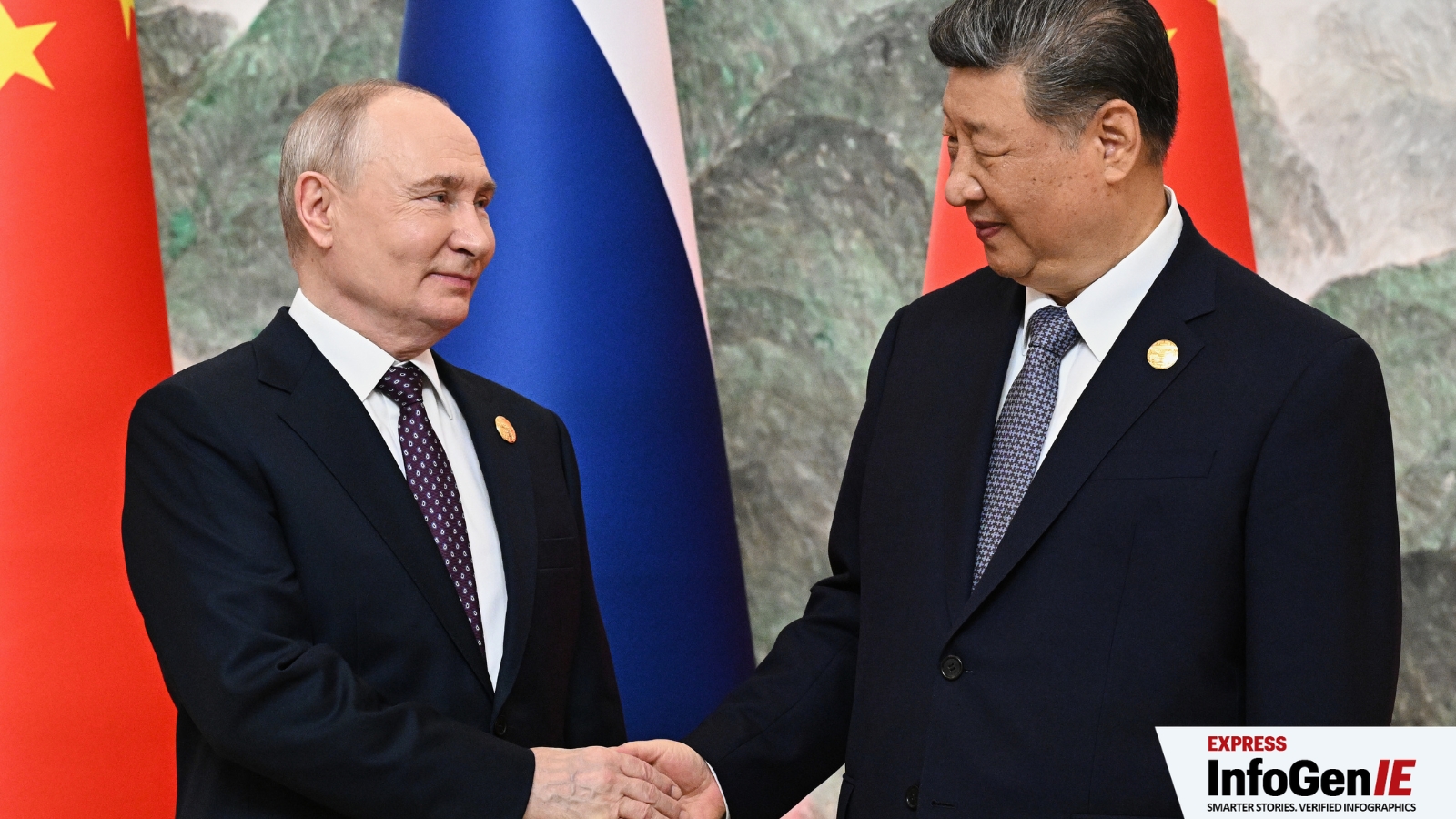
When Xi Jinping and Vladimir Putin jointly denounce Western protectionism and sanctions just as Donald Trump touches down in China for high-stakes talks, the timing is not a coincidence. It is a calculated diplomatic squeeze. By synchronizing their public attacks on American tariffs and financial blacklists, Beijing and Moscow are attempting to dictate the terms of the summit before a single negotiation begins, framing Washington as the primary destabilizer of global trade while masking the severe internal economic pressures driving both capitals to the table.
Most coverage treats these joint statements as routine geopolitical theater. That is a mistake. Beneath the predictable rhetoric about multipolarity and free trade lies a high-stakes struggle over industrial survival, currency dominance, and the future architecture of global supply chains.
The Architecture of Coordinated Pressure
Diplomatic choreography at this level requires months of preparation. By aligning their messaging immediately prior to Trump’s arrival, Xi and Putin are executing a classic pre-negotiation anchoring strategy.
If Washington enters Beijing expecting to negotiate bilateral trade deficits, intellectual property enforcement, or technology transfer restrictions in isolation, Moscow’s vocal presence in the background forces a broader, messier agenda. Suddenly, every tariff threat from the White House is linked to secondary sanctions on Russian energy, banking restrictions, and the weaponization of the US dollar.
The tactic serves two distinct purposes for Beijing. First, it signals to Washington that China will not abandon its strategic partnership with Russia in exchange for modest tariff relief. Second, it positions China as the defender of the Global South, arguing to developing nations in Southeast Asia, Latin America, and Africa that Western trade barriers and financial sanctions threaten everyone's economic sovereignty.
Yet this united front conceals an uncomfortable asymmetry. China and Russia are not equal partners in this resistance.
Why Moscow Needs Beijing More Than Beijing Needs Moscow
To understand the real mechanics of this alignment, follow the trade flows and settlement currencies. Cut off from Western capital markets, major European energy buyers, and dollar-denominated clearing systems, the Russian economy has undergone a rapid, forced reorientation toward the East.
China has become Russia’s indispensable economic lifeline. Beijing absorbs discounted Russian crude oil, natural gas, coal, and agricultural commodities, while supplying the machine tools, microelectronics, heavy vehicles, and consumer goods that Western sanctions stripped from Russian shelves. Trade between the two nations is now overwhelmingly settled in yuan and rubles, bypassing the SWIFT messaging network and eroding the reach of US Treasury enforcement.
For Putin, attacking Western sanctions alongside Xi is an existential necessity. Moscow needs Beijing to keep buying its hydrocarbons and to resist Washington’s threats of secondary sanctions against Chinese banks facilitating Russian trade.
Xi’s calculus is far more complicated. China is an export-driven manufacturing superpower whose economic survival depends on access to affluent consumer markets in North America and Europe. Russia’s economy, roughly the size of a single wealthy Chinese province, cannot absorb China’s massive industrial output.
Beijing cannot afford a total financial decoupling from the West. When the US Treasury threatens to cut off major Chinese commercial banks from the dollar system over dual-use exports to Russia, Chinese financial institutions quietly comply, slowing down payments and tightening compliance checks on Russian clients. Publicly, Xi and Putin stand shoulder to shoulder against Western economic coercion. Privately, Chinese state banks are terrified of losing access to dollar clearing.
The Protectionism Paradox
There is a glaring contradiction at the heart of the Beijing-Moscow critique of Western protectionism. Both nations condemn American tariffs and industrial subsidies as violations of free-market principles, even as their own economies rely heavily on state intervention, market access restrictions, and aggressive industrial policy.
Consider the manufacturing reality driving the current confrontation with Washington. Over the past decade, Beijing directed hundreds of billions of dollars in state-backed loans, land grants, and energy subsidies into strategic sectors—most notably electric vehicles, lithium-ion batteries, solar panels, and legacy semiconductors.
The result is structural industrial overcapacity. Domestic consumption in China remains sluggish, weighed down by a prolonged real estate downturn and weak household confidence. Unable to sell its surging factory output at home, Beijing has relied on aggressive exports to keep its manufacturing base humming and prevent widespread unemployment.
From Washington’s perspective, this is not free trade. It is the state-subsidized export of deflation and unemployment, designed to hollow out competing industrial bases in the United States and Europe. When Trump threatens sweeping tariffs, he is reacting to a second wave of Chinese export dominance that threatens to wipe out Western clean-energy and automotive manufacturing before those industries can reach scale.
Meanwhile, Russia’s complaints about Western protectionism ring equally hollow. Following the invasion of Ukraine, Moscow instituted sweeping capital controls, forced asset seizures of Western firms, and erected massive state-directed import substitution barriers.
When Xi and Putin champion "open global markets," they mean open Western markets for their exports, paired with protected domestic markets for their state champions.
Trump’s Transactional Leverage
Into this tangle of competing grievances steps Donald Trump, a leader who views multilateral alliances with skepticism and treats tariffs not as a last resort, but as his primary instrument of foreign policy.
Traditional diplomats approach summits in Beijing with thick briefing books full of incremental regulatory requests and human rights talking points. Trump operates differently. By threatening punitive, across-the-board tariffs and questioning longstanding security commitments, he intentionally creates maximum uncertainty.
Beijing hates uncertainty. The Chinese Communist Party prizes stability, predictability, and carefully scripted outcomes. Trump’s willingness to blow up established trade frameworks forces Chinese negotiators onto the defensive.
At the same time, Trump’s transactional worldview creates an opening that Xi and Putin are eager to exploit. Both leaders understand that Trump is less interested in ideological crusades than in concrete, headline-grabbing deals—massive agricultural purchases, commitments to build factories on American soil, or geopolitical concessions that he can present to domestic voters as decisive victories.
By raising the specter of an entrenched Sino-Russian economic bloc, Xi and Putin are testing whether Trump will soften his stance on tariffs or ease pressure on Moscow in exchange for bilateral trade concessions from Beijing.
The Hidden Vulnerability in the US Sanctions Regime
While Washington holds immense leverage through its consumer market and control over the dollar, the joint Beijing-Moscow offensive highlights a growing vulnerability in American economic statecraft. Sanctions and tariffs work best when applied sparingly against isolated targets. When deployed simultaneously against the world's largest manufacturer and the world's largest commodity exporter, they trigger defensive adaptation.
Over the past several years, central banks and finance ministries across Eurasia and the Middle East have watched how thoroughly Western powers froze Russia’s foreign exchange reserves. That single action shattered the assumption that sovereign dollar and euro assets were untouchable.
In response, China has steadily reduced its holdings of US Treasury securities while accelerating the development of its Cross-Border Interbank Payment System. Central banks from Riyadh to Brasilia have quietly expanded bilateral currency swap lines and experimented with alternative settlement platforms to reduce their exposure to dollar clearing bottlenecks.
None of these alternatives can replace the US dollar anytime soon. The greenback remains unmatched in liquidity, depth, and institutional trust, and China’s strict capital controls prevent the yuan from becoming a true global reserve currency.
However, the friction caused by Western sanctions is steadily carving out a parallel, sanctions-resistant trading sphere. Every time Washington imposes new export controls or financial blacklists, it increases the incentive for third-party nations to build workarounds. Xi and Putin are betting that if they can weather the immediate economic pain, the long-term erosion of Western financial leverage will tilt the balance of power in their favor.
What Actually Happens Behind Closed Doors
Strip away the public posturing, and the real negotiations in Beijing come down to three hard-edged realities that neither side can afford to ignore.
First, China needs a stable external trade environment to manage its domestic economic transition. With property values depressed and local governments drowning in debt, Beijing cannot survive a simultaneous collapse in exports to the United States and the European Union. Xi will push hard for tariff relief and technology access, offering targeted purchasing agreements and limited market openings in return.
Second, Washington wants verifiable limits on Chinese industrial dumping and a halt to the flow of dual-use components feeding Russia’s defense industrial base. Without enforcement mechanisms, promises from Beijing carry little weight in Washington, where skepticism of Chinese trade commitments is one of the few remaining points of bipartisan consensus.
Third, the Sino-Russian alignment has hard economic limits. Beijing will continue to buy cheap Russian energy and provide diplomatic cover against Western isolation, because a weak, dependent Russia on its northern border is far preferable to a pro-Western or chaotic one. Yet Xi will not sacrifice China’s access to Western technology and capital markets simply to rescue Putin from the consequences of his war in Ukraine.
The Reality Beyond the Summit
High-stakes summits rarely resolve deep structural rivalries. Even if Trump and Xi emerge from their meetings with a framework to pause new tariffs or establish working groups on trade imbalances, the underlying collision between American economic nationalism and Chinese state-led mercantilism will remain intact.
Washington is committed to reshoring critical supply chains and blocking adversary access to advanced artificial intelligence and semiconductor manufacturing. Beijing is equally committed to achieving technological self-reliance and dominating the industries of the next century. Moscow, locked out of the West, will continue to act as a disruptive force, eager to widen any crack between Washington, Beijing, and European capitals.
The synchronized condemnation of Western protectionism and sanctions is not a sign of an unstoppable new world order. It is a defensive crouch by two authoritarian powers trying to manage severe economic vulnerabilities while confronting an unpredictable American president who holds the keys to the world's largest consumer market. When the cameras turn off and the translators step back, the leverage still belongs to whoever can absorb the most economic pain without blinking.