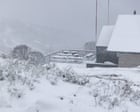
The intersection of a cut-off low-pressure system and a concentrated polar air mass has exposed the widening gap between Australia’s aging energy distribution infrastructure and the increasing frequency of "unseasonal" high-impact weather events. While standard reportage focuses on the visual novelty of autumn snow or the immediate inconvenience of localized blackouts, a structural analysis reveals a more concerning reality: the eastern Australian grid is currently ill-equipped to handle the mechanical and thermal stresses of rapid, off-cycle transitions. This volatility does not merely disrupt commutes; it triggers a multi-vector failure chain across energy reliability, agricultural logistics, and emergency response frameworks.
The Tri-Vector Failure Mechanism
The recent disruptions across New South Wales, Victoria, and Queensland are the result of three specific meteorological and mechanical vectors converging simultaneously. Understanding this convergence is necessary to move beyond reactive emergency management toward predictive infrastructure hardening.
1. Mechanical Stress and Kinetic Loading
High-velocity wind gusts, exceeding 90 km/h in coastal and alpine regions, operate as the primary kinetic disruptor. In an urban context, the "sail effect" of autumn foliage—which has not yet been shed—increases the drag coefficient on power lines and surrounding vegetation. This leads to a higher rate of line-strike incidents compared to mid-winter storms when deciduous trees are dormant. The result is a surge in transient faults that overwhelm automated reclosers, forcing manual inspections and prolonging outage durations.
2. Thermal Shock and Demand Spikes
The transition from mild autumn temperatures to sub-zero conditions within a 24-hour window creates a thermal shock to the built environment. Residential and commercial heating systems, often unoptimized for sudden loads in early May, create a sharp, vertical demand curve. This localized surge occurs while the grid is simultaneously dealing with supply-side instability caused by wind-driven physical damage.
3. Hydrological Saturation and Soil Stability
The storm cells delivered concentrated rainfall before transitioning to snow. This sequence is critical: heavy rain saturates the soil, reducing the structural integrity of the foundations for utility poles and transport infrastructure. When followed by high-velocity winds and the additional weight of snow accumulation, the probability of catastrophic pole failure increases exponentially.
Quantifying the Economic Friction of Power Instability
The immediate cost of power cuts is often measured in lost retail hours, but the deeper economic friction lies in the degradation of "Just-in-Time" supply chains and cold-storage logistics. For the eastern seaboard, where food processing and distribution are concentrated, a six-hour outage is not a linear loss of time; it is a step-function loss of inventory.
- Inventory Spoilage: Cold storage facilities operate on a thermal buffer. Once power is severed, the internal temperature rise follows a predictable curve. In many regional hubs, backup generation is sized for essential lighting rather than full-compressor loads, leading to total loss of temperature-sensitive stock.
- Logistical Bottlenecks: Snowfall in the Blue Mountains and the Great Dividing Range effectively severs the primary arterial routes for heavy vehicle transport. The closure of the Great Western Highway or the Hume Highway creates a "back-pressure" effect on ports and distribution centers, resulting in a three-to-five-day recovery period for every 24 hours of closure.
- Labor Productivity Loss: The transition to decentralized, remote work has shifted the burden of infrastructure reliability from commercial CBDs to residential suburbs. When the residential grid fails, the productivity of the professional services sector—a massive component of Australia's GDP—drops instantly, as home offices lack the industrial-grade redundancy of city towers.
The Physics of Snow Loading on Non-Winterized Infrastructure
In regions like the Central Tablelands or the Southern Highlands, snow accumulation during autumn presents a unique engineering challenge. Because the ambient air temperature is often hovering near the freezing point, the snow has a high moisture content, commonly referred to as "wet snow."
The density of this wet snow can range from $100\text{ kg/m}^3$ to $800\text{ kg/m}^3$. When this adheres to power lines and telecommunications towers not designed for such loads, the gravitational force exerted on the structures exceeds their safety margins. Furthermore, the phenomenon of "galloping"—where wind causes ice-coated wires to vibrate at low frequencies and high amplitudes—can cause physical contact between phases, leading to explosive short circuits and permanent transformer damage.
Critical Limitations in Current Meteorological Forecasting
While the Bureau of Meteorology (BoM) accurately predicted the arrival of the cold front, the granular impact on the "last mile" of infrastructure remains a blind spot. Existing models are excellent at identifying macro-scale pressure movements but lack the resolution to predict localized micro-bursts or specific ice-accumulation rates on utility assets.
This gap in "hyper-local" data prevents utilities from pre-positioning crews effectively. Instead of a surgical response, energy providers are forced into a "shotgun" approach, dispersing resources across vast regions and increasing the mean time to repair (MTTR). The inability to distinguish between a minor branch clip and a total pole collapse from satellite data alone remains a primary bottleneck in restoration efforts.
Infrastructure Hardening as a Strategic Imperative
The recurring nature of these "unprecedented" events suggests that the eastern Australian climate has entered a period of higher variance. The strategy of repairing to the status quo is no longer a viable economic path. To mitigate the impacts of future autumn volatility, the following structural shifts are necessary:
- Vegetation Management Re-indexing: Current pruning cycles are based on historical growth patterns. Increased rainfall followed by sudden cold snaps requires a dynamic pruning schedule that accounts for "fuel-load" and "wind-sail" risks in non-traditional months.
- Microgrid Isolation: Regional towns that are frequently isolated by snow or fallen lines must be transitioned to microgrids capable of "islanding." By integrating local renewables with industrial-scale battery storage, these communities can maintain essential services even when the main transmission line is severed.
- Hardening of Transport Arteries: Strategic sections of the Great Dividing Range require increased investment in snow-clearing assets and road-surface heating in critical bottlenecks. The current reliance on manual plowing and reactive closures is a 20th-century solution to a 21st-century volatility problem.
The current state of eastern Australia’s response to unseasonal weather is reactive, relying on the heroism of emergency crews rather than the resilience of the systems themselves. The primary vulnerability is not the weather, but the assumption that the climate of the next decade will mirror the climate of the last century.
Operational focus must shift from "restoration" to "anticipatory decoupling." This involves identifying the specific nodes where the energy grid, transport network, and communications systems intersect and reinforcing them against the specific mechanical loads of wet snow and high-velocity wind. Failure to implement these hardening measures will result in a permanent increase in the "volatility tax" paid by the Australian economy in the form of higher insurance premiums, lost productivity, and degraded infrastructure longevity.
The strategic play is a phased move toward undergrounding high-risk residential distribution lines and the deployment of AI-driven predictive maintenance that utilizes real-time sensor data from the poles themselves. This moves the utility from a position of "finding the break" to "preventing the failure" before the first snowflake hits the ground.