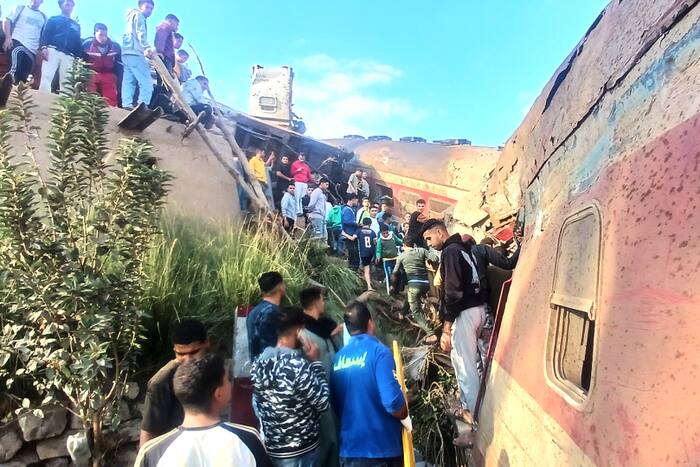
Rail network safety is an exercise in managing failure modes across mechanical, operational, and human vectors. When a passenger train collides with another carrying high passenger densities—such as the incident in Zagazig, Sharqia Governorate, Egypt, which resulted in at least seven fatalities and over 100 injuries—the event is rarely attributable to a single point of failure. Instead, it reflects a compounding collapse of redundant safety mechanisms designed to isolate trains within controlled blocks of track. Understanding the root mechanics of such collisions requires moving past initial body counts to analyze block signaling architecture, speed control protocols, and infrastructure maintenance deficits.
Block Signaling Failures and the Propagation of Human Error
Modern railway operations rely on block signaling systems to maintain spatial separation between trains on a single line. Under standard absolute block signaling rules, a line is divided into fixed segments. Only one train is permitted to occupy a single block at any given time, enforced by signal aspects (red, yellow, green) synced to track circuits.
In high-density rail corridors, three primary failure mechanisms allow two trains to occupy the same section of track:
- Signal Passed at Danger (SPAD): The crew of an approaching train fails to observe or respond to a restrictive (red) signal, entering an occupied block at speed. This is typically driven by crew fatigue, poor signal visibility, or inadequate train protection systems.
- Interlocking and Switch Malfunction: Mechanical or electrical failure in the track switches redirects a train onto a track occupied by stationary or oncoming rolling stock without the signal system updating accordingly.
- Manual Override Protocols: In networks operating under degraded conditions, controllers frequently issue manual line-clearance orders via radio or verbal instructions to bypass failing automated signals. This introduces direct human error into what should be an automated fail-safe process.
When automatic train protection (ATP) or positive train control (PTC) systems are absent or deactivated, the margin for human error drops to zero. ATP automatically applies emergency brakes if a train passes a red signal or exceeds speed limits prescribed by the signaling block. Without functional ATP, stopping distance becomes entirely reliant on manual driver reaction time and mechanical brake performance.
Kinetic Energy and Structural Dynamics of Passenger Collisions
The severity of casualties in a train collision is governed by kinetic energy transfer ($E_k = \frac{1}{2}mv^2$) and the structural integrity of the telescoping passenger cars. In a head-on or rear-end collision, kinetic energy dissipates through vehicle deformation, derailment, and structural collapse.
The primary physical factors determining casualty density include:
- Telescoping: When the underframe of one passenger car overrides the frame of another, shearing through the upper superstructure where passengers are seated. Modern cars utilize crashworthy crumple zones to absorb energy, but older rolling stock lacks these shear-resistant structures.
- Deceleration Rates: Uncontrolled deceleration from high velocity generates extreme G-forces, launching passengers into rigid internal fixtures.
- Secondary Impacts: The initial impact frequently forces passenger cars off the ballast, causing rollover events or secondary collisions with adjacent structures, overhead catenary poles, or embankment walls.
In the Zagazig collision, the high ratio of injuries to fatalities (exceeding 100 injured to 7 dead) points to an impact speed where structural cabin preservation occurred in some cars while localized severe crushing occurred at the immediate point of impact.
The Economic and Infrastructure Bottleneck in System Maintenance
Rail networks facing recurrent high-fatality accidents typically suffer from systemic underinvestment in legacy line modernizations. The economic pressure on passenger rail services often leads to a mismatch between rolling stock upgrades and signaling infrastructure maintenance.
A functional system audit classifies risk along three structural layers:
- Primary Layer (Track and Signaling Infrastructure): Upgrading mechanical relay interlockings to solid-state digital interlockings, installing modern track circuits, and deploying continuous cab signaling.
- Secondary Layer (Rolling Stock Compliance): Retrofitting engine cabs with automated speed enforcement mechanisms (ATP/PTC) and ensuring passenger carriages meet modern crashworthiness standards (EN 15227 or equivalent).
- Tertiary Layer (Operational Governance): Rigorous enforcement of rest schedules to prevent driver fatigue, standardized dispatch communication rules, and strict limits on manual signal overrides during system faults.
Replacing aging tracks and manual signaling requires significant capital expenditure and planned service downtime. When network managers prioritize throughput and capacity over maintenance windows, safety margins erode systematically over time.
Risk Mitigation Framework for Legacy Rail Networks
Resolving systemic safety deficits in high-utilization rail corridors demands a phased operational overhaul rather than piecemeal repairs following major incidents.
First, rail authorities must mandate mandatory installation of fail-safe cab signaling systems that enforce automatic braking independently of driver intervention across all active locomotives. If full PTC integration is financially cost-prohibitive in the short term, spot-based automatic train stop (ATS) systems must be implemented at every main-line signal block.
Second, operational protocols regarding manual signal overrides require immediate hardening. Authorization for a train to bypass a restrictive aspect must require dual-verification protocols involving both regional central control and local station masters, eliminating single-point dispatcher error.
Finally, infrastructure investments must target signal power reliability and switch maintenance to minimize the occurrence of signal outages that prompt manual overrides in the first place. System safety is not achieved through post-disaster inquiries, but through the continuous, redundant elimination of single-point operational vulnerabilities across the physical and digital network topology.