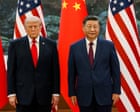
In the mahogany-heavy rooms of the Great Hall of the People this week, the silence coming from the American delegation was not an oversight. It was a product. As Donald Trump and Xi Jinping concluded their high-stakes summit in Beijing, the absence of a definitive, bellicose defense of Taiwan left the island’s leadership in a state of calculated breathing. For Taipei, a Trump who says nothing about their sovereignty is significantly safer than a Trump who treats it as a line item in a trade ledger.
The "silence" that followed these talks is being framed by some as a diplomatic win, but that interpretation misses the mechanical reality of the current administration. In this era of transactional diplomacy, no alliance is permanent, and every security guarantee has a recurring subscription fee. Taiwan is currently paying that fee through historic defense spending and massive semiconductor concessions, hoping that the sheer cost of their friendship makes them too expensive to sell out.
The Cost of the Shield
Taiwan has moved beyond the "strategic ambiguity" of the past. They are now practicing what can only be called "strategic solvency." Under immense pressure from Washington to prove they are a "model ally," Taipei has signaled a move to increase defense spending toward 5% of its GDP by 2030. This is not just a military upgrade; it is a down payment on American attention.
For decades, the U.S. posture toward Taiwan was built on shared democratic values and a vaguely defined commitment to regional stability. That foundation has shifted. The current White House views allies through the lens of a balance sheet. If Taiwan wants the protection of the Seventh Fleet, they are being told, they must buy the ships, the planes, and the missiles from American factories.
The silence after the Xi talks suggests that the payment was received. By not explicitly offering Taiwan up as a concession for better trade terms on soybeans or cars, Trump has signaled that the current arrangement—where Taiwan spends billions on U.S. arms—is functioning as intended.
Semiconductors as Ransom
The most significant shift in the power dynamic isn't happening in the Taiwan Strait, but in the fabrication plants of Arizona and Texas. The administration has successfully leveraged Taiwan’s semiconductor dominance to force a massive transfer of technical capital to the American mainland.
- Investment Mandates: Under recent agreements, Taiwanese tech giants have committed to over $250 billion in U.S. manufacturing investments.
- Intel’s Resurgence: The U.S. government, now a 10% shareholder in Intel after converting subsidies to equity, is actively pressuring Apple and Nvidia to shift their business away from TSMC and toward domestic foundries.
- The Leverage Play: By diversifying the global chip supply chain, the U.S. is slowly reducing the "silicon shield" that once made Taiwan indispensable.
This creates a brutal irony for Taipei. The very technology that makes them vital to the global economy is being stripped away to ensure they remain valuable enough for the U.S. to defend.
The Invisible Threat of the Grand Bargain
Beijing’s strategy during this summit was clear: frame Taiwan as the "most important issue" and hint at conflict if "mishandled." Xi Jinping is banking on the idea that every U.S. president has a price. In previous administrations, that price was measured in climate cooperation or North Korean containment. Today, it is measured in the U.S. trade deficit.
There is a persistent fear in Taipei of the "Grand Bargain"—a hypothetical scenario where Washington agrees to scale back arms sales or shift its diplomatic stance to "oppose" independence in exchange for a massive, multi-trillion dollar trade deal or a permanent end to the semiconductor war.
The reason Trump’s silence is viewed as the "best possible outcome" is that it confirms the Grand Bargain hasn't happened—yet. As long as the U.S. is preoccupied with securing market access for Boeing and forcing Chinese investment into American manufacturing, Taiwan remains a useful piece of leverage rather than a traded one.
The Strait of Hormuz Variable
A new and unpredictable element has entered the calculus: the energy crisis in the Middle East. During the summit, reports emerged of a shared interest in keeping the Strait of Hormuz open. China’s willingness to pivot its oil purchases toward the U.S. to reduce Iranian dependence provides Trump with a tangible "win" that has nothing to do with Taiwan.
When the U.S. can extract concessions from China on energy and fentanyl without even mentioning the island, Taiwan stays in the "safe" zone of the status quo. The danger only arises when the trade talks stall. In a vacuum of economic progress, the "Taiwan question" becomes the only card left to play.
The Myth of Unconditional Support
The hard truth that Taipei is forced to digest is that the era of the "blank check" is over. The American public’s appetite for foreign entanglements is at a historic low, and the administration has successfully messaged that alliances must be profitable.
Taiwan’s survival now depends on its ability to remain more profitable as a partner than as a bargaining chip. This requires a delicate balancing act:
- Maintaining technical superiority while satisfying the U.S. demand for domestic manufacturing.
- Buying enough American weaponry to satisfy the "America First" industrial policy.
- Staying quiet enough to avoid forcing a confrontation that the U.S. isn't ready to pay for.
The silence in Beijing wasn't a sign of weakness or a lack of interest. It was the sound of a transaction being processed. For an island that has lived in the shadow of an existential threat for seventy years, being a satisfied customer is, for the moment, better than being a cause célèbre.
Taipei knows that in this new world order, the only thing more dangerous than being an enemy of a superpower is being an ally that doesn't pay its way. They have seen the invoices. They are paying the bills. And for now, the quiet is the only receipt they are going to get.

/aerial-view-of-cityscape-at-taipei-center-district--taiwan-861177234-5b7f14a446e0fb005087f1e3.jpg)