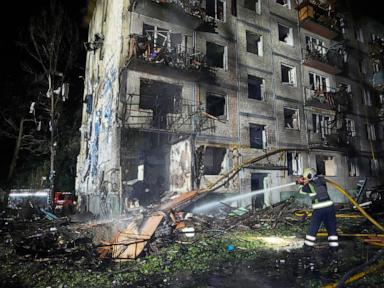
Every time a barrage of ballistic missiles and explosive drones screams into the Ukrainian capital, the global media machine runs the exact same predictable script. Red banners flash across television screens. Pundits gasp about escalation. Analysts breathlessly declare that a crossing of some phantom red line has occurred, as if the destruction of a residential block in Kyiv holds some mystical key to unlocking the entire strategic architecture of the war.
Stop buying the panic.
I have watched strategists, desk analysts, and armchair generals lose their minds over headline metrics for years now, mistaking tactical violence for strategic movement. The lazy consensus is simple: hit the center of power harder, break the civilian will, and the adversary collapses. It is an appealingly dramatic narrative for a 24-hour news cycle. It is also completely detached from the mechanical reality of modern attrition warfare.
Targeting the capital does not alter the math of this conflict. In fact, it exposes the terminal desperation of a military strategy running out of meaningful options.
The Geography of Attrition Misunderstood
Let us dismantle the core fallacy driving the coverage of these strikes. The assumption baked into almost every mainstream report is that a capital city functions as the central nervous system of a modern state in wartime. Cut off the head, or at least terrorize it enough, and the body stops functioning.
That theory worked in the Napoleonic era. It barely functioned in the Second World War. In a decentralized, digitized, heavily armed nation backed by a global logistics network, it is a pipe dream.
Kyiv is a political symbol, an administrative hub, and a media megaphone. But it is not the engine room of the front lines. The front lines are hundreds of kilometers away, powered by a sprawling, fractured supply chain that stretches across European railheads, local manufacturing cells, and decentralized repair yards. Dropping a cluster of Iskander missiles or Shahed drones into a neighborhood district kills civilians, destroys apartments, and creates heartbreaking human tragedies. It does not halt a single artillery shell from reaching a battery in the east or south.
Military analysts who obsess over strikes on metropolitan skylines are suffering from political geography bias. They look at a map of a country, spot the capital circle with a star next to it, and assume gravity centers there. But modern state resilience does not collapse because a skyscraper loses its windows. It adapts, decentralizes, and absorbs the blow.
The Attrition Trap Nobody Wants to Name
Here is the brutal truth that neither side wants to shout from the rooftops: these capital-city strikes are symptoms of a stalemate, not catalysts for a breakthrough.
When an air campaign achieves its objectives, you see systemic shifts in the adversary's capability. Command structures vanish. Logistics networks grind to a halt. Frontline units starve for fuel and ammunition because their rear-echelon depots have been turned to glass.
Look at what actually happens after these massive capital raids. Within forty-eight hours, power grid connections are patched with industrial-grade speed, air defense batteries reposition, and government operations continue out of hardened or dispersed locations. The net strategic gain for the attacker is near zero. The net tactical cost in expensive, high-tech ordnance is staggering.
Strategic violence that fails to degrade industrial capacity or frontline logistics is just expensive theater designed for domestic consumption back home.
I have spent years looking at defense procurement budgets and inventory burn rates. Precision-guided ballistic missiles are not infinite resources rolling off a quiet assembly line like cheap ball bearings. They require microchips, specialized guidance systems, complex propellants, and high-tolerance machining. Spending a multi-million-dollar inventory slice on urban terror attacks is a confession that the precision strike complex can no longer find or neutralize mobile military targets on the actual battlefield.
The Flawed Logic of Escalation Dominance
Another favorite ghost story of the commentary class is the concept of escalation dominance. The theory goes that if you scale up the brutality of urban bombardments enough, the defending population will eventually force their leadership to sue for peace to stop the bleeding.
History laughs at this theory.
From the Blitz in London to the bombings of Hanoi and the relentless shelling of cities across modern conflicts, civilian populations under existential threat rarely turn on their own governments. Instead, they harden. External aggression acts as a social adhesive, fusing a fractured population into a hostile block. When a missile hits an apartment building in the capital, it does not whisper thoughts of surrender into the minds of the survivors. It strips away whatever lingering nuance or appetite for compromise might have existed in the public square.
If the goal of the campaign is to break political resolve, these strikes are counterproductive by definition. They achieve the precise opposite of their intended psychological effect. They validate the defender's worst-case narrative, secure international sympathy and resupply, and cement domestic defiance.
The Real War Is Happening Where the Cameras Aren't
While everyone is staring at the smoke rising over the city skyline, the actual war is being decided in places most people cannot pronounce.
It is being decided in small electronic warfare baselines where software engineers update signal-jamming profiles against shifting drone frequencies. It is being decided in anonymous industrial yards where thousands of cheap, first-person-view quadcopters are assembled by hand. It is being fought along treelines in the mud, where the primary currency is not political will or media headlines, but tactical artillery shells, secure comms, and casualty evacuation logistics.
Focusing on capital city strikes as the main event is like watching a magician's left hand while the right hand picks your pocket. It is a distraction from the grinding, unglamorous mechanics of material replacement rates and industrial output.
Dismantling the Expert Consensus
When you point this out to traditional defense analysts, they often retreat to a fallback argument: "It forces them to pull air defense systems back from the front lines to protect the capital."
Let us run that logic through a stress test.
Imagine a scenario where a military command decides to strip its frontline mobile air defense units to create an impenetrable dome over the capital. What happens next? The frontline armored columns and supply hubs immediately become vulnerable to hovering reconnaissance drones and tactical bomber aircraft. The enemy exploits the gap, pushes through the trenches, and captures strategic territory by the kilometer.
No competent general sacrifices the integrity of the active combat zone simply to keep glass towers in the capital pristine. Air defense assets are deployed across a brutal triage matrix. Some must stay near major population centers for humanitarian and critical infrastructure reasons, but the core defensive posture remains anchored to where the shooting is actually killing the army. The idea that capital strikes can systematically bankrupt an opposing air defense network is a fantasy unsupported by operational data.
What Real Strategic Adaptation Looks Like
If you want to know how this war eventually shifts, stop looking at the night sky over government districts. Look at supply chains, domestic economic sustainability, and technological adaptation cycles.
The side that wins a war of attrition is not the one that can launch the most terrifying single-night salvo. It is the one that can sustain a baseline of industrial output, technological innovation, and personnel replacement longer than the other guy. Every ruble or dollar spent on a ballistic missile that destroys an empty office building or an apartment complex is capital burned away from a sustainable long-term defense economy.
The commentators screaming about escalation are missing the forest for the burning trees. These attacks do not change the trajectory of the conflict because they operate on a level disconnected from where the war is actually won or lost.
The next time the news alerts start flashing about midnight explosions in the capital, remember what you are actually looking at. You are watching the theater of war, staged for an audience thousands of miles away, while the real machinery of survival grinds on quietly in the mud and the factories.
The noise is deafening. The impact is zero.