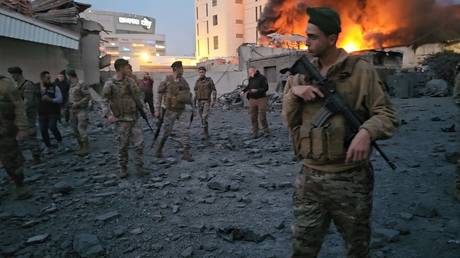
The headlines are screaming about shot-down fighter jets over Tehran. Media outlets are racing to confirm tail numbers and pilot identities, treating a tactical skirmish like it’s the opening scene of a 1990s technothriller. They want you to believe that "air superiority" is the metric that matters. They are wrong.
In modern asymmetric warfare, losing a $100 million aircraft is a PR disaster, but winning a dogfight is a strategic footnote. The obsession with kinetic kills in the sky ignores the cold reality of the 2020s: the most expensive hardware is often the most useless. In other news, read about: The Sabotage of the Sultans.
If Israel indeed downed an Iranian jet over its own capital, it isn't a sign of Iranian weakness. It’s a sign that the very concept of a "front line" has dissolved into a mess of electronic signatures and disposable attrition.
The Fallacy of the Kinetic Scorecard
Conventional news desks report on war like it’s a football match. One plane down? Goal for the away team. This is a fundamental misunderstanding of 21st-century escalation. The New York Times has provided coverage on this critical issue in extensive detail.
When a sophisticated air force penetrates the most heavily guarded airspace in the Middle East, they aren't there to rack up a kill count. They are there to test the "integration latency" of the enemy's sensor fusion. If an Iranian jet was intercepted, the real story isn't the explosion. The story is the data harvested in the seconds before the trigger pull.
I’ve watched defense contractors burn through billions trying to shave milliseconds off target acquisition. They call it "dominance." I call it a sunk cost. While the West polishes its F-35s, the rest of the world has realized that you don't need to win a dogfight if you can make the air too expensive to breathe.
Why Your "Air Superiority" Calculations are Obsolete
- The Cost Imbalance: A single interceptor missile can cost $2 million. A swarm of "suicide" drones costs $20,000. You can win every aerial engagement and still go bankrupt before the week is out.
- Sensor Saturation: In the Tehran theater, the noise is more important than the signal. By forcing an engagement, Israel isn't just "shooting down a plane." They are forcing the Iranian integrated air defense system (IADS) to scream its location to every satellite and ELINT (Electronic Intelligence) bird in orbit.
- The Martyrdom of Hardware: Iran doesn't need its air force to be good. It needs it to be a tripwire. Every time a legacy platform like an F-14 or a MiG-29 gets painted by a radar, it reveals the geometry of the attacker’s approach.
Stop Asking "Who Won the Fight?"
The "People Also Ask" section of your brain is likely stuck on: Can Iran retaliate? or Is Israel's Iron Dome enough? These are the wrong questions. The premise is flawed because it assumes a war of attrition that looks like 1967 or 1973. It won't.
The brutal honesty is that "retaliation" is now a continuous state of being, not a singular event. We are in a permanent loop of cyber-intrusions, maritime sabotage, and GPS spoofing. A jet falling over Tehran is a loud, shiny distraction from the silent war being fought in the fiber-optic cables and the shipping lanes of the Hormuz.
If you want to know who is winning, don't look at the wreckage in a field outside the city. Look at the insurance premiums for oil tankers. Look at the latency spikes in regional data centers. That is where the blood is actually being drawn.
The Logistics of a Ghost War
To understand the Tehran incident, you have to understand the math of the "Anti-Access/Area Denial" (A2/AD) bubble.
$$S = \frac{D \cdot R}{C}$$
In this simplified model, $S$ (Survivability) is a function of $D$ (Deception) and $R$ (Redundancy) divided by $C$ (Complexity).
The Israeli Air Force (IAF) operates at a level of complexity that is almost unsustainable. Every flight hour is a logistical nightmare of maintenance and proprietary software updates. Iran, conversely, thrives on low-fidelity redundancy. They aren't trying to build a better jet; they are trying to build a world where a better jet doesn't matter.
The Myth of the "Decisive Blow"
Military analysts love to talk about "decapitation strikes." They imagine a scenario where a surgical hit on a command center ends the conflict. This is a fantasy.
Modern command and control is decentralized by design. You can't decapitate a hydra. When a jet is downed over a capital city, it’s a theatrical performance for the domestic audience and the international press. It’s meant to project "control" when the reality on the ground is total chaos.
The High Price of Precision
We’ve been sold a lie that "smart" weapons make war cleaner. They don't. They just make the mistakes more expensive.
I’ve seen intelligence loops fail because the analysts were too focused on the "high-value target" and missed the 500 low-value threats moving in the shadow. Israel’s technical edge is undeniable, but it is also a golden cage. They are forced to play a perfect game. Iran only has to get lucky once.
- The Hubris of Stealth: Stealth isn't invisibility. It's a delay. Eventually, the physics of long-wave radar catch up.
- The Intelligence Trap: Believing your own propaganda about "surgical strikes" leads to strategic overreach.
- The Domestic Pressure: When you tell your people you have an "impenetrable" shield, any tiny crack becomes a political catastrophe.
The New Doctrine: Strategic Exhaustion
The status quo media wants you to focus on the "Live Updates." They want the adrenaline of the "breaking news" banner.
Ignore it.
The real conflict is a game of strategic exhaustion. The goal isn't to occupy Tehran or to "destroy" the IAF. The goal is to make the cost of maintaining the current posture so high that the social contract of the opponent snaps.
For Israel, that means a permanent state of mobilization that drains the economy and fractures the cabinet. For Iran, it means a tightening of the revolutionary grip that risks an internal explosion.
A jet being shot down is just a spark. The fuel is the economic and social fragility of two nations that have forgotten how to exist without an existential enemy.
If you are waiting for a "winner" to emerge from these updates, you will be waiting forever. There is no victory in a system designed for infinite friction. There is only the slow, grinding realization that the weapons we spent the last fifty years building are now the very things holding us hostage.
Stop watching the sky. The most dangerous threats aren't flying; they’re already inside the network.
Pack your bags and move your capital out of the line of fire. Because when the "impenetrable" air defense finally fails—and it will—no amount of "air superiority" is going to save the treasury from the bill.
The dogfight is dead. Long live the drone swarm.