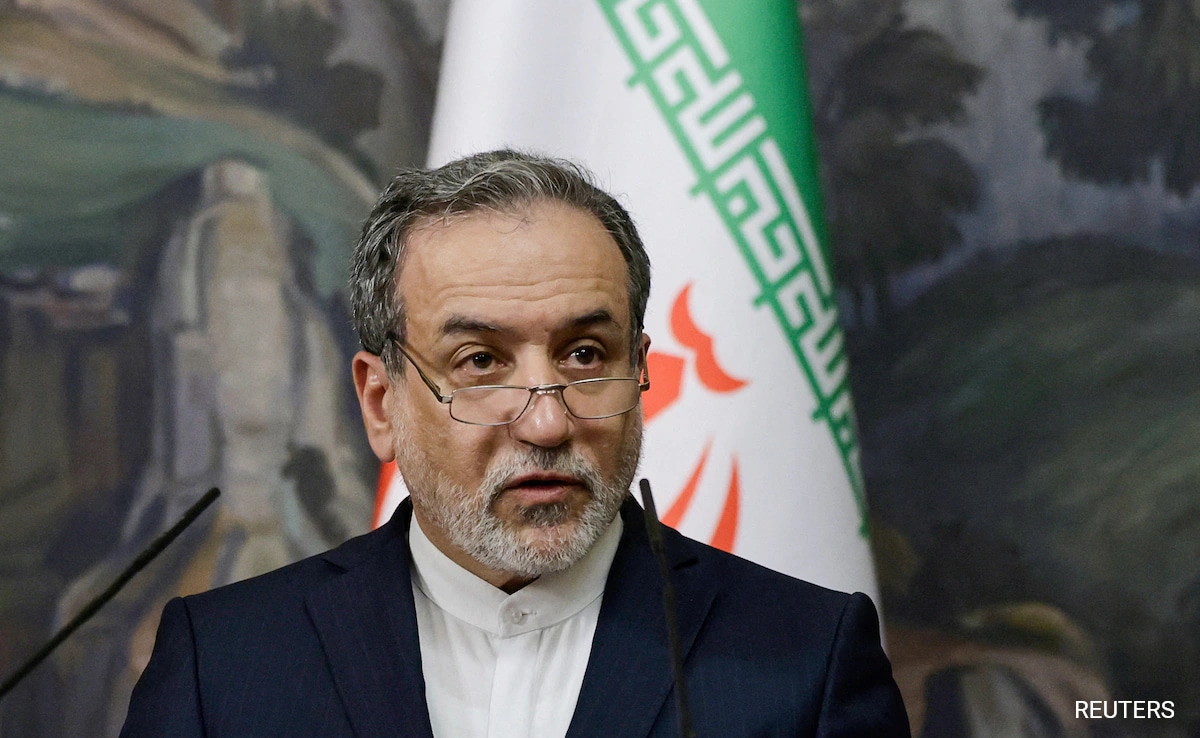
The international press is currently obsessed with a script that hasn't changed since 2003. When Iran's Foreign Minister stands before a microphone and claims their stance on nuclear weapon development is "unchanged," the media laps it up as either a comforting reassurance or a blatant lie. Both perspectives are wrong. They miss the mechanical reality of how regional power actually functions.
The "unchanged stance" refers to the 2003 fatwa by Supreme Leader Ali Khamenei, which supposedly forbids the production and use of nuclear weapons. Western analysts spend thousands of hours debating the sincerity of this religious decree. This is a massive waste of intellectual capital. In the world of high-stakes brinkmanship, sincerity is a luxury for the weak. For a state like Iran, the fatwa isn't a moral constraint; it’s a strategic asset that provides maximum maneuverability.
The Myth of the Binary Nuclear State
We need to stop talking about "The Bomb" as if it’s a light switch that is either on or off. The "lazy consensus" suggests that Iran is either a peaceful energy producer or a rogue state racing for a warhead. The reality is the Nuclear Threshold.
Being a "threshold state" means having every single component, every gram of enriched uranium, and every specialized trigger mechanism ready to go—without actually assembling them. Japan is the gold standard of this model. They could likely produce a weapon in weeks if the political will existed, yet they are technically a non-nuclear power.
Iran isn't trying to build a bomb to use it. They are building the capability to build a bomb to ensure they never have to.
When the Foreign Minister says their stance is unchanged, he is technically telling the truth. Their stance is to stay exactly at the threshold. Why? Because the moment you test a weapon, your leverage disappears. You go from being a "looming threat" that everyone must negotiate with to a "target" that must be neutralized or contained through total isolation.
Enrichment is the Only Metric That Matters
Forget the diplomatic rhetoric. If you want to know what’s happening, look at the centrifuges. Specifically, look at the jump from 3.67% enrichment (power plant grade) to 20% (medical isotopes) and finally to 60%.
The physics of uranium enrichment is counter-intuitive. Most people assume that going from 0% to 90% (weapons grade) is a linear path. It isn't. The vast majority of the "work" required to get to 90% is actually completed by the time you reach 20%.
$$W = m \cdot f(x)$$
Where $W$ represents the Separative Work Units (SWU) required. To get from 0% to 4%, you do about 70% of the work. To get from 20% to 90%, you are essentially doing a victory lap. By maintaining a stockpile of 60% enriched uranium, Iran has already crossed the technical rubicon. They are standing at the door with the key in the lock. Whether they turn that key is a political decision, not a technical one.
The Strategy of Managed Ambiguity
The competitor article treats the Foreign Minister’s statement as a static fact. It’s actually a dynamic shield. This is "Managed Ambiguity."
If Iran declared an intent to build a weapon, they would face immediate, kinetic intervention from Israel or the United States. If they completely dismantled their program, they would lose their only seat at the big-boy table and become another Libya—a country that gave up its WMD program only to see its leadership overthrown years later.
The "unchanged stance" is the perfect middle ground. It allows them to:
- Maintain Domestic Pride: The nuclear program is a symbol of scientific sovereignty.
- Pressure the West: "Fix the sanctions, or the 'unchanged stance' might... change."
- Deter Aggression: Every general in the Pentagon knows the breakout time is measured in days or weeks, not years.
I’ve seen analysts argue that the fatwa is a binding legal framework. That is remarkably naive. In the history of the Islamic Republic, "expediency" (Maslaha) always trumps traditional jurisprudence. If the survival of the state is at risk, the fatwa can be "reinterpreted" in an afternoon. To think otherwise is to fundamentally misunderstand the pragmatic core of Iranian statecraft.
Why "Breakout Time" is a Flawed Concept
The media loves the term "Breakout Time." They define it as the time needed to produce enough weapons-grade uranium for one nuclear device. But one device is useless. It’s a suicide note.
To have a credible deterrent, you need a triad or at least a survivable second-strike capability. You need miniaturized warheads that can fit on a Shabab-3 missile. You need heat shields that don't burn up upon re-entry.
The focus on enrichment levels is a distraction from the real bottleneck: Weaponization. This includes the complex electronics and the high-explosive lenses required to compress a core. This work can be done in small, nondescript labs that don't emit the radiation signatures of an enrichment plant. While the world watches the Natanz cooling towers, the real progress is happening in CAD software and metallurgy labs.
The Sanctions Paradox
We are told that sanctions are the tool to force a change in this "unchanged stance." In reality, sanctions have reached a point of diminishing returns.
When you isolate a country's economy for decades, you force it to develop a "Resistance Economy." Iran has become a master at illicit shipping, shadow banking, and bartering oil for Chinese technology. They have already paid the price of being a pariah. Why would they give up their only remaining leverage—the nuclear threshold—just for the hope of economic reintegration that can be snatched away by the next US election cycle?
The West keeps asking: "How do we stop them from getting the bomb?"
The wrong question.
The right question: "How do we live with a threshold state that has no intention of actually crossing the finish line?"
The Cost of the Status Quo
There is a downside to my contrarian view. If Iran remains at the threshold indefinitely, it triggers a regional arms race. Saudi Arabia has already signaled that if Iran gets the capability, they will follow suit. We are looking at a future where the Middle East isn't defined by a nuclear Iran, but by a "Latent Nuclear Middle East."
This isn't a failure of diplomacy. It’s the natural evolution of power in a multipolar world where the US security umbrella is viewed as increasingly leaky.
Stop reading the Foreign Minister’s lips. Start watching the enrichment cascades and the missile telemetry. The "unchanged stance" is a sophisticated ghost in the machine, designed to keep the world guessing while the concrete cures at Fordow.
The era of preventing nuclear proliferation in the Middle East is over. We are now in the era of managing nuclear proximity. Accept it.


