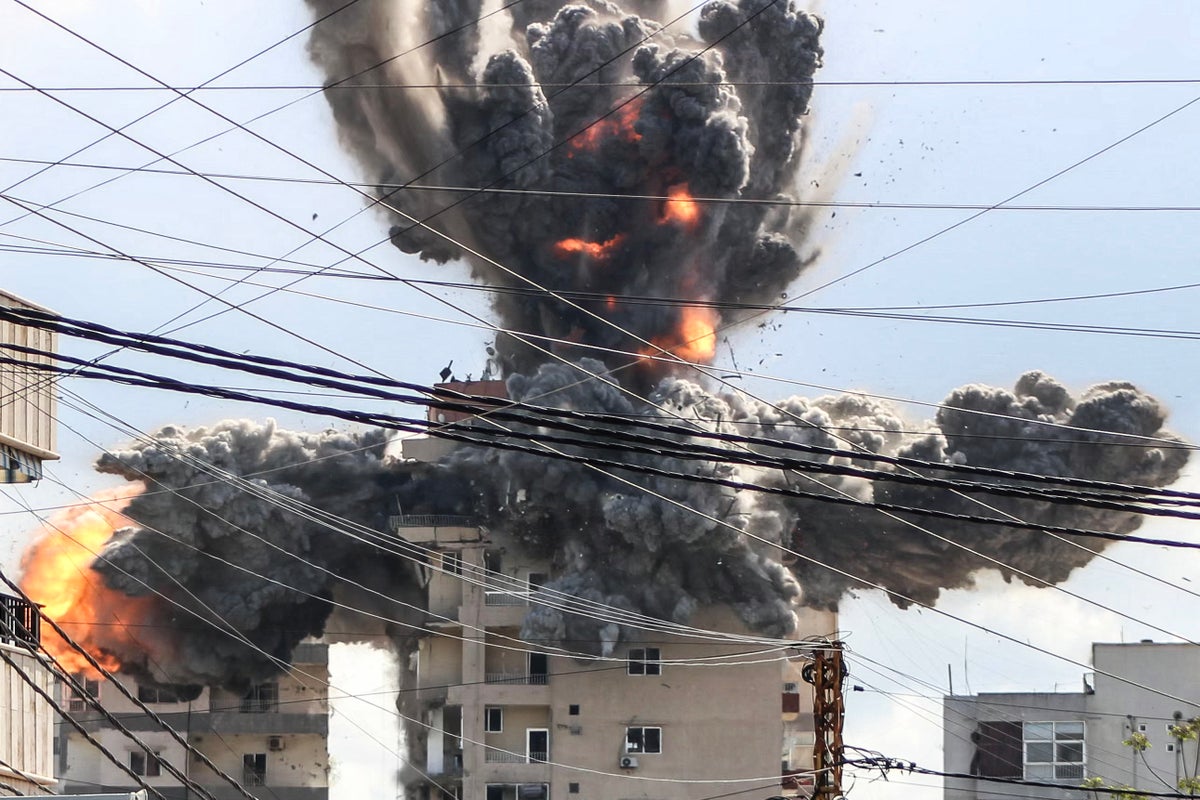
The coffee hadn't even gone cold. In the hills above Tyre and the sun-drenched stretches of the Bekaa Valley, Tuesday morning began with the mundane rhythms of a Mediterranean autumn. A shopkeeper unbolted a rusted metal shutter. A mother packed labneh sandwiches into a plastic lunchbox. The air held the scent of jasmine and car exhaust. Then, the sky tore open.
Military analysts often speak in the language of "surgical precision" and "strategic objectives." They use numbers to sanitize the chaos. But when 100 targets are hit in a single ten-minute window, the math stops being about strategy. It becomes a sensory overload that defies human comprehension. Imagine the sound of a heavy door slamming, then multiply it by a thousand, and place that sound inside your own chest.
Six hundred seconds.
That is all it took for the Israeli Air Force to rewrite the geography of Southern Lebanon. In the time it takes to boil an egg or scroll through a morning news feed, dozens of lives were extinguished, and the architectural skeleton of an entire region was fractured. This wasn't a slow build-up or a gradual escalation. It was a mechanical, high-speed erasure.
The Anatomy of the Blitz
To understand how a military executes a strike of this magnitude, you have to look past the smoke and into the software. This wasn't a series of pilots looking for movement on the ground. This was the culmination of months of "target bank" cultivation—a digital ledger of coordinates, heat signatures, and suspected weapon caches.
When the order came, the execution was less like a traditional dogfight and more like a synchronized orchestral performance, if the instruments were made of steel and fire. Jets didn't just fly; they swarmed. They occupied layers of the sky, dropping munitions that are designed to penetrate concrete before they ever think about exploding.
The Israeli Defense Forces (IDF) claimed the targets were launchers and infrastructure belonging to Hezbollah. From a tactical standpoint, the logic is cold and clear: if you hit everything at once, the enemy cannot react. They cannot move their missiles. They cannot find cover. Their command structure becomes a headless ghost.
But maps don't bleed. People do.
Consider a hypothetical man named Omar, a farmer who lives near the Litani River. He isn't a combatant. He doesn't hold a rank. But he lives in a village where, according to intelligence reports, a garage three houses down was being used to store medium-range rockets. When the "ten minutes" began, Omar wasn't thinking about regional hegemony or the shifting borders of the Middle East. He was thinking about the way his windows looked as they turned into a thousand glass needles. He was thinking about the weight of the ceiling.
The Weight of the Invisible
There is a specific kind of terror that comes from an invisible enemy. In modern warfare, the person pulling the trigger is often miles away, looking at a high-resolution screen in a climate-controlled room. They see pixels. They see heat blooms. They see the successful "neutralization" of a target.
On the ground, however, the experience is visceral. It’s the smell of pulverized limestone. It’s the sudden, jarring silence that follows a massive blast—a silence so thick it feels like cotton in your ears.
The death toll, which quickly climbed into the dozens, is a flickering number on a screen for most of the world. For the families in Lebanon, it is a permanent empty chair. It is a phone that rings and rings and is never answered. The "dozens" are not a statistic; they are a collection of unfinished stories. Teachers. Grandfathers. Children who were told that the noise was just thunder.
The tragedy of the Lebanese-Israeli border is that it has become a landscape of repetition. This is a soil that has been watered with blood for decades. Yet, this particular strike felt different. The sheer density of the violence—the 100-to-10 ratio—signals a shift from containment to something much more predatory.
The Geopolitical Ghost in the Room
Why now? Why with such Ferocity?
The answer lies in the crumbling walls of international deterrence. For months, the border has been a theater of "tit-for-tat." A rocket goes south; a drone goes north. It was a deadly dance, but it had a tempo. Tuesday broke that tempo. By compressing a massive amount of destruction into a tiny window of time, Israel sent a message that bypassed diplomats and went straight to the gut of their adversaries.
It was an attempt to shock the system.
But the "system" in Lebanon is not just a militant group. It is a country already reeling from economic collapse, a port explosion that leveled its capital years ago, and a political vacuum that has left its people adrift. When you strike 100 targets in ten minutes, you aren't just hitting a militia. You are hitting a fragile ecosystem. You are blowing out the power grids of hospitals. You are cratering the roads that ambulances need to travel.
The ripple effects of those ten minutes will last for ten years.
The Language of the Fallen
We often hear officials say that "every precaution was taken to avoid civilian casualties." It is a phrase used so often it has lost its meaning. In the density of Southern Lebanon, where villages and military assets are interwoven like the threads of a rug, "precaution" is a relative term.
When a 2,000-pound bomb hits a target in a residential neighborhood, the "collateral" is the story. It’s the schoolbooks covered in grey dust. It’s the stray cat wandering through a kitchen that no longer has a roof.
The invisible stakes are the psyche of a generation. What does a child become when their world can be unmade in the time it takes to watch a cartoon? They don't grow up thinking about peace; they grow up thinking about the sky. They learn to listen to the drone of an engine with a sophisticated, terrifying expertise. They learn that safety is a lie.
The conflict is often framed as a clash of ideologies or a battle for security. But at its core, it is a failure of imagination. It is the inability to see the person on the other side of the fence as someone who also wants to drink their coffee while it’s hot, who also wants to see their children grow old.
The Dust That Never Settles
As the sun set on Tuesday, the smoke began to clear, but the air remained heavy. In the ruins of the 100 targets, the recovery began. It is a slow, agonizing process. You don't just "clear" a site; you sift through it. You look for shoes. You look for IDs. You look for the pieces of a life that were scattered by a machine.
The world moves on quickly. The news cycle is a ravenous beast that demands fresh meat, and by tomorrow, there will be a new headline, a new crisis, a new set of numbers to digest. But for those in the Bekaa Valley, the clock is stuck.
They are still living in those ten minutes.
They are still waiting for the sound to stop.
The most haunting part of modern conflict isn't just the capacity for destruction; it is the efficiency of it. We have reached a point where we can destroy a century of history in the time it takes for a shadow to move across a courtyard. We have mastered the art of the strike, but we are no closer to the art of the peace.
Tonight, the moon will rise over the Mediterranean. It will shine on the white stone of the coastal cities and the jagged remains of the inland villages. It will look down on a border that is more than a line on a map—it is a wound that refuses to heal, a place where the air is thick with the ghosts of the "dozens," and where everyone is just waiting for the next ten minutes to begin.
The rubble is still warm.