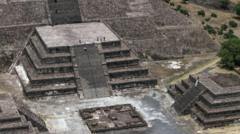
The headlines are doing exactly what they were designed to do: manufacture a narrative of exported American pathology. When a gunman opens fire at a world-class historical site like Teotihuacán, the immediate reaction from Mexican officials and the global press is to look for a convenient bogeyman. In this case, they found "material related to US mass shootings." It is a PR masterstroke that shifts the gaze away from local systemic failures and onto the messy, violent culture of the neighbor to the north. But this isn't about US gun culture. It is about a desperate attempt to protect a multi-billion dollar tourism industry by pretending the violence was an imported infection rather than a domestic reality.
The Myth of the Exported Manifest
The claim that a shooter carried "US-related material" is the oldest trick in the geopolitical playbook. It suggests a contagion theory of violence. If we can link a tragedy to a foreign ideology or a foreign trend, we can distance ourselves from the root causes. Mexican authorities are playing to a global audience that is already primed to believe that everything wrong with the world starts in a suburban American basement.
But look at the mechanics. Teotihuacán is one of the most heavily visited archaeological sites on the planet. The security apparatus required to manage those crowds is massive. If an individual can walk into the heart of the Sun and Moon pyramids with a weapon and high-capacity magazines, the failure isn't in what he read online—the failure is in the physical perimeter. Blaming American media influence is a convenient way to avoid discussing how a high-profile target was left vulnerable despite years of rising regional tension.
Tourism as a Shield for Incompetence
Mexico’s economy relies on the "Pueblos Mágicos" and the ancient ruins remaining pristine in the minds of Western travelers. The moment a site like Teotihuacán is categorized as "unsafe" due to internal instability, the revenue dries up. By framing the shooter as a radicalized outlier obsessed with American tragedies, officials maintain the illusion that the site itself is safe. They want you to believe this was a freak lightning strike from across the border, not a predictable result of porous security and local proliferation.
I have watched various governments try to sanitize crime scenes to protect their brand. In 2014, when violence flared in tourist corridors in other parts of the world, the script was identical: "This is an isolated incident influenced by foreign radicalization." It’s a lie. Violence is rarely isolated. It is a symptom of a localized breakdown in order. When you see officials highlighting the "American connection," you are watching a marketing department masquerade as a police force.
The Logistics of Fear
Let’s dismantle the logistics. The competitor reports focus on the content of the shooter's backpack. They talk about manifestos and digital footprints. This is a distraction. The only metric that matters is the access.
- The Screening Gap: How does a person with a rifle clear a checkpoint at a UNESCO World Heritage site?
- Response Time: How long did it take for armed guards—who are supposedly stationed throughout the park—to neutralize the threat?
- Intelligence Sharing: If this individual was "inspired" by US events, was there any cross-border communication regarding his behavior prior to the event?
The answer to these questions usually reveals a lack of funding, training, or will. Instead of answering them, we get a lecture on the dangers of American social media. It is a classic redirection.
The Data of Displacement
Data from the Global Terrorism Database and regional crime statistics show that while "copycat" behavior exists, it is almost always secondary to the availability of means. Mexico has some of the strictest gun laws in the world on paper. Yet, the black market is saturated. To blame a US manifesto for a shooting in Teotihuacán is like blaming a cookbook for a kitchen fire while ignoring the fact that the stove was leaking gas for a decade.
The "US Mass Shooting" narrative is a product that Mexico sells to the international community to keep the State Department travel advisories from turning red. If the violence is "American," then Mexico is a victim. If the violence is "Mexican," then Mexico is a failed state in the eyes of the traveler. They will choose the victim narrative every single time because it keeps the hotels full.
The Reality of Site Vulnerability
Archaeological sites are notoriously difficult to secure. They are vast, porous, and often located in areas where the central government's grip is loose. Teotihuacán covers roughly 83 square kilometers. The idea that a single gunman with a "US-inspired" motive is the primary threat is laughable. The real threat is the normalization of armed presence in these zones.
We see this in Egypt, in Greece, and across Latin America. Security theater—guards with rusted AK-47s and bored expressions—gives a false sense of security until someone decides to test the gates. When the gates fail, the officials don't fix the gates. They find a piece of paper in the shooter's pocket and hold a press conference about "foreign influences."
Stop Asking Why and Start Asking How
The media is obsessed with the why. Why did he do it? Why Teotihuacán? This is the wrong line of questioning. The why is for psychologists and talk show hosts. The only question that matters for the safety of the public and the integrity of the site is how.
- How did the weapon bypass the metal detectors?
- How did the shooter move through the Calzada de los Muertos without being intercepted?
- How did the authorities lose control of the narrative so quickly that they had to pivot to "American influence" within hours?
When you focus on the "US material," you are participating in a cover-up. You are helping the Mexican tourism board sweep the physical security failures under the rug of cultural critique.
The False Comfort of the Lone Wolf
Labeling this as a US-inspired event also allows for the "Lone Wolf" designation. This is the most dangerous term in modern security. It suggests that the person acted in a vacuum, fueled only by the internet. In reality, no one acts in a vacuum. There are supply lines, there are reconnaissance phases, and there are gaps in local law enforcement that are exploited.
By calling it a lone wolf incident inspired by foreign media, the government avoids having to investigate local complicity or negligence. It is the perfect crime for a bureaucracy that wants to stay blameless.
The Cost of the Cover-Up
The downside of my perspective is grim: if you accept that this wasn't just an "American import," you have to accept that one of the wonders of the world is inherently unsafe under current management. That is a hard pill for travelers to swallow. It’s much easier to believe that if we just fixed American internet culture, Teotihuacán would be safe again.
But truth isn't here to make you feel safe. Truth is here to show you the cracks in the foundation. The "American connection" is a ghost story told to keep the tourists from looking at the holes in the fence.
Identify the redirection. Reject the narrative that violence is a purely ideological export. Look at the perimeter. Look at the response. Look at the failure of the state to protect its own crown jewels. Everything else is just noise designed to keep you booking flights to a site that can't even secure its own entrance.
Fix the gates. Stop reading the manifestos.


