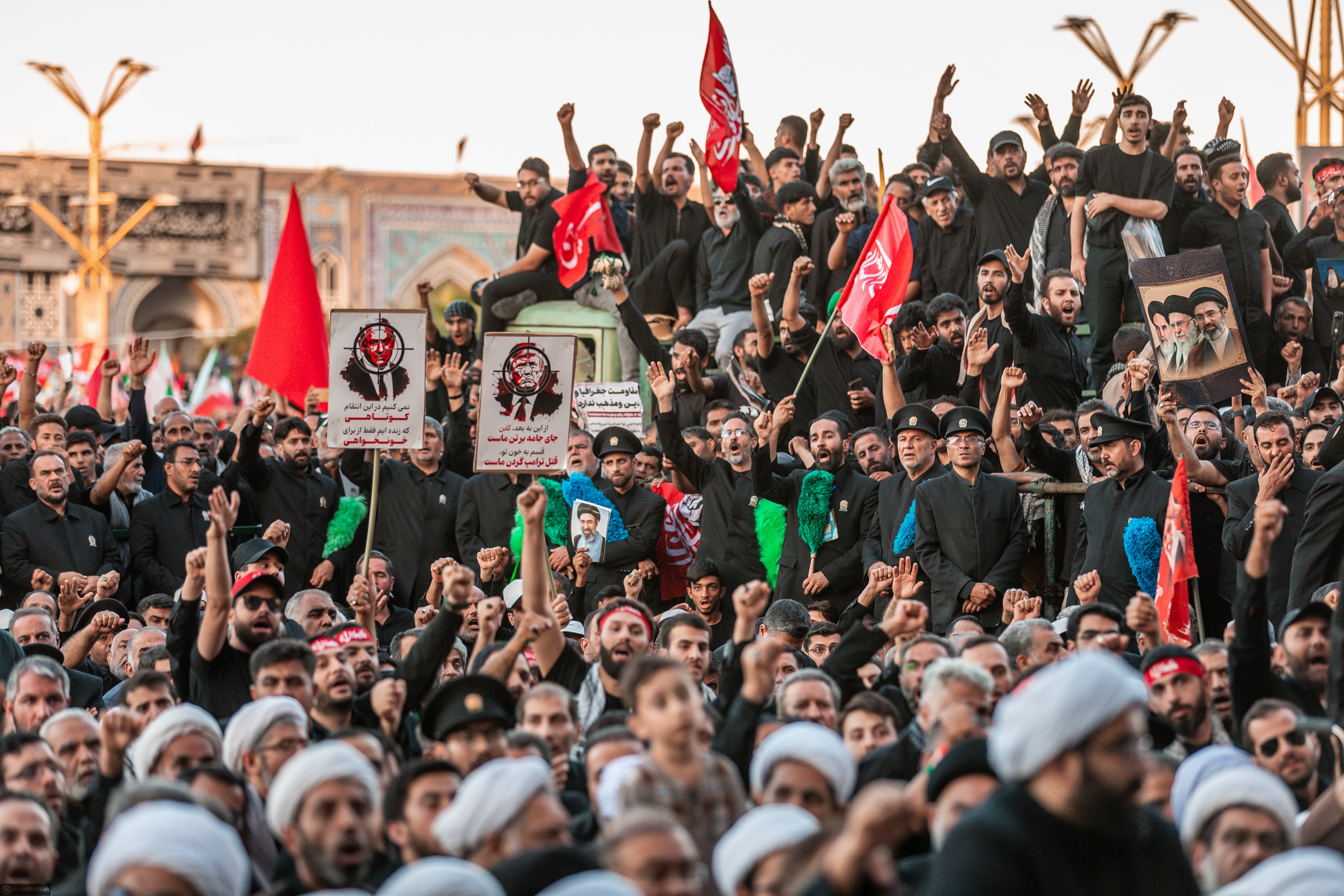
The air in Tehran during a state funeral does not move. It hangs. It is a thick, collective breath held by hundreds of thousands of people packed shoulder to shoulder, moving like a slow, black sea under a pale sky. When Ayatollah Ali Khamenei was laid to rest, the grief was not merely personal; it was institutional, heavy, and loud.
Then came the chant.
It started somewhere near the center of the procession, a rhythmic, guttural roar that quickly tore through the crowd. It was not a new phrase, but in the vacuum left by a dead leader, it carried a fresh, volatile weight. They called for the death of Donald Trump.
Thousands of miles away, across an ocean and a continent, that roar traveled in the span of a single heartbeat. It did not travel through diplomatic channels or official cables. It flashed onto a screen. A digital notification. A fragment of video capturing the raw fury of a grieving crowd.
The response was almost instantaneous. A counter-threat. A promise of total destruction if a single hair on an American head was touched.
This is how the world moves now. We live in an era where the distance between a chanted eulogy in the Middle East and the highest levels of American military power has shrunk to absolute zero. The guardrails are gone. The bureaucratic delays that once allowed hot heads to cool have been replaced by the instant friction of global communication.
The Anatomy of the Roar
To understand the stakes, look at a hypothetical shopkeeper in Tehran named Javad. He does not run the government. He does not command the Islamic Revolutionary Guard Corps. He sells saffron and tea in a cramped stall in the Grand Bazaar. For decades, the face of the Supreme Leader looked down from a framed photograph on his wall, a constant, unchanging fixture in a world of economic sanctions and shifting alliances.
When the leader dies, Javad’s world fractures. The funeral is not just a ceremony; it is a pressure cooker. When the speaker at the pulpit raises a microphone and invokes the name of the American president who ordered the assassination of Qasem Soleimani years prior, Javad joins the shout. He shouts from economic desperation. He shouts from a lifetime of state media. He shouts because everyone around him is shouting.
His voice is just one vibration in a massive wall of sound.
But when that sound is broadcast to the West, Javad’s individual nuance disappears. To the American administration, the crowd is not a complex collection of grieving, frightened, or angry individuals. It is a monolith. It is a direct, state-sanctioned threat from an adversarial superpower.
Consider what happens next.
The American president sits in an office surrounded by advisers. He sees the footage. He hears the explicit call for his assassination. In politics, weakness is a terminal diagnosis. To ignore a public threat chanted by hundreds of thousands of people at a state funeral is to invite domestic criticism and signal vulnerability to global rivals.
So, the finger hovers over the keyboard. The statement is drafted. It is sharp, uncompromising, and terrifyingly direct. If Iran takes a step toward fulfilling those chants, the response will be swift, devastating, and final.
The cycle completes itself in minutes. A chant in Tehran becomes a military warning from Washington. The spark has found its tinder.
The Illusion of Distance
We like to believe that geopolitics is a chess game played by rational actors who think three moves ahead. We comfort ourselves with the idea that there are rooms full of seasoned diplomats, historians, and analysts filtering every piece of intelligence before a decision is made.
That comfort is a lie.
The reality is far more fragile. The modern information ecosystem has democratized provocation. A single video clip, stripped of context, can dictate the foreign policy of the world’s most powerful military. The terrifying truth is that both sides are now reacting to the optics of the situation rather than the underlying reality.
Think about the sheer logistics of the escalation. In the past, if a foreign crowd threatened a leader, the news would take hours to reach a desk. It would be summarized in a briefing memo. The memo would be vetted. A measured statement would be issued the following morning.
Today, the president sees the crowd at the exact same moment as a teenager scrolling through social media in Ohio. The emotional impact is raw. It bypasses the intellect. It demands an immediate, visceral reaction to satisfy a political base that thrives on strength and retaliation.
The danger lies in the miscalculation.
When Washington threatens total destruction, the new leadership in Tehran cannot afford to look intimidated either. They are trying to solidify their grip on power in the wake of a massive transition. They must project absolute defiance to keep their own hardliners in check.
Each side reads the other’s posturing not as political theater, but as a literal declaration of intent.
The Cost of the Last Word
The rhetoric escalates, but the people who pay the price are never the ones writing the statements or leading the chants.
Back in the Grand Bazaar, Javad watches the news on a small television. The American threat flashes across the screen. The currency drops another few percentage points against the dollar within an hour. The price of wholesale goods spikes. The fear of a sudden airstrike settles into the bones of every ordinary citizen who is just trying to survive the week.
In America, service members look at their phones and wonder if a sudden deployment order is coming. Families wait. The tension stretches across the globe, thin and taut as a piano wire.
It is easy to analyze these events from a cold, analytical perspective. We can talk about deterrence theory, regional hegemony, and diplomatic leverage. We can treat the whole affair as a standard news cycle that will be forgotten when the next headline breaks.
But doing so ignores the human cost of living in a perpetual state of hair-trigger readiness. When the rhetoric becomes this volatile, the margin for error drops to nothing. A technical glitch, a misunderstood naval maneuver in the Persian Gulf, or an overzealous local commander could turn a war of words into a catastrophic kinetic conflict before anyone has the chance to clarify what they actually meant.
The funeral in Tehran has ended. The body is in the earth. The crowds have dispersed back into their daily lives, back to the mundane struggles of work, family, and survival.
Yet, the words spoken there remain airborne, circling the globe, waiting for the next reaction. The world watches the screens, holding its collective breath, hoping that the next notification isn't the one that finally sets the sky on fire.