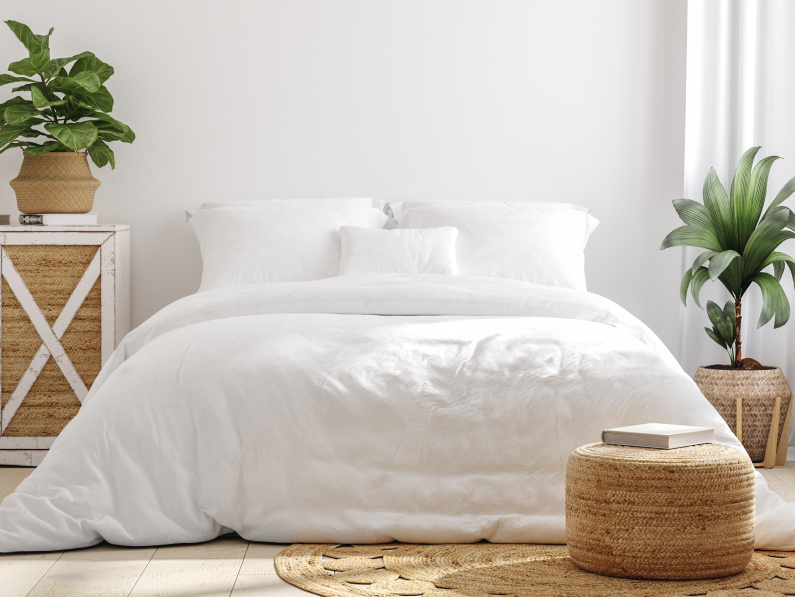
Selecting a duvet for a Canadian bedroom is fundamentally an exercise in microclimate management under variable boundary conditions. The canonical Canadian sleep environment is defined by broad seasonal swings—often ranging from sub-zero winter exterior temperatures with aggressive forced-air heating to humid, unconditioned summer nights. Most consumers approach duvet acquisition through heuristics like weight or price, which systematically fail because they ignore the primary physical variable: thermal resistance, measured in togs or clo units, interacting with local ambient humidity and individual metabolic heat output.
The Thermodynamic Taxonomy of Fill Materials
Thermal performance is a direct function of trapped air volume per unit weight, commonly referred to as loft. The material choice dictates the ceiling of efficiency, durability, and moisture regulation.
Down, sourced primarily from the under-plumage of ducks or geese, represents the benchmark for loft-to-weight efficiency. The three-dimensional clusters branch outward, creating microscopic air pockets that restrict convective heat loss. Quality is measured by fill power, which quantifies the volume in cubic inches occupied by one ounce of down. A fill power of 400 indicates low-density clusters with trapped air pockets prone to collapse under pressure, whereas a rating of 800 or higher denotes mature clusters with superior resilience and insulation density. The structural limitation of down is its vulnerability to moisture; when exposed to sweat accumulation without adequate vapor permeability, the clusters clump, destroying the loft and neutralizing its thermal value.
Synthetic alternatives, typically structured from polyester microfibers, attempt to mimic down architecture at a lower cost threshold. While modern siliconized microfibers approach the initial tactile softness of natural down, they lack the structural memory of organic keratin. Synthetic fibers compress over time under routine laundering and body weight, leading to progressive thermal degradation within eighteen to thirty-six months. Their primary advantage lies in moisture management behavior under specific chemical treatments, maintaining structural integrity when wet, though their overall vapor transmission rate remains inferior to natural fibers.
Wool occupies an entirely separate functional category, acting as an active thermal regulator rather than a passive insulator. The protein structure of wool fibers features a crimped architecture that traps air while possessing hygroscopic properties. Wool can absorb up to thirty percent of its weight in moisture vapor without feeling damp to the touch, releasing that moisture through a process of heat-of-sorption. For Canadian sleepers dealing with nocturnal perspiration caused by heavy insulation, wool prevents the microclimate from reaching the dew point, eliminating the clammy sensation common with synthetics.
Feather-down blends introduce rigid quill structures into the fill matrix. While lowering the cost per unit, the quills reduce loft efficiency, add dead weight, and frequently migrate through fabric casings, puncturing the shell and degrading the structural enclosure. High-performance sleep configurations eliminate feather blends entirely, forcing a binary choice between pure high-fill-power down, high-grade synthetic microfibers, or active wool batting.
Construction Geometries and Cold Spot Mitigation
The internal architecture of a duvet casing dictates how effectively the fill material maintains uniform distribution. Poorly constructed shells allow fill to migrate, creating localized voids where thermal resistance drops to zero.
The traditional stitch-through construction, where top and bottom fabrics are sewn together directly, creates compression channels known as cold spots. Along these stitched lines, the insulation thickness approaches zero, allowing convective currents to bleed heat rapidly from the body. This geometry is acceptable only for low-insulation summer weights where thermal retention is intentionally minimized.
Baffle-box construction resolves this structural flaw by incorporating vertical fabric walls between the top and bottom layers of the shell. These internal walls create discrete cubic compartments that trap the fill in place while allowing it to expand to its maximum loft. The height of the baffle directly determines the maximum potential thickness of the thermal barrier. Premium winter-grade duvets utilize baffle heights of two to three inches, ensuring that the insulation layer remains uniform across the entire surface area of the bed, regardless of tossing, turning, or gravity-induced shifting.
Channel weaving represents an intermediate approach, featuring vertical walls that run the entire length of the duvet. While superior to stitch-through designs, channel construction permits fill to migrate from the foot of the bed to the head over extended periods of use, requiring manual redistribution by the user.
Environmental Variables and Regional Calibration
Canadian residential microclimates vary wildly based on geographic location and building age. A home in a poorly insulated Victorian-era heritage house in Montreal requires a radically different thermal coefficient than a tightly sealed condominium in downtown Vancouver equipped with centralized, climate-controlled heat pumps.
The metric of thermal resistance must be evaluated against ambient bedroom temperature rather than outdoor weather reports. The optimal thermal zone for human sleep sits between 16 and 19 degrees Celsius. When indoor heating drops the bedroom ambient temperature toward the lower bound, a high-loft down duvet with a rating equivalent to 10 to 13 togs is required to maintain skin temperature equilibrium.
Conversely, modern urban apartments frequently maintain ambient winter temperatures above 21 degrees Celsius due to aggressive vertical stack heating. Deploying a heavy winter-weight duvet in these environments triggers excessive vasodilation and sweating. The body attempts to dump core heat, but the high thermal resistance traps the moisture, raising relative humidity inside the sleep microclimate and inducing micro-awakenings. In these conditions, a lightweight down or structured wool duvet with lower thermal resistance prevents overheating while maintaining the tactile weight comfort many sleepers psychologically require.
Maintenance Economics and Degradation Vectors
The total cost of ownership for a duvet is dictated by its degradation rate and cleaning protocol requirements. Natural fill products, when protected by high-thread-count down-proof cotton shells and removable duvet covers, exhibit remarkable longevity, frequently lasting between ten and fifteen years. However, improper washing—specifically exposure to high heat during drying—strips the natural oils from down clusters, rendering them brittle and prone to structural failure.
Synthetic duvets have a compressed lifecycle. The mechanical stress of washing causes the microfibers to mat and tangle, permanently reducing loft. Even without washing, body oils and compression forces degrade synthetic resilience within three to five years, necessitating complete replacement.
The outer shell material acts as the first line of defense against both fill migration and particulate infiltration, such as dust mites and skin dander. High-density down-proof cotton, woven with a thread count exceeding 300 using fine-gauge single-ply yarns, prevents down clusters from escaping while remaining breathable. Lower-quality shells often utilize thick multi-ply yarns that increase fabric weight and reduce vapor permeability, trapping body moisture inside the fill matrix regardless of how breathable the internal material claims to be.
Strategic Procurement Framework
To optimize a sleep system for Canadian conditions, evaluate the purchase through three distinct operational constraints:
Establish the baseline ambient temperature of the bedroom during the coldest operational month, ensuring measurements reflect the room condition rather than the thermostat setting in the hallway.
Calculate personal metabolic output and moisture generation. Sleepers who run hot require hygroscopic materials like wool or low-loft synthetic blends to manage vapor transmission, whereas cold sleepers require high-fill-power down to maximize trapped air volume.
Select construction geometry based on maintenance tolerance and durability targets, prioritizing baffle-box architecture over stitch-through designs to eliminate thermal bridging and ensure long-term insulation uniformity.
Source dual-season configurations—consisting of a lightweight summer duvet and a medium-weight spring/fall duvet that can be tethered together via corner loops—to handle the extreme seasonal delta characteristic of Canadian residential architecture without requiring multiple standalone storage units.