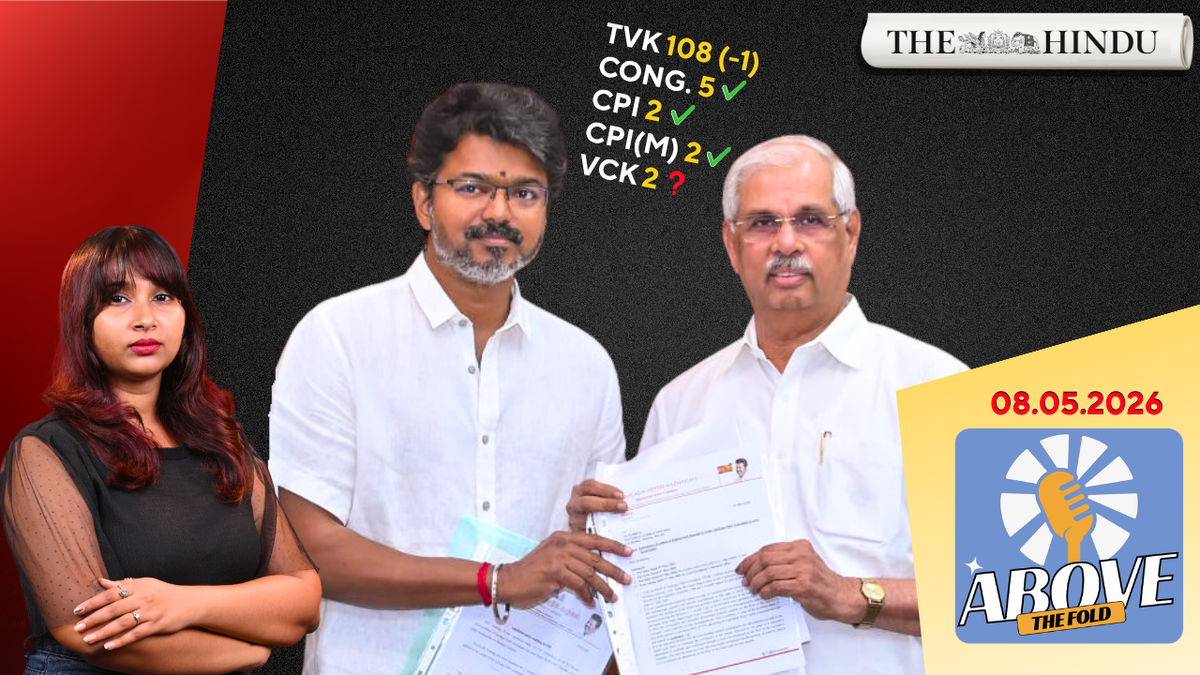
The heavy brass doors of the Raj Bhavan don’t swing open for everyone, and they certainly don't usually open three times in quick succession for the same man unless the very foundations of the state are shifting. On May 8, 2026, the air in the coastal breeze felt thick, humid, and expectant. Vijay walked up those steps again. To the casual observer, it was a meeting between a leader and Governor Rajendra Arlekar. To those watching the tea stalls, the factory floors, and the digital pulse of the city, it was the sound of a closing trap.
Power in its rawest form isn't found in the polished wood of a Governor’s office. It’s found in the friction between ideologies that usually refuse to touch. When the CPI and CPI(M) threw their weight behind Vijay, the political physics of the region changed. You could almost hear the collective intake of breath from the establishment. The Left doesn't just "support" people; they provide a structural spine to a movement that, until recently, many dismissed as a mere personality cult or a fleeting cinematic ambition. You might also find this similar article interesting: The Lipulekh Tri-Junction Analysis Strategic Deadlock and the Geopolitical Cost of Cartographic Sovereignty.
Consider the old man sitting at a bench in a public square, his fingers stained with newsprint. He remembers the strikes of the eighties. He remembers when the red flag meant something more than a protest—it meant a seat at the table. For him, seeing these veteran organizations align with a modern juggernaut like Vijay isn't just news. It’s a resurrection.
The numbers tell a story, but the optics scream it. This third meeting wasn't a courtesy call. You don't go back a third time to discuss the weather or the local cuisine. You go back because the leverage has changed. Every time a major ideological bloc signs on, the man walking into that office carries more "ghost votes" with him—the people who don't post on social media but follow the instructions of their local union leaders with religious fervor. As reported in detailed reports by TIME, the effects are widespread.
Politics is often described as a game of chess, but that’s too clean. It’s more like a construction site in a storm. You’re trying to build something permanent while the wind tries to rip the tools out of your hands. By securing the CPI and CPI(M) backing, Vijay didn't just add numbers. He bought the scaffolding. He gained the street-level machinery that knows how to turn a feeling into a vote.
The Governor sits behind a desk that has seen a century of transitions. He represents the constitutional anchor. Vijay represents the tide. When the tide hits the anchor three times in a row, the anchor starts to feel the pressure of the ocean behind it. The conversation in that room likely wasn't about the present, but about the inevitable friction of the coming weeks.
What does a third meeting mean for the person who just wants their electricity to stay on or their children to have a job? It means the stalemate is breaking. We often view these high-level summits as distant dramas, but they are the blueprints for our daily lives. If this alliance holds, the legislative floor will no longer be a place of easy majorities. It will be a battlefield where every inch of ground is contested by a newly unified front.
The stakes are invisible until they aren't. They are invisible when you’re scrolling through a headline about "Governor Arlekar" and "Vijay." They become visible when the policies discussed in those quiet rooms translate into the price of grain or the freedom to speak in the town square. The Left’s entry into this specific camp provides a secular, grassroots legitimacy that a solo act simply cannot manufacture. It’s the difference between a soloist and an orchestra.
There is a specific kind of silence that falls over a city when it knows a major announcement is looming. It’s not a peaceful silence; it’s the silence of a held breath. Outside the Raj Bhavan, the cameras were perched like vultures on a fence, waiting for a scrap of a quote or a specific tilt of the head. But the real story wasn't in what Vijay said to the microphones. It was in the fact that he was there at all, backed by the very people who usually spend their time fighting the kind of stardom he represents.
The friction is the point. The Left and the modern populist movement are strange bedfellows, but in the heat of a 2026 political summer, necessity burns away the old grudges. They need his reach; he needs their discipline. Together, they form a gravity well that is pulling in every undecided voter and every wavering official in the state.
If you look closely at the footage of that afternoon, you see more than just a politician. You see the embodiment of a new math. 1+1 doesn't equal 2 in politics; it equals a momentum that defies simple addition. The support of the CPI and CPI(M) acted as a catalyst, turning a series of meetings into a sustained siege of the status quo.
The sun began to set over the governor's residence, casting long, distorted shadows across the lawn. Those shadows reached out toward the gates, toward the people waiting for a sign. The third meeting ended as the first two did—with a dignified exit and a flurry of speculation—but the air felt different this time. The weight of the endorsement was palpable. It was no longer a question of if the political landscape would change, but how much of the old world would be left standing when the dust finally settled.
He walked down the steps, not as a man seeking permission, but as a man reporting a new reality. The brass doors closed, but the click of the lock sounded less like an end and more like the cocking of a hammer. The streets were still waiting, the flags were being readied, and the third staircase had been climbed. There are no more courtesy calls left to make.