Dust tastes like old pennies and crushed stone.
If you have never swallowed it, you do not know how quickly it coats the tongue, turning saliva into paste, sealing the mouth shut. It is the taste of a world ending in a fraction of a second. One moment, there is the ordinary friction of a Tuesday—the clatter of a coffee cup, the hum of a distant radio, the mundane security of four walls and a floor that stays stubbornly beneath your feet. The next moment, the sky falls.
Then, silence.
Not peace. Just the absence of everything you knew.
The Weight of the Earth
In Colombia, the earth does not merely shift; it awakens. When tectonic plates lock, strain, and finally tear, they release an energy that human architecture is woefully unprepared to negotiate. Concrete shatters like dry biscuit. Rebar twists into agonized, metallic knots.
Imagine, just for a brief, terrifying second, standing in your living room as the floor drops three inches, then five, then vanishes entirely. Gravity takes over. You fall, tumbling through a descending avalanche of your own belongings, until the chaos stops and settles into a crushing, suffocating stillness.
Thirty-six hours.
Try holding your breath for sixty seconds. Your chest burns. Panic claws at your throat. Your brain screams for oxygen. Now, multiply that panic by two thousand one hundred and sixty minutes.
That is how long a woman lay trapped beneath the rubble after a devastating tremor struck Colombia. Thirty-six hours of darkness so complete it feels tangible, heavy, and wet against the eyelids. Thirty-six hours of wondering if the sky still exists, or if the sun has burned out forever.
Rescue workers call this the golden window, though there is nothing golden about it. It is a grim countdown written in chalk on the side of triage tents. After seventy-two hours, the odds of pulling someone out alive plummet into statistical despair. Dehydration claims kidneys. Crush syndrome poisons the blood the moment a fallen beam is lifted. But thirty-six hours? Thirty-six hours is a battleground between biology and gravity.
The Anatomy of a Miracle
From the outside, a disaster zone looks like a jagged moonscape of gray ash. Bulldozers roar. Sirens slice the humid air into frantic ribbons. Dogs strain against leather leashes, noses twitching as they sample the wind for the faint, unmistakable scent of human warmth beneath the ruins.
To the untrained eye, it is hopeless. How do you find a single heartbeat in a mountain of pulverized history?
You listen.
In the hours following the quake, rescue teams operating in the affected Colombian regions did not rely solely on heavy machinery. Heavy machinery is a blunt instrument, good for moving mountains, terrible for saving lives. Instead, they relied on acoustic sensors, thermal cameras, and, above all, quiet.
Absolute, pin-drop silence.
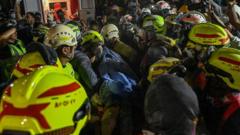
Rescue commanders will tell you that the most valuable tool in an earthquake zone is a pair of ears. Every twenty minutes, the cacophony stops. The diesel engines die. The shouting ceases. Hundreds of rescue personnel freeze in place, holding their breath, turning their faces toward the jagged ruins. They listen for a tap. A scratch. A cough. Anything that proves the concrete still holds a soul.
Down in the dark, thirty-six hours deep, our hypothetical protagonist—let us call her Luz, because the name means light, and light is the only thing she cannot see—does not know about the tactical pauses. She only knows the rhythm of her own terror.
At first, she screamed. Her voice tore against the dust until her throat was raw, bleeding iron. No one answered. The sound swallowed itself, absorbed by feet of compressed masonry. She learned quickly: screaming wastes air. Screaming burns precious moisture.
So she stopped. She listened instead.
She heard the deep, low groan of the shifting debris above her. Every time an aftershock rolled through the hills, the ceiling of her micro-cave settled another inch. Dust sifted down into her hair, filling her eyes, stinging her skin. She curled tighter into herself, pressing her knees to her chest, carving out a pocket of air no larger than a breadbox.
Human resilience is an inconvenient, stubborn thing. When stripped of comfort, status, technology, and safety, the human animal retreats into a primal, unyielding stubbornness. We do not want to die. Even in the pitch black, with bruised ribs and a leg pinned beneath a collapsed wardrobe, the spine stiffens. The heart keeps beating, thump-thumping a stubborn rhythm against the ribs, refusing to surrender its lease on the morning.
The Edge of the Blade
In the twenty-fourth hour, despair becomes a physical weight. It sits on the chest, heavier than the concrete.
Luz began to bargain with the dark. She thought of her mother's kitchen, of the sharp, sweet smell of ripe plantains frying in oil, of the chatter of cousins on a Sunday afternoon. Memories became a lifeline, a warm hearth built entirely out of thought. If she could remember the exact shade of blue on her childhood bedroom wall, she could keep the terror at bay for another ten minutes.
Above ground, the rescue teams were facing a different kind of torture.
Exhaustion blurs the edges of reality. By the second night, rescue workers had been digging with bare hands, trowels, and small saws for over thirty hours straight. Fingernails were worn to the quick, caked in dried blood and gray silt. Men and women who had not slept wept openly into their dust masks, trading shifts only when their muscles gave out entirely.
This is the hidden cost of disasters. We measure them in property damage, in insured losses, in the cold statistics of magnitude scales. We forget the psychological shrapnel embedded in the minds of those who pull the living from the dead.
Consider what happens next: the moment a metal rod is finally cut, when a shaft of raw, unfiltered sunlight pierces the abyss for the first time in a day and a half.
A cheer went up. Not a celebratory cheer, but a ragged, sobbing roar that echoed across the valley.
They found a pocket. Or rather, the pocket found them.
A rescue dog had locked onto a scent near a crushed staircase. Hand-digging commenced. Inch by agonizing inch, rescue workers scooped away the pulverized brick. They uncovered a hand. Gray with ash, bruised purple at the knuckles, but warm.
When the rescue worker touched those fingers, a reflex older than language took over. The hand squeezed back.
The Return
Extricating someone from a crush injury is a race against biology. When heavy weight compresses limbs, toxins build up in the trapped tissue. Release that pressure too fast, and a flood of potassium and myoglobin rushes into the bloodstream, stopping the heart instantly.
Medics slid into the narrow crawlspace, administering intravenous fluids while the concrete was still being chipped away around her trapped leg. Every movement was calculated, precise, agonizingly slow.
Thirty-six hours.
When Luz finally emerged into the blinding glare of the Colombian sun, she did not look like a survivor from a movie. She looked like a ghost dragged back into the land of the living. Her clothes were shredded and stiff with dust. Her eyes squinted against the light, weeping tears that cut clean tracks through the gray grime on her cheeks.
Paramedics threw a thermal blanket over her shoulders. Someone pressed a cup of water to her cracked lips.
She did not speak. She simply breathed.
Thousands of miles away, on a glowing screen, a dry news headline registered the event as a brief statistic. One life saved out of hundreds affected. A footnote in a global ledger of catastrophe.
But down there in the dark, beneath the weight of an indifferent earth, an entire universe had been rescued from extinction. The sun still rises over the Andes. The coffee shops open their shutters. The world spins on, heedless and indifferent.
Yet somewhere in that valley, a woman is learning how to swallow air that doesn't taste like dust, taking her first shaky steps into a morning she was never supposed to see.