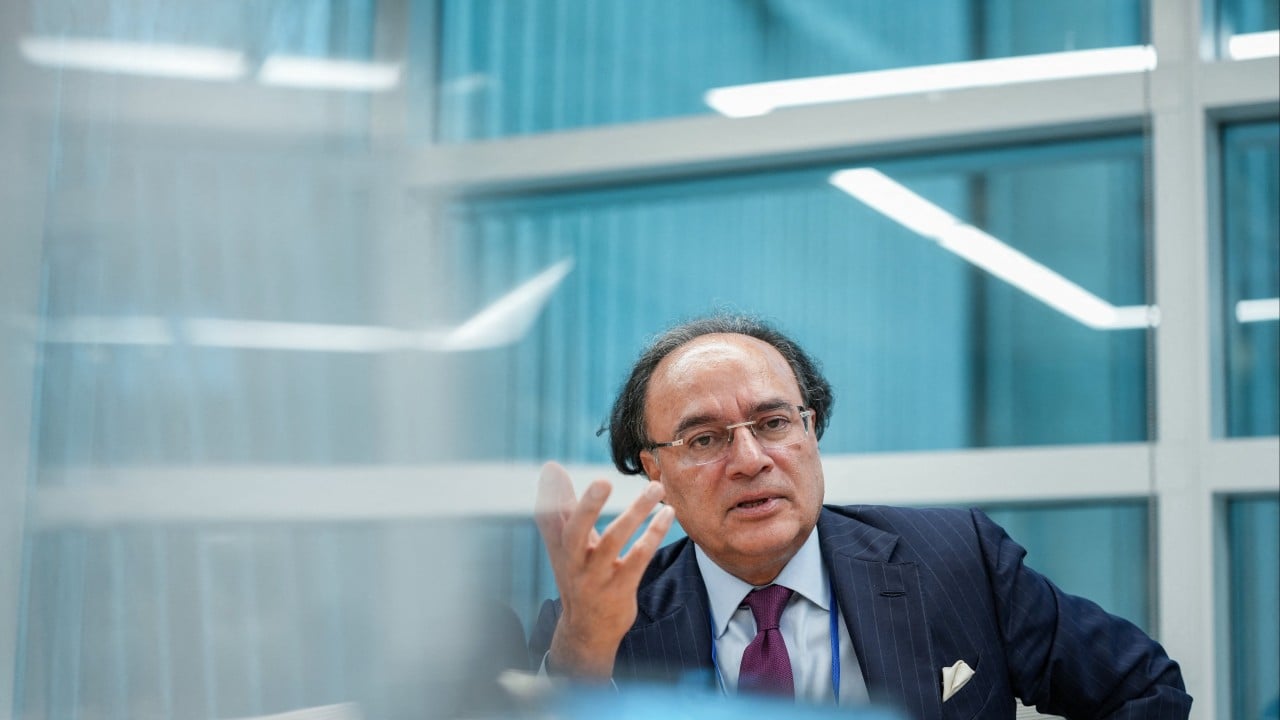
The ink on a billion-dollar loan agreement doesn’t just represent currency. It represents time. For a finance minister in Islamabad, that time is measured in the rhythmic ticking of a clock that everyone in the room can hear, even if no one mentions it. When Finance Minister Muhammad Aurangzeb recently reaffirmed Pakistan’s commitment to repaying a US$3 billion loan to the United Arab Emirates, he wasn't just citing a line item in a ledger. He was describing the pulse of a nation trying to find its footing on shifting sands.
To understand the scale of this, stop thinking about macroeconomics for a second. Think about a bridge.
The Invisible Infrastructure of Trust
Imagine a small-scale farmer in the Punjab province. He doesn't know the specifics of the UAE’s deposit at the State Bank of Pakistan. He doesn't track the fluctuations of the foreign exchange reserves. But he feels the result of those numbers every time he buys fertilizer or pays his electricity bill. When the national coffers are dry, the currency shivers. When the currency shivers, the price of his life goes up.
The US$3 billion from the UAE acts as a structural beam for that bridge. It isn't money meant to be spent on flashy projects or new highways. It is "buffer" money. It sits in the central bank, providing the psychological and fiscal weight necessary to keep the Pakistani Rupee from spinning into a void. Without it, the bridge sways. With it, the farmer has a fighting chance at a stable season.
Minister Aurangzeb’s public declaration of "commitment" is more than a polite nod to a Gulf ally. It is a signal to the world's markets that the bridge is being reinforced. Pakistan is currently navigating a complex dance with the International Monetary Fund (IMF), and the IMF does not like surprises. They want to see that old debts are acknowledged before new lifelines are extended. By stating clearly that the UAE debt will be honored, the government is essentially proving its character to the global neighborhood.
The Mathematics of Sovereignty
Debt is a heavy word. In common parlance, we view it as a failure. In the world of developing nations, however, debt is often the only tool available to carve out a future.
Pakistan’s economic story over the last few years has been one of survival. The country has faced a trifecta of pressures: the lingering aftershocks of catastrophic flooding, a global energy crisis that sent import costs screaming upward, and internal political transitions that made long-term planning feel like a luxury.
When the UAE deposited that US$3 billion, they weren't just acting as a bank. They were acting as a stabilizer. This type of bilateral support is rooted in a long history of "brotherly relations," a term often used in diplomatic circles that translates to a very real, very high-stakes friendship. But even the best of friends eventually expect their ledger to balance.
The challenge lies in the "how."
How does a country with a narrowing tax base and rising inflation find the surplus to hand back three billion dollars? It involves a surgical approach to the budget. It means privatizing state-owned enterprises that have been bleeding cash for decades. It means reforming an energy sector that loses billions to "line losses" and theft.
The Human Cost of a Balanced Ledger
Consider a hypothetical teacher in Karachi named Ayesha. She represents the human element of these high-level negotiations. When the government commits to repaying massive international loans, it often has to pull back on subsidies. Ayesha sees this in the price of petrol. She sees it in the rising cost of the flour she buys for her children.
For Ayesha, the "commitment to repay" sounds like an abstract victory for the state, but it feels like a tightening of the belt at home. This is the paradox of national recovery. To reach a place of long-term stability—where the country isn't constantly asking for extensions or roll-overs—the population has to endure a period of intense friction.
Minister Aurangzeb’s confidence stems from a belief that this friction is leading somewhere. The recent narrowing of the current account deficit and a slight uptick in exports suggest that the gears are finally starting to catch. But gears need grease. The UAE’s US$3 billion is that grease. It prevents the engine from seizing while the mechanics—the policymakers—try to fix the internal combustion.
Beyond the Rollover Culture
For years, Pakistan’s strategy was the "rollover." A loan would come due, and the government would ask the lender to simply extend the deadline. It was a cycle of kicking the can down a road that was rapidly running out of pavement.
The tone shift in recent months suggests that the "can-kicking" era is nearing its end. By speaking of repayment rather than just another extension, there is an attempt to change the national brand. Pakistan wants to be seen not as a perpetual borrower in crisis, but as a sovereign partner meeting its obligations.
This isn't just about pride. It’s about the interest rate.
When a country is seen as a "risky" borrower, everything it does becomes more expensive. If you are viewed as someone who might not pay back a loan, the next person who lends to you will charge you a premium for that risk. By honoring the UAE debt, Pakistan is effectively lowering its own future costs. It is buying back its reputation, one billion at a time.
The Gulf Connection
The relationship between the UAE and Pakistan is deeper than a simple transaction. Millions of Pakistanis live and work in the Emirates, sending back remittances that form the backbone of the country’s foreign exchange inflows. This human bridge is as important as the financial one.
When the UAE supports Pakistan, they are supporting the home country of a significant portion of their own workforce. It is an ecosystem of mutual dependence. However, the UAE is also evolving. They are moving toward an investment-based model rather than just a "grant and deposit" model. They don't just want to lend money; they want to buy into the future of Pakistani ports, mines, and energy grids.
The repayment of the US$3 billion is the ante. It’s what Pakistan pays to stay at the table for much larger, more transformative investment deals.
The Weight of the Silence
In the quiet offices of the Finance Ministry, the maps on the wall aren't just geographical; they are chronological. They show when every debt is due, when every bond matures, and when every grace period ends.
To the casual observer, a minister saying a country is "committed" to a debt sounds like a platitude. It sounds like something they have to say. But look closer at the timing. This statement comes at a moment when the country is trying to convince the world that it is finally ready to do the hard work of structural reform. It is a promise made not just to the UAE, but to the Pakistani people.
It is a promise that says: "We are tired of the cycle. We are ready to be the masters of our own house."
The road to financial independence is rarely paved with easy choices. It is paved with the grit of people like Ayesha and the farmer in Punjab, who bear the weight of these macro decisions every day. As the US$3 billion moves back across the water, it leaves behind something more valuable than the cash itself: a proven track record.
The clock continues to tick in Islamabad. But for the first time in a long time, the sound isn't quite as deafening. The bridge is holding. The beams are being reinforced. And the man at the desk knows that in the world of global finance, your word is the only currency that never devalues.
There is a particular kind of silence that follows a massive repayment. It is the silence of a burden being set down. It is the quiet of a country catching its breath before the next climb.