The platform at Mumbai’s Central Station smells exactly the same as it did thirty years ago. It is a thick, unmistakable cocktail of diesel exhaust, fried batata vada, wet iron, and humanity. If you stand still long enough in the sweltering heat of July, the crowd doesn’t just push past you; it absorbs you.
For decades, the journey from this sprawling coastal metropolis northward to Ahmedabad has been a rite of passage measured not in kilometers, but in endurance. Five hundred kilometers. Seven hours on a good day if you catch the express. More often, it is an overnight trek where the rhythm of the tracks lulls you into accepting that speed is a luxury India simply could not afford. Time, in this part of the world, has always been elastic. It stretches to accommodate the delays, the monsoon washouts, and the sheer, overwhelming scale of moving more than a billion people.
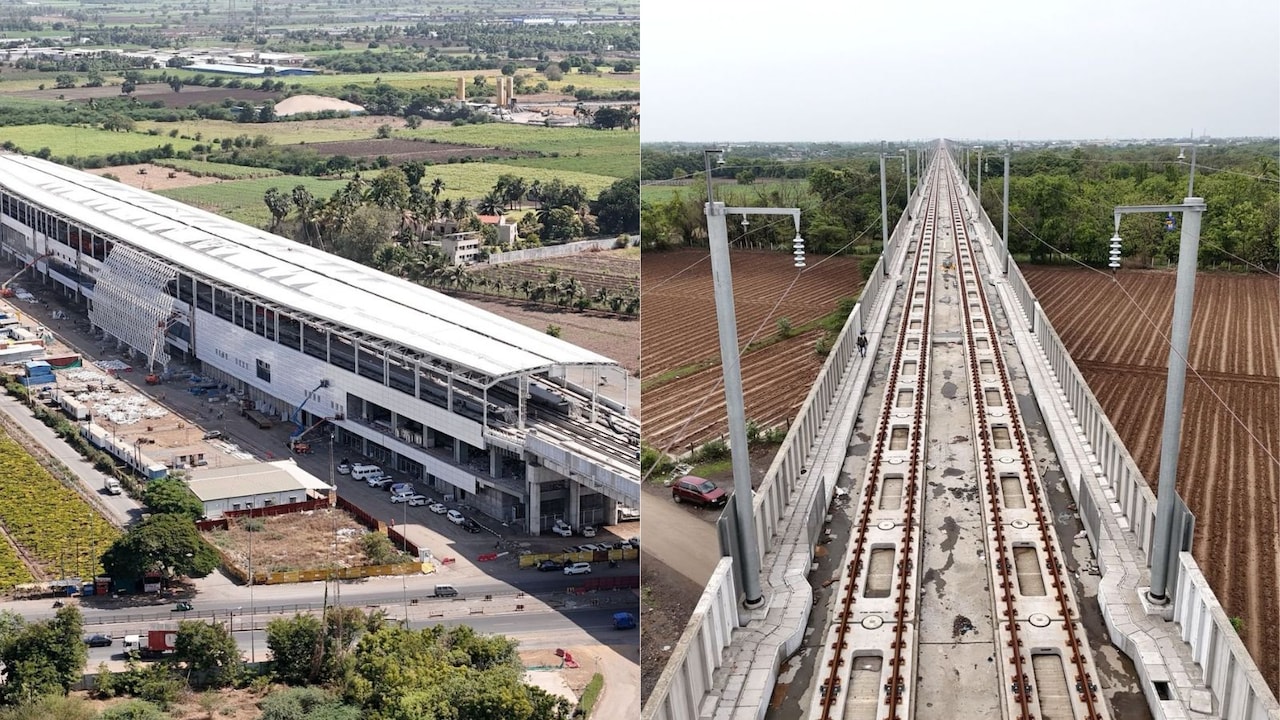
But a few hundred kilometers away, out in the sun-baked stretches of Gujarat, a massive concrete spine is rising above the farmlands. It does not look like India’s past. It looks like a monument to a future that many believed would never actually arrive.
The Mumbai-Ahmedabad High-Speed Rail corridor—popularly dubbed the bullet train—is no longer a glossy PowerPoint presentation or a political talking point. It is a physical reality creeping toward its 2027 launch date. When those aerodynamic white noses finally tear through the landscape at 320 kilometers per hour, they won't just be cutting travel times down to a meager two hours. They will be shattering a psychological barrier that has defined Indian life for generations.
To understand why this matters, you have to look away from the engineering diagrams and look at someone like Aarav.
He is a hypothetical composite of the thousands of young professionals currently tearing their hair out in Mumbai's financial district. Aarav’s family lives in Ahmedabad. Every Friday evening, his life becomes a frantic, high-stakes calculation. Does he risk the unpredictable delays of a domestic flight, factoring in the grueling two-hour Uber ride through Mumbai’s gridlocked traffic just to get to the airport terminal? Or does he book a sleeper berth on the train, resigning himself to arriving Saturday morning with a stiff neck and half a weekend already gone?
Aarav lives his life in the gaps between places. His relationships are sustained by video calls that drop out in tunnels. His sense of home is divided. When you ask him about the bullet train, he doesn’t talk about the technology. He talks about being able to have dinner with his parents on a Tuesday night and still making it back to his Mumbai office for a 9:00 AM presentation the next morning.
Distance has always been a tax on the human spirit. The high-speed rail line is the first real attempt to repeal that tax.
The sheer scale of what is happening beneath the surface is dizzying, even for those who track infrastructure for a living. We are looking at a project that requires bridging rivers, boring under oceans, and carving through densely populated urban realities. Consider the sheer audacity of the 21-kilometer underground tunnel stretch, which includes a seven-kilometer section plunging directly beneath the waves of the Arabian Sea at Thane Creek.
Imagine the pressure. Not just the physical weight of the ocean overhead, but the institutional weight of executing India’s first undersea rail tunnel. It requires specialized boring machines eating through the earth like subterranean leviathans, operating in conditions where a single miscalculation means catastrophe.
Yet, despite the cynics who predicted the project would stall indefinitely in bureaucratic mud, the progress is undeniable. Miles of viaducts—the elevated concrete pathways that lift the tracks safely above the chaos of local traffic and seasonal floods—now stand completed. The stations are taking shape, shifting from skeletal steel frameworks into futuristic hubs.
The year 2027 has become a hard horizon.
It is easy to look at the numbers and see only a massive financial gamble. The critics have been vocal, and their doubts are not entirely unfounded. Why spend billions on a premium high-speed corridor when the existing railway network, the literal lifeblood of the nation, requires urgent modernization? It is a fair question. It is a terrifying amount of money to spend on a single line connecting two specific economic hubs.
But this argument misses the foundational truth of how technology alters human behavior. When Japan introduced the Shinkansen in 1964, critics labeled it a reckless vanity project for a nation still recovering from the devastation of war. They argued that airplanes were the future, that rails were obsolete. What they failed to foresee was how the Shinkansen would stitch Tokyo and Osaka into a single, roaring economic mega-region. It didn't just move people faster; it changed where people chose to live, where companies built factories, and how a society viewed its own capabilities.
The Mumbai-Ahmedabad line is a massive experiment in psychological acceleration.
When the travel time between these two economic powerhouses drops to under three hours, the traditional boundaries of the city dissolve. Ahmedabad ceases to be a distant destination requiring a travel itinerary; it effectively becomes a suburb of Mumbai. A textile merchant in Gujarat can pitch a client in Bandra Kurla Complex before lunch and be back in his own bed by evening. The economic friction that slows down commerce—the missed meetings, the spoiled cargo, the sheer exhaustion of travel—evaporates.
The project is a انتقال—a profound translation of Japanese precision into the raw, unpredictable vernacular of the Indian landscape. The Shinkansen technology is famous for its obsessive focus on safety and punctuality, operating in a country where a twenty-second delay triggers a national apology. Merging that cultural DNA with the realities of Indian land acquisition, monsoon cycles, and local governance is perhaps the greatest quiet triumph of the entire enterprise.
It has required an unprecedented level of collaboration, forcing thousands of engineers from different worlds to find a common language. They had to learn to balance the absolute rigidity of millimetric rail tolerances with the fluid, shifting realities of Indian terrain.
You can see this tension resolved in the concrete pillars that now dot the landscape. They are uniform, elegant, and uncompromising. They represent a rare moment where long-term vision managed to outrun short-term political cycles.
But what happens to the people on the ground as this train screams past overhead?
There is a vulnerability we must acknowledge here. As the country leaps forward into the era of high-speed rail, the contrast between the old and the new becomes starker. The bullet train will race past villages where water is still drawn from wells, over roads where bullock carts still vie for space with motorbikes. The risk of creating a two-tiered society—one that flies along elevated concrete tracks at breakneck speeds and another that watches from the dust below—is real.
The success of this project cannot only be measured by the wealth it generates in the boardrooms of Mumbai or the diamond markets of Surat. It will be measured by how effectively that speed liquefies the economy, creating opportunities that trickle down to the very fields the tracks cross. The goal cannot just be to move the affluent faster; it must be to elevate the baseline of what the entire nation believes it can achieve.
The train is coming. The pillars are set. The concrete is curing in the sun.
The next time you find yourself stuck in a sweltering railway station, listening to the static-heavy announcements of another delayed express, listen closely to the undertone. The old world is loud, chaotic, and comfortable in its slow rhythms. But the horizon is shifting. By 2027, the quiet hum of an electric motor accelerating to three hundred kilometers per hour will rewrite the morning routine of millions.
Time will no longer stretch to accommodate our patience. Instead, we will finally have the tools to catch up to it.