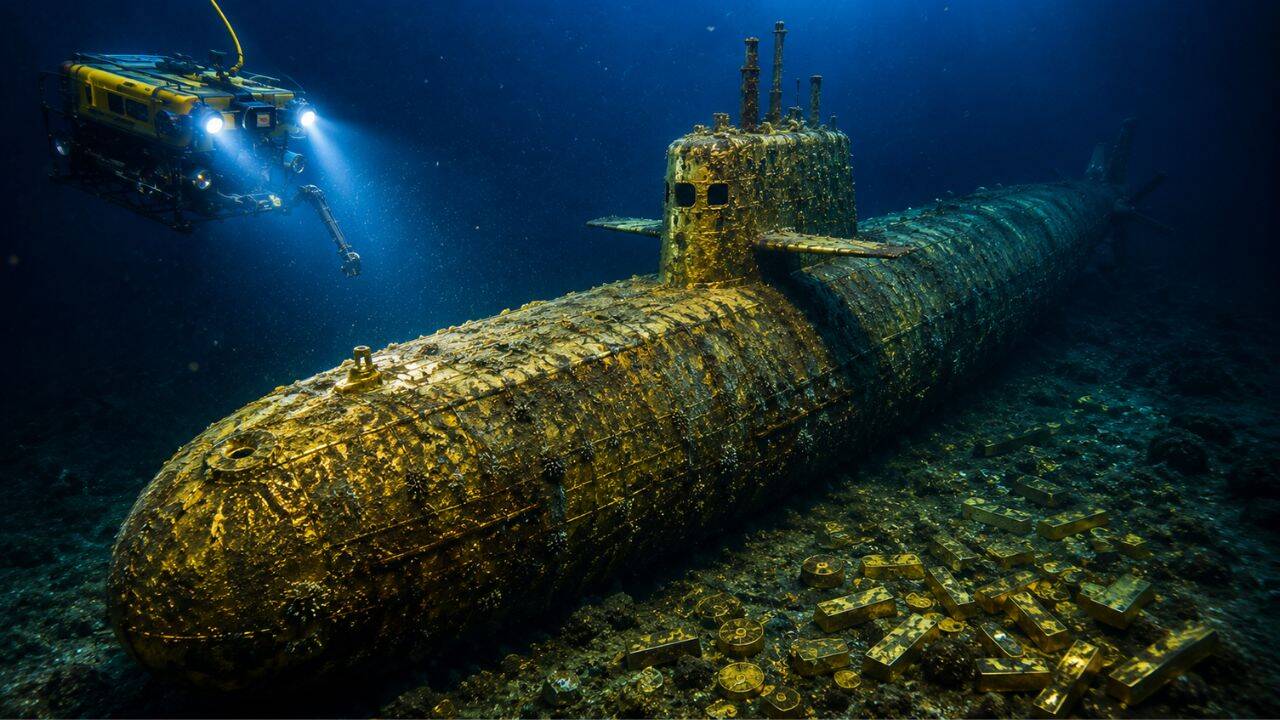
The pressure at seventeen thousand feet destroys everything familiar. It does not merely crush; it reshapes. Down there, the Atlantic Ocean exists in total, absolute darkness, a heavy black silence where the temperature hovers just above freezing. Water weighs down at several tons per square inch. For more than half a century, a massive cylinder of steel sat in that quiet dark, pressed into the thick mud of the seabed, holding a secret that a dying empire had hoped would alter the course of human history.
Inside that steel tube lay two metric tons of pure gold.
But the gold is the least interesting part of the story. The real weight of the vessel lay in the ghosts of the one hundred and twelve men who went down with it, and the desperate, frantic final months of a global war fought by people who knew the end was coming but refused to stop running toward it.
The Ghost Ship of Kure
In March 1944, the port of Kure was a place of gray iron and bitter smoke. Japan was losing the war. The high commands in Tokyo and Berlin could see the map shrinking, the supply lines snapping like dry twigs under the pressure of Allied advances. Desperation breeds strange plans. The Japanese military devised a mission of astonishing audacity: they would send a massive submarine across the entire planet, through waters crawling with enemy destroyers, to deliver raw materials and wealth directly to Nazi-occupied France. In return, they hoped to bring back jet engines, radar equipment, and German technical secrets.
The vessel chosen for this suicide run was the I-52. She was a giant of her time, stretching nearly three hundred and fifty feet long, a cargo submarine designed not for stealthy dogfights but for endurance.
Imagine standing on the deck of that submarine as it slipped away from the homeland. A young crewman, perhaps nineteen years old, looks back at the receding shoreline of Japan. Let us call him Kenji, a hypothetical composite of the young mechanics who kept those massive diesel engines turning. Kenji knows the odds. He knows that the sea is full of American sonar. Yet, under his feet, stowed securely in the hold, are one hundred and forty-six gold bars packed into wooden crates. To Kenji, that gold is not wealth for a lavish life; it is the physical manifestation of his country’s survival. If they reach France, the empire breathes a little longer. If they fail, the ocean swallows the last bankroll of a collapsing dream.
The journey was long, hot, and suffocating. For months, the crew lived in a metal cooker, breathing recycled air heavily scented with diesel fumes, sweat, and rotting cabbage. They sailed down through the Pacific, around the Cape of Good Hope, and crept up into the vast, open hunting grounds of the Atlantic.
The Flight of the Avenger
By June, the I-52 was nearing its rendezvous point. The plan required them to meet a German U-boat in the middle of the Atlantic to pick up a liaison officer and a pilot who could guide them through the heavily guarded Bay of Biscay. They made the handoff in the dark. The sea was choppy, the sky black.
What the crew of the I-52 did not know was that their secret code had been broken months ago. Every transmission they sent to Berlin was read in Washington and London almost as quickly as it was read by the recipients.
High above the waves, flying through the midnight clouds, was an American Avenger torpedo bomber launched from the escort carrier USS Bogue. The pilot, Lieutenant Commander Jesse Taylor, was searching the dark water with primitive radar.
Consider the sudden shift in reality. One moment, the men inside the I-52 are celebrating their successful meeting with the Germans, perhaps sharing a rare tin of fruit or smoking a cigarette in the cramped galley. The next, a blinding flash of magnesium light rips through the night sky. Taylor had dropped a flare.
The submarine tried to dive. The massive ballast tanks flooded, and the steel hull groaned as it plunged beneath the surface, seeking the safety of the deep. But Taylor did not drop conventional bombs. He dropped an acoustic torpedo, a weapon that listened for the thudding heartbeat of the submarine’s propellers.
Inside the I-52, the sound of the approaching torpedo would have been a high-pitched, metallic whine, growing louder by the second. The crew could do nothing but hold onto the pipes and pray.
The explosion was distant but devastating to the men on the carrier deck miles away who monitored the hydrophones. They heard the crunch of metal. They heard the terrible, unmistakable sounds of a submarine breaking apart under the pressure of the sea. Then, silence.
The Obsession of a Modern Hunter
For fifty years, the I-52 was a legend told by old sailors and cataloged in dusty naval archives. Most people assumed she was gone forever, an unrecoverable needle in a three-mile-deep haystack.
Then came Paul Tidwell.
Finding a sunken submarine in the deep ocean is not a matter of luck; it is an exercise in absolute mental endurance. Tidwell, an ocean researcher with the build of a boxer and the patience of a monk, became consumed by the story of the I-52. He spent years combing through declassified American naval logs, track charts, and German radio transcripts. He realized that the coordinates recorded by the American bomber in 1944 were slightly off due to the primitive navigation of the era.
In 1995, Tidwell gathered a team and chartered a Russian research vessel, the Akademik Mstislav Keldysh, equipped with two deep-sea submersibles capable of withstanding the terrifying pressures of the abyss.
The search was grueling. Days bled into weeks. The sonar screens showed nothing but flat, featureless mud. The expense was enormous, the skepticism from the scientific community loud. Skeptics pointed out that the search area was larger than many American cities, and the target was a rusted cylinder buried under half a century of ocean silt.
But Tidwell persisted because he felt a connection to the men onboard. He had met with Japanese veterans and the families of the lost crew before he sailed. He carried their memories into the middle of the Atlantic.
On the final days of the expedition, the side-scan sonar picked up a shadow. It was distinct. It had sharp, straight lines that nature does not create.
Emerging from the Black
The submersibles dropped into the water, sinking through the blue, then the twilight zone, and finally into the absolute blackness of the deep ocean. It took hours just to reach the bottom.
When the lights of the submersible finally cut through the silt, the image that emerged was breathtaking. The I-52 was sitting upright in the mud. She looked remarkably preserved, frozen in time by the freezing, oxygen-depleted water. The conning tower was intact. The massive numbers painted on her side were still visible through the light dusting of sea debris.
The damage from the torpedo was clear, a jagged wound near the stern where the ocean had rushed in to claim her.
Tidwell and his team managed to recover artifacts from the debris field surrounding the wreck. They found shoes, a briefcase belonging to a Japanese engineer, and even a small metal box that contained a sample of opium, part of the medicinal cargo. They also found a single gold coin, a confirmation that the fortune was indeed down there, scattered in the mud or locked deep within the collapsed holds.
But when Tidwell looked through the thick acrylic viewport of the submersible at the silent hull, the desire to salvage the gold began to change into something else. The metal structure was not just a treasure chest. It was a tomb.
The Fragility of Metal and Memory
We often look at history as a series of grand movements, treaties signed by men in suits, and battle lines drawn on maps. We forget that history is made of flesh and bone.
The discovery of the I-52 reminded the world of the human cost of these grand strategies. The gold was meant to buy weapons to continue a war that was already lost. It was an investment in destruction. Yet, fifty years later, that same gold was just an inert yellow metal resting in a place where human eyes were never meant to see it.
Tidwell eventually decided against a massive, destructive salvage operation to rip open the hull for the remaining bars. The technical challenges were immense, but the moral challenges were greater. The Japanese government and the families of the crew viewed the site as sacred ground.
Today, the I-52 remains exactly where she fell, three miles down, surrounded by the eternal quiet of the Atlantic floor. The gold is still there, heavy and useless, guarded by the immense weight of the ocean. It stands as a monument to a moment when humanity used its greatest technological achievements to chase wealth and power across the globe, only to leave it buried in the dark, where no one could ever spend it.