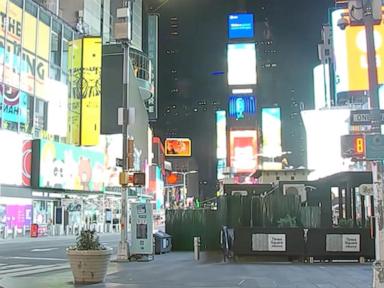
The headlines are predictable. They are visceral. They are designed to trigger a specific, primal outrage. "Man Abandons Baby in Times Square." The footage—grainy, flickering, captured by one of the thousands of unblinking eyes watching the Crossroads of the World—shows a man walking away from a stroller. The public reacts with a synchronized gasp. The police launch a "manhunt." The digital mob demands a head on a spike.
But if you’re looking at this as a simple criminal act, you’ve already lost the plot.
The lazy consensus screams about "monster parents" and "moral decay." It treats this event as an isolated anomaly, a glitch in the Matrix of a civilized society. It isn't. This isn't a story about a bad man in a bright jacket. It is a diagnostic report on the terminal failure of how we manage urban crisis, parental desperation, and the illusion of public safety.
We are obsessed with the search for the man. We are completely ignoring the system that made a stroller in the middle of a neon-lit tourist trap his only perceived exit strategy.
The Myth of the Safe Haven
Every state in this country has Safe Haven laws. In New York, you can leave an infant (under 30 days old) with an appropriate person at a hospital, police station, or firehouse. No questions asked. No handcuffs.
The media loves to cite these laws as if they are a universal solvent for parental panic. They aren't. Safe Haven laws assume a level of rational, long-term planning and legal literacy that a person in the middle of a psychological or financial collapse simply does not possess.
When you are drowning, you don’t look for a lifeguard stand 1.2 miles away. You grab the nearest piece of driftwood. For a person pushed to the brink in Manhattan, Times Square—the most heavily policed, highly visible square footage on the planet—is that driftwood.
Leaving a child in the most crowded place in America isn't an act of cruelty; it’s a desperate, distorted attempt at guaranteed discovery. He didn't leave the baby in a dark alley. He left the baby where he knew, with mathematical certainty, that a pair of eyes would land on that stroller within sixty seconds.
The Surveillance Trap
We spend billions on the NYPD’s Domain Awareness System. We have facial recognition, license plate readers, and a literal bunker of screens monitoring the heartbeat of the city. We are told this keeps us safe.
Yet, we only use this massive infrastructure to perform autopsies on tragedies.
We use the cameras to find the man after the baby is abandoned. We use the data to track his flight path through the subway system. Why didn't the most "secure" location in the Western world trigger an intervention before the stroller was left behind?
Because our surveillance state is designed for retribution, not prevention. We have optimized our cities to catch criminals, but we have completely failed to build cities that catch people before they fall. If a man wanders Times Square for an hour looking visibly distraught with an infant, the cameras don't care. The AI isn't programmed to detect "desperation." It's programmed to detect "unattended bags" and "active shooters."
We are living in a panopticon that can find your face in a crowd of ten thousand but can't find a reason to offer you a hand before you break.
The High Cost of Moral Outrage
The "manhunt" is a performance. It’s theater designed to make the tax-paying public feel like the "bad guys" are being handled.
But what happens when we catch him? We spend hundreds of thousands of dollars on the trial, the public defender, and the eventual incarceration. We incinerate capital to punish a person who, by definition, has already reached a point of total personal insolvency.
Imagine a scenario where 10% of the budget used for the "Manhattan South" manhunt was diverted into localized, friction-less crisis intervention. I’ve seen cities pour millions into "Real Time Crime Centers" while the waitlist for emergency childcare or mental health stabilization units stretches into months.
We are subsidizing the punishment and starving the prevention. It is a fiscally irresponsible way to run a civilization.
Why You’re Asking the Wrong Question
The "People Also Ask" boxes on your search engine are filled with queries like:
- "What is the penalty for abandoning a child in NYC?"
- "How can someone do this to a baby?"
- "Where is the mother?"
These questions are irrelevant. They are emotional junk food.
The real question—the one that actually matters for the future of urban policy—is: "What level of systemic failure must occur for a man to believe that a police-heavy tourist hub is the only safe place to surrender a human life?"
If you think the answer is "he’s just a bad person," you’re part of the problem. You’re choosing the comfort of a villain narrative over the discomfort of a broken social contract.
In my years analyzing urban infrastructure and social dynamics, I've learned that people generally act in accordance with the incentives and pressures of their environment. When the environment offers no clear path for help, people create their own paths. Sometimes those paths involve leaving a stroller under the glow of a Broadway billboard.
The Brutal Reality of "Better Data"
The data on child abandonment doesn't point to a rise in "evil." It points to a rise in isolation.
The "village" it takes to raise a child has been replaced by a gig economy that demands 16-hour days and an apartment market that consumes 70% of a minimum wage income. In New York City, the cost of living isn't just a number on a spreadsheet; it’s a physical weight that crushes the cognitive load of its residents.
When your cognitive load is blown, your decision-making defaults to the immediate and the visible.
The man in the video isn't an outlier. He is a symptom.
Stop Hunting, Start Integrating
If we want to "fix" this, we have to stop treating the NYPD as the primary response to every social tremor.
We need to dismantle the idea that "security" is the same as "safety."
- Security is a camera watching you walk away.
- Safety is a community center that knows you're struggling before you leave the house.
The current approach—the one the competitor article salivates over—is a feedback loop of failure. We ignore the struggle, we record the tragedy, we hunt the perpetrator, we fill the prison, and we wonder why it happens again next month.
It happens because we have built a society where it is easier to be a fugitive than it is to be a father in crisis.
Until we stop prioritize the "manhunt" over the "man," the lights of Times Square will continue to illuminate the very things we claim we want to hide.
Put down the pitchforks and look at the ledger. We are paying for the spectacle of justice while the reality of human misery remains unaddressed. The baby is safe now, but the city that created the situation is more dangerous than ever because it refuses to see its own reflection in those security monitors.
Stop looking for the man. Start looking at the streets.