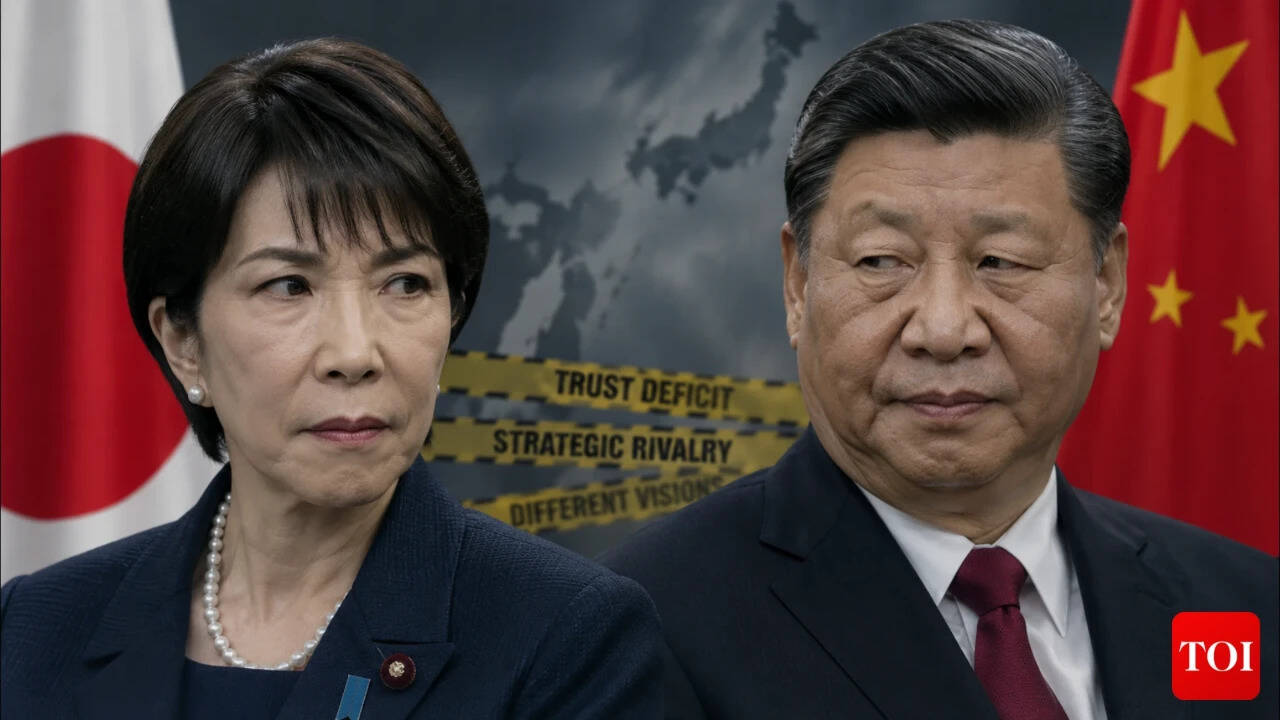
Japan has officially crossed a diplomatic Rubicon. Tokyo's defense white papers no longer hide behind bureaucratic euphemisms or polite diplomatic jargon when assessing Beijing. Japan labels China its greatest strategic challenge, fundamentally rewriting seven decades of post-war pacifism and defense doctrine.
For generations, Tokyo maintained a strict security posture defined by Article Nine of its constitution and a self-imposed defense-only spending cap hovering around one percent of gross domestic product. That era is over. The shift is not merely rhetorical. It represents a hard-nosed calculation born from expanding maritime incursions near the Senkaku Islands, unannounced ballistic missile tests splashing down inside Japan's exclusive economic zone, and an unyielding Chinese naval buildup in the Western Pacific.
To understand why this pivot happened, you have to look past the headlines and examine the brutal geography defining East Asian security.
The Geography of Vulnerability
Tokyo sits at the edge of a maritime bottleneck. Look at a map of the first island chain. Japan, Taiwan, and the Philippines form a natural barrier enclosing China's coastal access to the open ocean. Beijing views this geography as a maritime cage engineered to restrict its rise. Tokyo views the same geography as an existential lifeline.
If Beijing exerts military dominance over the East China Sea and forces a reunification scenario with Taiwan, Japan's sea lanes for energy and food imports face immediate chokeholds. Over ninety percent of Japan's crude oil arrives via maritime routes passing through contested waters.
A military conflict in the Taiwan Strait would instantly paralyze Tokyo's economy. This realization drove the defense establishment to redefine national security. The government is no longer planning for localized territorial defense alone. Tokyo is preparing for integrated theater denial.
Rewriting the Defense Budget
Money talks louder than policy white papers. Prime Minister Fumio Kishida and his successors committed to doubling defense spending to two percent of gross domestic product by twenty twenty-seven. This brings Tokyo into alignment with North Atlantic Treaty Organization standards, transforming the country into the world's third-largest military spender behind the United States and China.
The budget increase is not going toward routine maintenance. Billions are flowing directly into counterstrike capabilities. For decades, acquiring long-range cruise missiles was politically untouchable because such weapons crossed the line from defense to offense. Now, Tokyo is purchasing hundreds of American-made Tomahawk missiles and upgrading domestic Type Twelve surface-to-ship missiles to extend their range past one thousand kilometers.
These weapon systems give Japan the ability to strike enemy missile bases on foreign soil if an attack is imminent. This capability shatters the old doctrine of strictly waiting to be hit before responding.
The Industrial and Economic Tightrope
Behind the military maneuvers lies a grinding economic reality. Japan's corporate sector remains deeply entwined with the Chinese mainland. Toyota, Sony, and countless manufacturing giants rely on Chinese factories for assembly and Chinese consumers for revenue.
Beijing understands this leverage. When geopolitical tensions flare, economic coercion usually follows. Tokyo has watched China weaponize supply chains against Australia, South Korea, and Lithuania. Consequently, the government is pushing a policy of economic security. Subsidies are flowing to companies willing to repatriate critical manufacturing lines or diversify operations into Southeast Asia and India.
Yet decoupling is easier said than done. Jahrzehnte of capital investment cannot be erased in a fiscal quarter. Japanese corporate boards walk a narrow ledge every single day, trying to appease national security hawks in Tokyo while protecting profit margins in Shanghai and Shenzhen.
The Alliance Realignment
Japan cannot deter a rising superpower alone. The security architecture of the region relies entirely on the United States-Japan security treaty.
Washington has quietly encouraged Tokyo's militarization for years, weary of bearing the sole burden of regional deterrence. The command structures are shifting to accommodate this reality. The United States military is upgrading its headquarters in Japan to a joint force headquarters, improving real-time operational coordination with the Japan Self-Defense Forces.
At the same time, Tokyo is forging independent security links with regional partners who share its anxieties. Prime Minister Kishida spearheaded diplomatic breakthroughs with Seoul, burying historical grievances to establish trilateral intelligence sharing with Washington. Similar defense pacts are expanding with Australia, the United Kingdom, and the Philippines.
An informal coalition is taking shape around China's periphery. Beijing routinely denounces these developments as an Asian version of the North Atlantic alliance, accusing Tokyo of acting as a proxy for American hegemony.
The Domestic Political Calculus
None of this happens without a quiet revolution in public opinion. For decades, the Japanese public held a deeply ingrained aversion to military expansion, scarred by the devastation of the Second World War.
Aggressive Chinese maritime behavior changed that calculation. When Chinese coast guard vessels routinely violate Japanese territorial waters around the Senkaku Islands, public sentiment hardens. Regular citizens who once championed pacifism now view increased defense budgets as a regrettable necessity.
Opposition politicians still voice concerns about constitutional overreach and the risk of accidental escalation. Critics argue that acquiring counterstrike capabilities turns Japan into a primary target in any superpower conflict. But these voices are increasingly drowned out by a bipartisan consensus that inaction carries a much higher price tag than preparation.
The political taboo against talking openly about war has broken. Tokyo has accepted that hope is not a strategy.
The Point of No Return
Japan has stepped off a historic path of pacifist restraint. The declaration naming China as its greatest strategic challenge is not a temporary diplomatic flare-up. It is a structural reorientation of a G7 economy preparing for a darker, more contested future in the Indo-Pacific.
The ship has turned, and the waters ahead are uncharted.