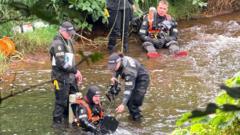
A hot afternoon changes in seconds. A group of teenagers hangs out by the riverbank, the water looks calm, and someone decides to jump in. Then, the current takes over. Emergency sirens wail through the night, and days later, a dive team recovers a body. This nightmare just unfolded again, leaving a community shattered after a 15-year-old boy went missing in a local river and rescue teams found his body after an extensive search.
It happens every single summer. The headlines look identical, only the names and locations change. We treat these incidents as freak accidents, but they aren't. They are predictable, recurring tragedies. For an alternative look, consider: this related article.
When a teenager goes missing in a river, the media coverage follows a strict script. First comes the breaking news alert, then the quote from a grieving relative, and finally the warning from local police to stay away from the water. It doesn't work. The statistics don't lie. Young people keep drowning, and our collective approach to open water safety is completely failing them.
Understanding what actually happens beneath the surface of a moving river is the only way to stop this loop. It isn't about telling kids to avoid the water entirely because they won't listen. It's about breaking down the invisible mechanics of moving water and changing how we teach survival. Related insight on this matter has been provided by USA Today.
Why Rivers Are Far Deadlier Than They Look
A river is a deceptive machine. On a sunny day, the surface often looks still, almost glassy. This visual trick lulls teenagers into a false sense of security, making them believe a river behaves just like a backyard pool or a calm lake. It doesn't.
Underneath that smooth surface lies a massive volume of moving water. Water weighs roughly 62.4 pounds per cubic foot. When thousands of gallons move down a river channel at even three miles per hour, the force is immense. It easily sweeps an athletic 15-year-old off his feet. Once a swimmer loses footing, the river dictates where they go, not their swimming ability.
Unlike pools, rivers have irregular bottoms. Heavy rain miles upstream changes depth and current speed without warning. A spot that was waist-deep last week might feature an eight-foot drop-off today.
Then you have debris. Falling branches, submerged logs, and discarded shopping carts trap swimmers. Emergency dive teams call these "strainers." They act exactly like a colander in a kitchen sink. The water passes through, but solid objects, including a human body, get pinned against the debris by the sheer force of the current. Escape without external help is nearly impossible.
The Cold Shock Response That Paralyses Strong Swimmers
People assume good swimmers don't drown in calm weather. That assumption is dead wrong. Peer-reviewed data from organizations like the Royal National Lifeboat Institution and the National Water Safety Forum shows that a huge percentage of open water drowning victims are capable, athletic swimmers.
The real killer is often cold shock response, not a lack of swimming skill.
Even in mid-summer, deep river water remains incredibly cold, frequently dropping below 60 degrees Fahrenheit. Jumping suddenly into water that cold triggers an involuntary physical reaction.
- The Involuntary Gasp: The sudden temperature drop forces an immediate, uncontrollable gasp for air. If your head is underwater when you gasp, you inhale water straight into your lungs.
- Hyperventilation: Your breathing rate spikes wildly. Panic sets in instantly as your brain screams that you can't get enough oxygen.
- Vasoconstriction: Blood vessels in your limbs constrict rapidly to keep your core warm. Your muscles lose strength within minutes. You can't swim, even if you know how.
This reaction peaks within the first 60 seconds. If a teenager doesn't know how to handle those first 60 seconds, they won't survive to swim to the bank.
The Flaw In Traditional Water Safety Education
We teach kids to swim in rectangular pools with concrete edges, clear visibility, and lifeguards sitting on elevated chairs. We hand out certificates for swimming ten laps or retrieving a plastic ring from the shallow end.
This training builds false confidence. It prepares children for a controlled environment, not the chaos of natural waterways.
When a kid steps into a river, there are no lanes. The water is murky. Mud and rocks shift underfoot. Currents pull at their ankles. The moment panic strikes, pool-trained instincts fail. They try to swim directly against the current to get back to where they jumped in. They fight the river, burn through their energy in two minutes, and go under.
Safety campaigns that scream "Stay Out of the Water" are lazy. They ignore teenage psychology. Risk-taking is wired into the adolescent brain. Peer pressure, summer heat, and the thrill of exploration mean kids will always find their way to rivers, quarries, and reservoirs. Instead of futile bans, we need to teach real-world open water survival tactics.
What To Do If The Current Grabs You
Survival in a river requires doing the exact opposite of what your brain tells you to do. Survival requires submission to the water, at least initially.
If you get swept away, stop swimming. Fighting the current is a death sentence. Instead, turn onto your back and float. Keep your ears submerged, your chest pushed up, and your legs flaring out in front of you.
This position protects your head from rocks and keeps your airway clear of the splash. It preserves your energy and gives your body time to get past the initial cold shock response.
[River Current Direction] --->
[Swimmer Position: Floating on back, feet facing downstream, head upstream]
Look downstream. Keep your feet pointed ahead of you. If you drift into a rock or a log, use your shoes to push off rather than letting your head or torso take the impact.
Do not try to swim straight to the nearest bank if the current is fast. Look for a bend in the river or a spot where the water slows down naturally, creating an eddy. Swim diagonally with the current, moving toward the shore at an angle. Think of it like crossing a street while walking forward; you angle your path rather than fighting oncoming traffic head-on.
How Communities Must Adapt Moving Forward
Blaming teenagers for being reckless after a tragedy is easy, but it changes nothing. Communities must take physical, actionable steps to secure high-risk river areas and educate families properly.
First, emergency rescue equipment needs to be accessible, functional, and highly visible. Throw lines and life rings should sit at regular intervals along popular river paths. Crucially, these stations need clear, simple visual instructions. Someone trying to save a drowning friend has seconds to act, and they shouldn't have to figure out how to unlock or untangle a rescue rope.
Second, education must pivot. Schools need to incorporate open water dynamics into physical education. Kids should know what a rip current looks like in the ocean and how an eddy behaves in a river. They need to practice the "Float to Live" technique until it becomes muscle memory.
If you are a parent, take your teenagers to a safe, designated natural swimming area. Show them the difference between a pool and open water. Let them feel the tug of a gentle current while you are right there next to them. Normalize wearing life jackets during water activities, even if it doesn't look cool to their friends.
Talk openly about the reality of rescue operations. Explain that once someone disappears under murky river water, emergency teams can rarely see them. It becomes a recovery mission, not a rescue. Give them the hard facts straight, without sugarcoating. That conversation might actually save their life next July.