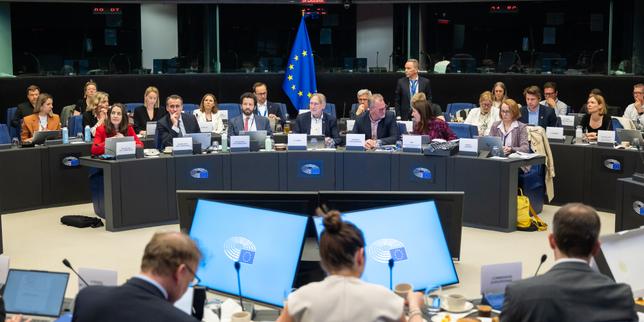
The European Union has finally capitulated to Washington’s July 4 deadline, rubber-stamping a provisional trade deal that strips customs duties from American industrial goods to avert a catastrophic 25 percent tariff on European automobiles. Brussels is spinning the agreement as a strategic victory, pointing to a newly inserted suite of legislative safeguards, emergency suspension clauses, and a 2029 sunset mechanism designed to contain American unilateralism. But an analysis of the text reveals a structural imbalance. By trading immediate, concrete market access for conditional legal triggers, European negotiators have built a fragile fortress that depends entirely on the restraint of a White House that has built its political brand on discarding international trade norms.
The deal, hammered out between the European Parliament and the Council, serves as the formal legislative framework for the Turnberry agreement struck last year. Under the terms, the EU eliminates import duties on US industrial products and expands preferential tariff-rate quotas for American agricultural and seafood exports, notably processed lobster. In return, Washington promises to cap its global reciprocal tariff on European goods at 15 percent instead of unleashing the punitive escalations threatened for this summer.
The Zero Tariff Trap
European negotiators spent months holding up this legislation, twice pausing ratification after Washington threatened retaliation against allies who opposed its geopolitical maneuvers, including the proposed acquisition of Greenland. The final text attempts to institutionalize a defense mechanism against such volatility.
The centerpiece of this defense is a safeguard mechanism allowing the European Commission to unilaterally suspend tariff preferences if a sudden surge in American imports threatens serious injury to domestic industries or the agricultural sector. Furthermore, the Commission has given Washington until December 31, 2026, to lower its duties on European steel and aluminum derivatives below the 15 percent threshold, threatening a snapback of European tariffs if the deadline is missed.
This looks formidable on paper. In reality, it misunderstands the mechanics of modern trade enforcement.
To trigger a safeguard investigation, the European Commission must gather data, demonstrate causal injury to domestic producers, and survive a highly politicized review process among member states. This takes months. Meanwhile, American industrial goods will flow into the single market completely duty-free from day one. A domestic manufacturer facing a sudden influx of subsidized American machinery cannot afford a three-quarter waiting period while Brussels bureaucrats compile economic dossiers.
The imbalance becomes more acute when examining the concessions made on agricultural products and seafood. By offering immediate market access for non-sensitive agricultural goods and retroactively suspending lobster tariffs back to August 2025, the EU has surrendered tangible leverage in exchange for promises.
The Mirage of Retaliation
The European Parliament successfully fought to include a sunset clause that terminates the agreement on December 31, 2029, explicitly aligning the deal's expiration with the conclusion of the current US presidential term. The logic is clear. European lawmakers want an automatic exit ramp if the political landscape in Washington shifts or worsens.
But the sunset clause exposes the underlying weakness of the entire framework. It acknowledges that this is not a comprehensive, stable trade treaty built on mutual regulatory alignment, but an institutionalized truce.
Consider the leverage dynamic. If the United States violates the agreement by imposing additional tariffs under the guise of national security, the EU's ultimate recourse is the suspension clause. The European Commission can reinstate customs duties on American industrial imports. But doing so immediately invites the very scenario this agreement was designed to prevent: a full-scale trade war featuring 25 percent tariffs on European cars and aerospace components.
The enforcement mechanism is a financial doomsday device. If the EU uses its safeguards, it triggers its own economic punishment. Washington knows that Brussels remains deeply divided on trade retaliation, with automotive-dependent economies inherently allergic to any move that provokes White House tariff pens.
Diverging Transatlantic Realities
While Europe codifies its concessions into law, the domestic legal and political foundations of the deal in the United States remain highly volatile. Earlier this year, the US Supreme Court struck down key elements of the administration's reciprocal tariff program, temporarily throwing Washington’s broader trade strategy into chaos and forcing European lawmakers to suspend their ratification process out of sheer bewilderment.
Rather than walking away from a compromised framework, Brussels rushed back to the table to meet the July 4 deadline. The fear of missing the deadline and triggering immediate auto tariffs overrode the systemic warning signs coming from the American judicial system.
The structural asymmetry extends to what each side is actually trading. The EU is opening a highly regulated, legally bound single market where tariff removal is permanent until an extraordinary, legally defensible emergency suspension is proven. The United States is offering a political commitment to cap tariffs at 15 percent, administered through executive actions that can be reinterpreted, circumvented via national security exemptions, or abandoned entirely through a single late-night executive order.
The European Union has institutionalized a policy of appeasement disguised as strategic autonomy. By lowering its economic defenses today in exchange for the right to complain tomorrow, Brussels has chosen predictable vulnerability over unpredictable confrontation.