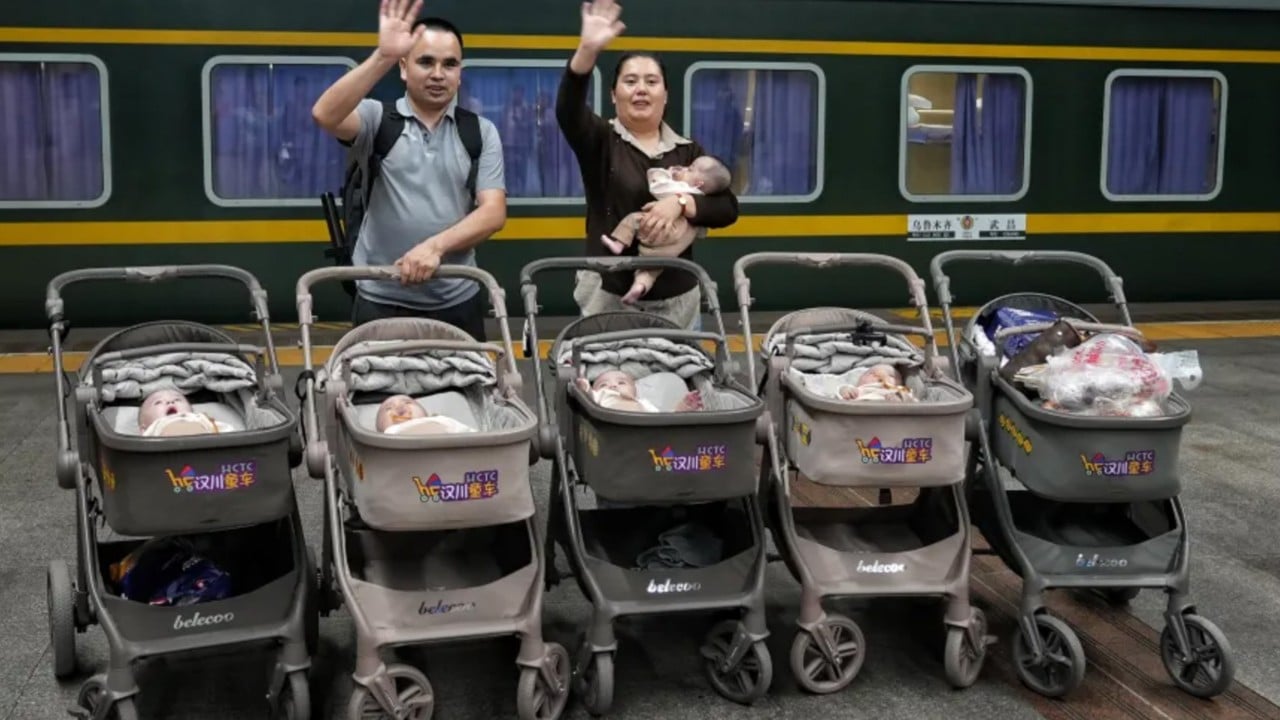
Moving five infants simultaneously across a high-throughput rail network turns a standard family trip into a multi-agent logistics problem where a single delayed feed or missed station stop compounds across five separate dependency chains. Human-interest coverage of a Chinese couple bringing quintuplets home by train typically frames the event around heartwarming strangers and helpful railway staff, which obscures the underlying operational mechanics that make such a transit possible. Treating the episode as a coordination and risk-management system reveals how informal assistance bridges capacity gaps in public transit, why rail infrastructure behaves differently from private vehicles under high-load conditions, and where uncoordinated goodwill introduces new failure modes.
Deconstructing the Human Interest Narrative
Standard media reporting on extreme multi-infant travel relies on a predictable arc: a high-odds biological event, a daunting journey, moments of public kindness, and a safe arrival. That structure satisfies emotional curiosity while leaving the operational variables unspecified. When an article states that strangers and railway staff helped carry babies or clear space, it describes outputs without defining the constraints that made those actions necessary in the first place.
In analytical terms, five infants represent five concurrent, high-dependency payloads rather than one larger unit. A single infant requires continuous monitoring of airway clearance, thermoregulation, hydration, and posture; five infants multiply those requirements across a fixed number of adult caregivers. Two parents operating without external support face an immediate staffing deficit the moment two or more infants need simultaneous attention, especially in narrow corridors, boarding thresholds, or stations with uneven vertical access.
The competitor framing also treats public assistance as a spontaneous moral phenomenon rather than a structural response to a resource mismatch. When passengers vacate seats or railway employees coordinate boarding, they are temporarily reallocating human labor and spatial volume to a high-priority bottleneck. Distinguishing between the surface narrative (strangers being kind) and the system mechanism (ad-hoc labor and space reallocation under capacity constraints) clarifies why such stories stand out: routine rail systems are engineered for individual or small-group autonomy, not five-infant concurrency.
Because no full competitor text or verified case dataset is provided here, exact headcounts of assisting staff, train line designations, travel distances, and specific station names remain unknown facts rather than established figures. Any claim about exact staffing ratios or trip durations in this specific case would be an educated hypothesis rather than verified data. What can be established with rigor is the structural logic connecting extreme multi-infant mobility, rail transit design, and coordinated human intervention.
The Three Pillars of Extreme Multi-Infant Rail Transit
To understand how a couple can move quintuplets by train without collapsing their operational bandwidth, the journey can be broken into three interlocking pillars: Span of Control, Spatial and Temporal Friction, and Distributed Assistance.
Span of Control and Caregiver Bottlenecks
In organizational theory, span of control refers to the number of subordinates or units a manager can effectively oversee. In infant care, caregiver span of control is bounded by physical reach, sensory monitoring, and task duration. Changing a diaper, burping a baby, or securing a carrier occupies two hands and focused attention for several minutes. With five infants, sequential task execution creates queuing delays: while one infant is serviced, the remaining four wait in a state whose needs can shift unpredictably.
Two parents face a hard ceiling on simultaneous physical intervention. Even with specialized multi-child carriers, strollers, or bassinets, moving five infants through a turnstile, onto a train car with a step gap, or into a seating bay exceeds two-person handling capacity if any bag, stroller frame, or medical item must also be moved. Without external hands, the parents must either stage the move in fragments—creating separation risk—or rely on third parties to absorb low-skill, high-leverage physical tasks such as lifting luggage or holding a stationary infant under direct parental supervision.
Spatial and Temporal Friction in Rail Environments
Rail systems offer distinct advantages over road travel for large parties, alongside sharp physical constraints. High-speed and conventional passenger trains eliminate highway steering demands, provide access to restrooms and broader aisles than cars, and operate on fixed schedules. Yet trains impose strict spatial geometries and tight dwell times.
Key sources of friction along a rail journey include:
- Platform-to-train thresholds: Gaps and height differences between station platforms and carriage doors require decisive lifting maneuvers where balance and timing matter.
- Narrow interior circulation: Aisles, vestibule doors, and seating clusters restrict lateral movement, turning wide strollers or multiple bags into physical obstructions.
- Fixed station dwell times: Boarding and alighting windows are calibrated for average passenger flow, leaving narrow margins when multiple infants and gear must cross the threshold sequentially.
- Environmental variability: Crowding, noise, temperature shifts between air-conditioned cabins and platforms, and motion can trigger crying or discomfort simultaneously across infants.
Temporal friction interacts directly with caregiver fatigue. Every minute spent negotiating a transfer, locating an elevator, or repacking supplies consumes cognitive and physical reserves needed for the next leg of the trip.
Distributed Assistance as a Buffer System
When strangers and railway workers step in, they function as a temporary buffer against both span-of-control overload and spatial friction. Railway staff bring institutional authority and system familiarity: they know platform layouts, accessible routes, door locations, and crowd-management protocols. Fellow passengers bring immediate local labor and spatial flexibility, such as yielding adjacent seats so the family can remain clustered rather than fragmented across cars.
This buffer works best when roles remain clearly bounded. A railway employee guiding the party to a wide boarding door or freight/accessible lift reduces navigational friction; a passenger holding a folded stroller or watching a seated baby while a parent retrieves an item reduces handling bottlenecks. The system succeeds not because strangers replace parental judgment, but because they temporarily expand available hands and space at high-friction points.
Cause-and-Effect Chains Standard Coverage Misses
Surface-level reporting often treats each helpful gesture as an isolated good deed. In practice, rail transit involving quintuplets operates through tight cause-and-effect chains where one upstream variable shapes several downstream outcomes.
First, clustering seats reduces split-attention risk. If five infants are spread across non-adjacent rows or separated from primary gear, caregivers must divide visual attention and traverse aisles repeatedly, increasing trip time and stress. Grouping passengers around a contiguous block of seats compresses the care perimeter, allowing two adults to monitor all five infants with shorter movement paths.
Second, assisted boarding protects dwell-time discipline. A slow, unassisted five-infant boarding sequence can delay doors, disrupt station schedules, or force rushed, awkward lifts. Coordinated staff assistance at the platform edge accelerates threshold crossing, lowering physical strain on caregivers while keeping train operations on schedule.
Third, visible high-load need lowers coordination friction among strangers. An unusual sight—five infants traveling together—signals an obvious capacity deficit immediately. Bystanders do not need complex instructions to recognize that two parents cannot carry five babies, bags, and frames at once. That immediate shared perception speeds up voluntary cooperation compared to ambiguous situations where people hesitate to intrude.
Fourth, unstructured help carries hidden safety and hygiene trade-offs. Crowd proximity and well-intentioned intervention introduce variables that a family normally controls: unfamiliar hands, exposure to respiratory or gastrointestinal pathogens in enclosed transit spaces, accidental bumps in narrow aisles, and potential miscommunication over which bag or item goes where. What looks like pure upside in a feel-good story actually requires active filtering by the parents so speed and convenience do not compromise infant safety.
Operational Playbook for Extreme Multi-Infant Transit
Moving five infants by rail—or supporting a family attempting such a trip—requires treating the journey like a controlled operation rather than a casual outing. The logic below applies whether the traveler is a parent planning the route or a rail operator designing assistance protocols.
- Map vertical and threshold bottlenecks before departure. Identify every step from curb to platform and platform to cabin door, prioritizing step-free access, wide entryways, and carriage layouts that allow grouped seating.
- Partition gear into modular, single-lift loads. Avoid oversized, awkward bags that require two hands or slow doorway passage; separate immediate care essentials (feeding, diapering, medical items, weather layers) from secondary luggage so critical supplies stay within arm's reach.
- Establish a clear custody and supervision rule for third-party help. Define in advance what strangers and staff can lift or hold—such as luggage, strollers, or a baby seated directly beside a parent—versus boundaries that preserve caregiver control and infection hygiene.
- Stage boarding and alighting in sequenced waves. Coordinate with station or onboard staff ahead of arrival so entry and exit happen in a deliberate order rather than a chaotic rush against closing doors.
- Build slack into transfer and recovery windows. Assume every care task takes longer in transit than at home, and allow buffer time at origin, transfer points, and destination to handle delays or simultaneous infant needs without panic.
Addressing common practical questions through this operational lens clarifies why planning matters even when goodwill is abundant. Families often wonder whether public transit is viable with multiples, whether advance notice to rail operators changes outcomes, or how to manage strangers wanting to touch or hold babies. In general, rail is structurally more accommodating than solo driving once a family has support for thresholds and seating clusters, advance coordination converts reactive scrambling into planned staging, and clear boundaries let caregivers accept physical help with luggage or access while limiting unnecessary contact with vulnerable infants.
Limits, Trade-Offs, and Strategic Realities
No logistics framework eliminates the inherent complexity of moving five infants. Public transit remains a shared environment subject to schedule disruptions, platform crowding, mechanical delays, and variable staff availability on any given shift. Relying on spontaneous passenger kindness is not a repeatable guarantee; goodwill helps most when paired with pre-arranged operational support and disciplined preparation.
There is also a trade-off between speed and control. Moving rapidly through a station with multiple helpers can clear a bottleneck quickly, yet rushing increases the chance of leaving an item behind, bumping a carrier, or overlooking an infant's comfort cue. High-reliability execution balances momentum with deliberate checks at each transition point.
For railway operators and transit planners, episodes like a couple bringing quintuplets home by train point to a clear strategic action: codify high-need family assistance into standard station and onboard response protocols rather than leaving it to ad-hoc improvisation. By giving frontline staff clear playbooks for grouped seating allocation, accessible boarding routes, and rapid staging support—while advising families to notify operators in advance and pack modular gear—rail networks can turn extraordinary human effort into reliable, repeatable operational capability.