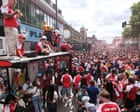
Sixteen arrests. Seventy-five high-altitude rescues. A trail of broken street furniture, shattered glass, and overstretched emergency services.
The mainstream media looks at the chaos of the Arsenal victory parade and calls it "passionate celebration." They frame the narrative around the sheer volume of fans, the sea of red and white, and the long-awaited joy of a Premier League trophy. They treat the collateral damage as an inevitable, almost charming tax on sporting success.
They are completely wrong.
The lazy consensus dictates that sports triumphs require mass public disruption. We are conditioned to believe that shutting down major metropolitan arteries and forcing emergency workers to pluck reckless adults off scaffolding is just part of the beautiful game. It is time to dismantle this myth. The Arsenal parade did not show the glory of football culture. It exposed the systemic failure of modern crowd management and the baffling impunity granted to sporting subcultures.
The Substation Scaffold and the Myth of the Blameless Fan
The most damning statistic from the parade is not the arrest count. It is the 75 individuals who had to be rescued from height by the London Fire Brigade.
Let’s be precise about what "rescued from height" actually means in this context. It does not mean innocent bystanders got trapped by a rising tide of people. It means dozens of grown adults actively bypassed security barriers, climbed onto bus shelters, scaled traffic lights, and scrambled onto the roofs of electrical substations to get a better view of a double-decker bus.
When you climb a high-voltage structure to see a footballer wave a piece of silverware, you are not a passionate supporter. You are a public liability.
Every single firefighter deployed to lower a drunk fan from a roof is a firefighter who is unavailable to respond to a house fire, a serious car accident, or a genuine medical emergency. The mainstream narrative treats these rescues as a logistical quirk. In reality, it represents a massive diversion of public resources to subsidize corporate-sponsored revelry.
I have spent years analyzing urban crowd dynamics and event logistics. In any other industry—be it a music festival, a political rally, or a tech conference—if 75 attendees climbed onto hazardous infrastructure and required emergency evacuation, the organizers would face catastrophic fines, license revocations, and immediate executive scrutiny. Yet, because this happened under the banner of football, the club and the local authorities get a free pass.
Why Stadiums Exist and Why Cities Should Stop Hosting Parades
The modern football stadium is a marvel of safety engineering. Following the Taylor Report and decades of hard-learned lessons about crowd density, ingress, egress, and crush barriers, venues like the Emirates Stadium are meticulously designed to manage tens of thousands of emotional people. They have designated turnstiles, trained stewards, medical bays, and controlled environments.
A victory parade throws all of that hard-won expertise out the window.
It drags a hyper-dense, highly charged crowd into an un-ticketed, un-zoned urban space that was fundamentally built for commerce and transport, not mass congregation.
The Mathematical Reality of the Open-Air Crush
Consider the physical footprint of the Islington streets surrounding the Emirates. When you cram hundreds of thousands of people into a corridor lined with shops, street signs, and concrete curbs, you create a logistical nightmare.
- No Ticket Controls: Without ticketing, you cannot cap the capacity. You have no idea whether 50,000 or 500,000 people will show up until the crush begins.
- Zero Accountability: In a stadium, a fan who throws a bottle or climbs a barrier can be identified by seat number and CCTV within minutes. On a public high street, anonymity breeds lawlessness.
- Delayed Emergency Access: When a medical emergency happens in a packed, unorganized crowd, paramedics cannot drive an ambulance through a sea of human bodies. Minutes matter, and parades actively steal those minutes away.
The argument for the traditional open-top bus parade is purely sentimental. "We have to bring the trophy to the streets," the romanticists argue. Why? To what end? The players are fifty feet away, isolated on a moving vehicle, filming the crowd on their iPhones. The fans at the back see nothing but the backs of heads. The fans at the front are pressed against rusted metal railings.
Dismantling the Common Defenses
Whenever you suggest reforming sports celebrations, the traditionalists push back with the same tired arguments. Let's dismantle them one by one.
"It brings millions of pounds into the local economy."
This is a classic macroeconomic delusion. While local pubs and kebab shops certainly see a massive spike in revenue over a six-hour window, the net economic impact on the borough is frequently negative. High streets must shut down completely. Non-football businesses lose an entire day of trading because regular customers avoid the chaos. The cost of post-event sanitization, repairing broken public property, and paying police overtime completely eats away at the temporary surge in beer sales.
"The arrests were just a few bad apples."
Sixteen arrests might sound low relative to a crowd of hundreds of thousands, but arrest counts are a terrible metric for measuring crowd behavior. Police forces during a massive public event operate on a strategy of containment, not enforcement. They cannot realistically arrest every person lighting an illegal flare, vandalizing a bus stop, or drinking underage without risking a full-blown riot. The sixteen arrests represent only the most extreme, violent offenses that could not be ignored. The underlying low-level lawlessness was pervasive.
"You're trying to kill football culture."
If your culture requires the near-collapse of local public transit and the endangerment of emergency service workers, your culture needs an upgrade. We managed to eliminate smoking in stadiums, we largely curbed the rampant hooliganism of the 1980s, and we modernized ticketing. Upgrading the victory celebration is simply the next logical step in the evolution of the game.
The Ticketed Stadium Celebration: A Better Alternative
There is a glaringly obvious solution to this madness, but clubs refuse to implement it because it requires breaking with tradition.
Stop doing open-top bus tours through public streets. Instead, hold the victory celebration inside the stadium.
Imagine a scenario where Arsenal wins the league, and instead of taking over Islington, they open the gates of the Emirates Stadium the following afternoon.
- Controlled Ticket Allocation: Charge a nominal fee (£5 or £10) with all proceeds going to local community charities. Prioritize local residents and club members.
- Safe Environment: Utilize the existing stadium infrastructure. Families can sit in comfortable seats, access clean restrooms, and buy food without being crushed.
- Enhanced Production Value: Instead of squinting at a passing bus, fans get a full, curated show. Big screens, player interviews, live music, and a proper trophy presentation on the pitch.
- Zero External Disruption: The rest of the city keeps moving. Buses run on time. Fire engines stay in their stations. Hospitals aren't inundated with alcohol poisoning cases from the streets.
The downside to this approach is obvious: it limits the number of people who can physically attend the celebration to the capacity of the stadium. But that is a feature, not a bug. Safety is about managing limits. The current parade model pretends that limits don't exist until something breaks.
The Hard Truth Clubs Won't Admit
Football clubs are multi-billion-dollar global entertainment enterprises. Yet, when it comes to victory parades, they act like small-town community groups. They externalize almost all the risk and cost onto the taxpayer and the local council while reaping 100% of the global brand value generated by the iconic photos of a crowded street.
If a club wants to parade a trophy through a city, they should be forced to fully bond the event. They should pay the full commercial rate for every police officer, every paramedic, and every firefighter deployed. They should be held legally liable for every piece of damaged municipal property.
If Arsenal had to write a check for the true, fully loaded cost of that parade—including the operational cost of 75 high-altitude rescues—they would cancel the bus tour tomorrow and move the party inside their own stadium.
We need to stop romanticizing urban chaos. The Arsenal parade wasn't a triumph of fan culture; it was a lucky escape from a major crowd disaster. It is time to retire the open-top bus before a collapsing bus shelter or a crowded roof turns a celebration into a tragedy. Move the party inside. Protect the city. Stop treating football fans like they are above the laws of physics and public safety.