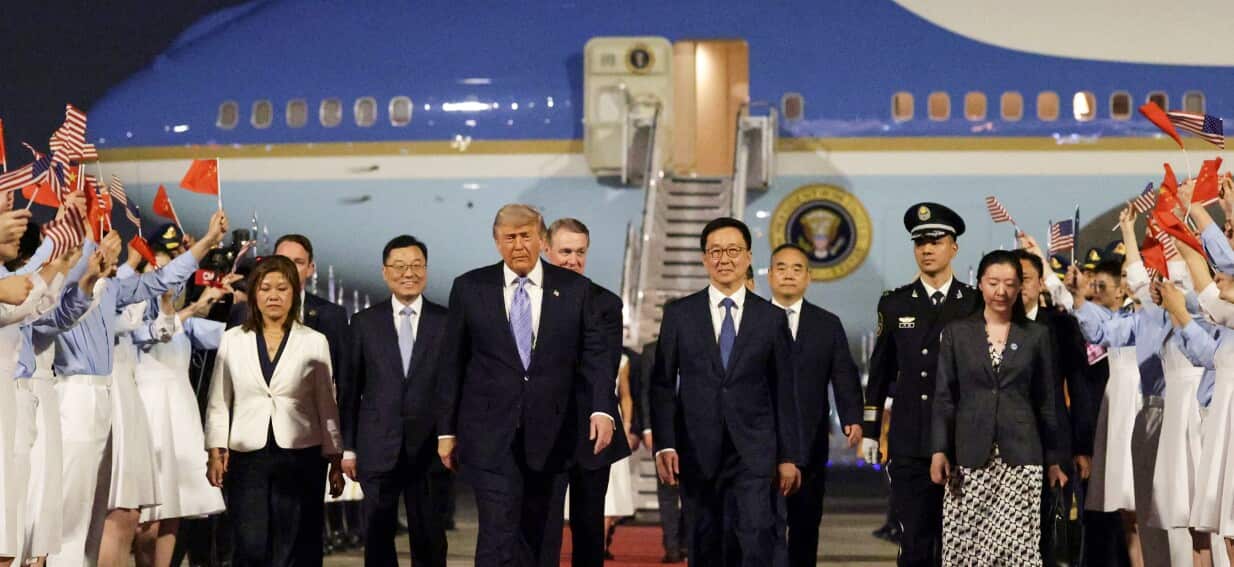
The media is currently obsessed with the optics of high-stakes diplomacy. You see the headlines: "Tariffs on the Table," "Taiwan Sovereignty at a Crossroads," and "The Iran Nuclear Shadow." They paint a picture of a zero-sum boxing match where a few days in Beijing will decide the fate of the global economy.
They are wrong. They are focusing on the noise while ignoring the signal.
The standard narrative suggests that a U.S. President visiting China is there to "extract concessions" or "demand fairness." This premise is flawed because it assumes the 20th-century geopolitical playbook still functions in a world of decoupled supply chains and hyper-advanced domestic subsidies. If you think this visit is about balancing the trade deficit or "fixing" the Taiwan Strait, you’ve already lost the plot.
The Tariff Fallacy and the Death of Low-Cost Manufacturing
Pundits love talking about tariffs because they are easy to explain. They are the blunt instruments of trade. But here is the truth that mainstream analysts refuse to admit: Tariffs are no longer a deterrent to Chinese state-backed firms; they are a catalyst for their evolution.
I have sat in boardrooms from Shenzhen to Ohio. When the U.S. imposes a 25% duty, the "lazy consensus" says Chinese companies will fold or move to Vietnam. Some do. But the ones that matter—the giants in EV batteries, solar glass, and telecommunications—simply automate. They use the pressure to purge their own inefficiencies.
By the time a U.S. President lands to discuss "relief" or "fairness," the Chinese industrial machine has already pivoted. They aren't selling us cheap plastic anymore. They are selling us the high-end components we can no longer make ourselves.
The Hidden Data on Trade Deficits
- Fact: The U.S. trade deficit with China is often cited as a sign of American weakness.
- Contrarian Reality: It is actually a sign of American consumption addiction fueled by a lack of domestic industrial capacity.
- The Nuance: Even if China stopped exporting tomorrow, that deficit wouldn't vanish; it would just migrate to Mexico or India, likely with higher costs and lower quality.
Focusing on the deficit during a state visit is like a doctor treating a fever while ignoring the stage-four infection. The "infection" is the hollowed-out U.S. manufacturing base, and no amount of tough talk in the Great Hall of the People will magically rebuild a factory in Michigan.
Taiwan is a Distraction for the Tech War
The "People Also Ask" sections of the internet are filled with questions about whether this visit will "stabilize" the Taiwan situation.
It won't. Stability is an illusion used to keep markets from panicking.
The real battle isn't over an island; it’s over the lithography machines and the silicon that comes off them. China doesn't want Taiwan just for the land; they want the ecosystem. The U.S. position on Taiwan is increasingly tied to the CHIPS Act and the desperate attempt to bring advanced node manufacturing back to Arizona.
When the two leaders sit down, the public hears about "freedom of navigation." Behind closed doors, they are talking about export controls on gallium and germanium.
Why the Status Quo is a Lie
We pretend there is a "One China" policy that everyone agrees on. In reality, it is a strategic ambiguity that has reached its expiration date. By focusing on the military posturing, the U.S. misses the economic reality: China is currently building its own closed-loop semiconductor supply chain. They are spending hundreds of billions—far more than the U.S. CHIPS Act—to ensure that by 2030, American "leverage" on chips is non-existent.
The Iran Gambit: Geopolitics as a Bargaining Chip
The competitor's article likely frames Iran as a "security concern." This is a shallow take.
To Beijing, Iran is not a security concern; it is a cheap gas station and a way to keep the U.S. bogged down in the Middle East. China’s 25-year strategic agreement with Iran isn't about shared values. It’s about energy security and ensuring the U.S. cannot pivot its full military and economic weight to the Indo-Pacific.
Every time a U.S. President asks China to "help" with Iran, China asks for a "discount" on trade restrictions. It is a brilliant, cyclical leverage play. They trade compliance in a region they don't care about for dominance in the industries of the future.
The Failure of Corporate Diplomacy
I've seen CEOs join these trade delegations thinking they are there to open markets. They aren't. They are there as props.
Western companies like Apple or Tesla have built such massive dependencies on Chinese infrastructure that they effectively function as lobbyists for Beijing in Washington. When the President threatens tariffs, it’s the American CEOs who scream the loudest.
The Illusion of "Winning"
If the visit ends with a $200 billion purchase agreement for Boeing planes or Iowa soybeans, the media will call it a "win."
It is a loss.
These "purchasing agreements" are temporary, non-binding PR stunts. They do nothing to address the structural theft of intellectual property or the forced technology transfers that occur in the shadows. We trade our long-term technological supremacy for a short-term bump in the quarterly export data.
Moving Toward a Realistic Decoupling
The most "counter-intuitive" advice I can give is this: Stop trying to "fix" the relationship.
The relationship is broken because the interests are fundamentally misaligned. China wants to be the global hegemon by 2049. The U.S. wants to maintain a rules-based order it created in 1945. These two goals cannot coexist.
The "brutally honest" answer to how to handle these visits? Treat them as competitive intelligence gathering, not diplomacy.
Actionable Reality for Business Leaders
- Stop Betting on "Stability": If your supply chain relies on a "thaw" in U.S.-China relations, you are gambling with your shareholders' money.
- Audit Your Software, Not Just Your Hardware: The next wave of conflict isn't in physical goods; it’s in the data pipelines. If your data passes through Chinese servers, it belongs to the state. Period.
- Recognize the Subsidy Gap: You cannot compete with a company that has the literal treasury of the world's second-largest economy as its venture capital fund. You must differentiate through agility, not scale.
The Great Hall of Mirrors
The pomp and circumstance of the Beijing visit is a performance for two different domestic audiences. Trump needs to look like the "Art of the Deal" master for his base. Xi needs to look like the respected global elder who can manage the "barbarians."
Neither side is actually interested in the "agenda" items the press is reporting.
The real agenda is the quiet, methodical reorganization of the world into two distinct technological spheres. One led by the U.S. (with its aging infrastructure and fractious politics) and one led by China (with its top-down digital authoritarianism).
If you are looking for a "breakthrough" on this trip, you are looking for a ghost. The breakthrough happened years ago when we realized the "Golden Age of Globalization" was actually just a massive transfer of wealth and capability that cannot be undone by a few days of meetings and a state dinner.
The U.S. is playing checkers. China is playing Go. And the media is reporting on the snacks served at the table.
Stop asking if the visit will "succeed." Start asking how much more of the future we are willing to trade for a peaceful headline today.
Don't watch the handshake. Watch the export logs. That’s where the real war is being lost.
The Cost of the Status Quo
Every year we maintain the "lazy consensus" of engagement without enforcement, we lose approximately $200 billion to $600 billion in intellectual property theft, according to the Commission on the Theft of American Intellectual Property. That is the equivalent of losing a Fortune 50 company every year.
A state visit doesn't stop this. It masks it.
We are currently witnessing the managed decline of Western industrial relevance, packaged as "complex diplomatic negotiations." If that makes you uncomfortable, good. You’re finally paying attention.
The era of the "Global Citizen" is dead. We are back to the era of the "Industrial Fortress." You either build yours, or you live in someone else's.
The flight back to D.C. will be full of "optimistic" briefings and "productive" talk. Ignore them. The only thing that changed in Beijing was the date on the calendar. The trajectory remains exactly the same.
Trade isn't the goal. Power is. And power doesn't negotiate; it occupies.
The deal isn't coming. The divorce is already finalized. We're just arguing over who keeps the furniture while the house is on fire.