The global energy market is currently staring down the barrel of a literal explosion. President Donald Trump just issued a warning that makes his previous rhetoric look like a polite suggestion. He’s told Tehran in no uncertain terms that if they touch Qatar’s gas infrastructure one more time, the U.S. will "massively blow up" the entire South Pars gas field. This isn't just another social media post. It’s a red line drawn right across the world's most valuable patch of ocean.
If you’re wondering why this matters to you, look at the price of gas at your local station or your heating bill. The South Pars field, which Iran shares with Qatar (where it's called the North Dome), is the largest natural gas reservoir on the planet. We’re talking about 51 trillion cubic meters of gas. It's the heart of Iran’s economy and the backbone of Qatar’s wealth. Also making headlines in related news: The Kinetic Deficit Dynamics of Pakistan Afghanistan Cross Border Conflict.
The trigger for the threat
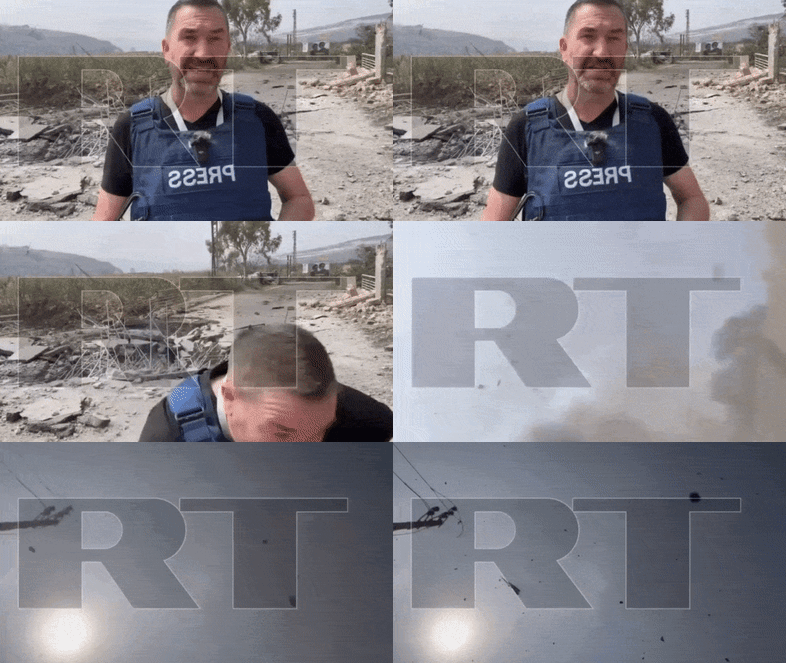
Things spiraled out of control on Wednesday when Israel "violently lashed out"—Trump’s words—at the South Pars field. It was a limited strike on a relatively small section, but it hit a nerve. Tehran didn’t wait. They immediately retaliated by firing ballistic missiles at Qatar’s Ras Laffan Industrial City.
Tehran’s logic was simple: since Qatar shares the field with them, they’d make Doha pay for the Israeli strike. But Trump is pushing a different narrative. He’s insisting that Qatar was "in no way, shape, or form" involved in the Israeli attack. He’s even claiming the U.S. had no prior knowledge of Israel’s move, though some reports from the Pentagon suggest otherwise. Further details regarding the matter are covered by TIME.
Why South Pars is the ultimate target
You can’t overstate how vital this field is. For Iran, South Pars provides about 80% of its domestic electricity. If it goes up in smoke, Iran goes dark. Literally. It’s not just about exports; it’s about basic survival for the Iranian people.
Trump knows this. By threatening the "entirety" of the field, he’s threatening to wipe out Iran’s future as a modern state. It’s a high-stakes gamble intended to stop the tit-for-tat strikes that have already paralyzed the Strait of Hormuz. Right now, about a fifth of the world’s oil and a massive chunk of Liquefied Natural Gas (LNG) are stuck because the shipping lanes are effectively closed.
The Qatar connection
Qatar is in a nightmare spot. They’re a tiny peninsula stuck between a vengeful Iran and a hyper-aggressive U.S.-Israeli alliance. They host the largest American airbase in the region (Al Udeid), but they also need to stay on speaking terms with Iran to keep the gas flowing from their shared field.
After the Iranian missiles hit Ras Laffan, Qatar didn’t just complain. They expelled Iranian military and security attaches. That’s a massive diplomatic break for a country that usually tries to play both sides. It shows just how much damage the Iranian strike actually did.
What happens if the field is destroyed
Let’s be real: if Trump actually follows through, the environmental and economic fallout would be staggering.
- Methane Leaks: The wells in South Pars operate at extreme pressures. If they’re blown up, we could see uncontrolled methane releases that would make previous industrial disasters look like a campfire.
- Global Supply Shock: Even though Iran uses most of its gas domestically, the shock to the global market would be instant. Europe’s gas prices already jumped 35% just on the news of the threat.
- Regional Blackouts: It’s not just Iran. Iraq relies on Iranian gas for about 40% of its power. If South Pars is gone, Baghdad goes dark too.
Trump’s strategy of maximum pressure 2.0
Trump says he doesn't want to "authorize this level of violence" because of the long-term impact on Iran’s future. It’s a classic "tough love" stance. He’s trying to play the role of the adult in the room by telling Israel to stop hitting the gas field while telling Iran that the U.S. will do much worse if they don't back off Qatar.
Honestly, it’s a terrifying game of chicken. Iran has already listed major energy sites in Saudi Arabia and the UAE as "legitimate targets." We aren't just talking about a border skirmish anymore. This is a full-blown energy war.
If you’re invested in the markets or just worried about the cost of living, keep a very close eye on the Persian Gulf over the next 48 hours. If one more missile lands near a Qatari LNG tanker, the "Fire and Fury" we heard about years ago might actually arrive in the form of a leveled gas field.
Check your local energy provider's latest rate forecasts and consider locking in prices if you haven't already. The volatility we're seeing today is likely just the beginning of a long, expensive summer.