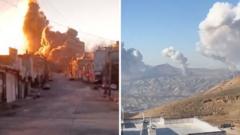
Tensions in the Persian Gulf just hit a fever pitch that feels different from the usual saber-rattling. You’ve likely seen the conflicting headlines. On one side, Tehran claims it launched a "massive" strike against a U.S. naval base in Bahrain. On the other, U.S. officials are reporting the successful destruction of a critical Islamic Revolutionary Guard Corps (IRGC) command node. Someone is lying, or at the very least, stretching the truth until it snaps.
When the dust settles on these kinds of reports, the reality usually sits somewhere in the middle. But in this case, the stakes involve the U.S. Navy’s 5th Fleet and the most elite branch of the Iranian military. It’s a mess of propaganda, electronic warfare, and genuine kinetic strikes. We need to look at what actually happened on the ground and in the water, not just what the press offices are churning out.
Why Bahrain is the Ultimate Pressure Point
Bahrain isn't just another desert island. It hosts the U.S. Naval Forces Central Command (NAVCENT). This is the heart of American maritime power in the Middle East. If Iran actually landed a "massive" blow here, the global oil market would be in a tailspin.
The IRGC claims their drones and missiles bypassed sophisticated air defenses to hit the base. They're painting this as a direct retaliation for recent hits on their commanders. It’s a bold claim. Bahrain is packed with Patriot missile batteries and integrated naval defense systems. To hit it effectively, you don't just need luck. You need to overwhelm the system with sheer volume or sophisticated jamming.
Iran loves the optics of this. Even if a single drone gets through and hits a parking lot, they'll call it a "historic victory." For the U.S., any admission of a breach is a PR nightmare. It signals a vulnerability in the very shield meant to keep the Strait of Hormuz open.
The Destruction of the IRGC Command Node
While Iran was busy broadcasting its alleged success, the Pentagon dropped a bombshell of its own. U.S. forces reportedly took out an IRGC command and control center. This wasn't a random tent in the woods. We're talking about a coordinated strike on the brains of the operation—the people who plan the drone swarms and the fast-boat harassments.
The U.S. military has been tracking these nodes for months. Taking one out isn't just about killing people; it's about degrading their ability to communicate. If you can't talk to your units, you can't fight. The timing of this "destruction" is a clear message. It says, "We know where you live, and we can hit you while you’re busy trying to hit us."
Experts in regional security often point out that the IRGC operates with a degree of autonomy. Losing a command node causes immediate chaos in the local chain of command. It forces the remaining leaders to go into hiding, which further slows down their operational tempo.
Sifting Through the Fog of War
You have to be skeptical of both sides. In 2020, after the Soleimani strike, Iran claimed hundreds of U.S. casualties at Al-Asad Airbase. The real number was zero fatalities, though many suffered traumatic brain injuries. We’re seeing a similar script play out today.
Iran needs to look strong for its domestic audience and its proxies in Lebanon, Yemen, and Iraq. If they don't look like they’re punching back, they lose face. The U.S., conversely, needs to project total dominance to keep allies like Saudi Arabia and the UAE from panicking.
- Watch the satellite imagery. Commercial firms like Maxar or Planet Labs usually release "before and after" shots within 48 hours. If the Bahrain base is intact, Iran’s claim is a bust.
- Check the shipping lanes. If tankers are still moving through the Persian Gulf without a spike in insurance premiums, the "massive attack" didn't do much damage.
- Listen for the silence. Sometimes the most telling sign is what isn't said. If the IRGC goes quiet for a week, it’s a good bet their command structure really did take a heavy hit.
The Strategy of Deniability and Escalation
What we're seeing is a classic "gray zone" conflict. It’s not a full-scale war, but it’s definitely not peace. Iran uses its proxies to create a buffer, but this direct claim of hitting a base in Bahrain is a shift. It's an escalation.
The U.S. response—hitting a command node—is a surgical way to push back without starting World War III. By targeting the IRGC directly rather than Iranian civilian infrastructure, the U.S. is trying to keep the fight professional. Or as professional as a high-stakes missile exchange can be.
The 5th Fleet is currently on high alert. You don't just ignore a claim of a massive attack, even if you think it's mostly hot air. They're likely running 24/7 combat air patrols and ramping up their signals intelligence to see where the next move is coming from.
The Role of Electronic Warfare
Don't overlook the "invisible" fight. Part of the U.S. claim about destroying the IRGC command involves disrupting their electronic signatures. In modern warfare, if you can "blind" your enemy, the kinetic strike is just the finishing move.
The IRGC has been investing heavily in electronic warfare (EW) to counter U.S. drone tech. If the U.S. successfully dismantled a command node, it likely means they cracked the EW shield Iran was hiding behind. That’s a massive win for Western intel. It tells the Iranians that their "secret" locations aren't actually secret.
What This Means for Regional Stability
If you're living in Manama or working in the oil industry, this is terrifying. But for the rest of the world, it's a grim reminder that the Middle East is a powder keg with a very short fuse.
The "attack" on Bahrain, even if exaggerated, proves that Iran is willing to target U.S. assets in sovereign neighboring countries. That puts Bahrain in a tough spot. They want the protection of the U.S. Navy, but they don't want to be the battlefield for a proxy war.
Expect more "tit-for-tat" actions. The U.S. probably won't stop at one command node if they feel the threat to the 5th Fleet is growing. Iran won't stop its propaganda machine because it's their cheapest and most effective weapon.
Keep your eyes on the official Pentagon briefings for hardware specifics. If they start moving more carrier strike groups into the North Arabian Sea, they’re expecting more than just talk. For now, treat the "massive attack" with a healthy dose of doubt. The real story is the surgical dismantling of the IRGC’s ability to coordinate. That’s the move that actually changes the board.
Monitor the regional flight trackers. When high-level military transport planes start making unusual loops around Bahrain and Qatar, you know the logistical cleanup or reinforcement is underway. Watch the crude oil futures; they are the most honest indicator of how much the world actually believes these reports of "massive" destruction.