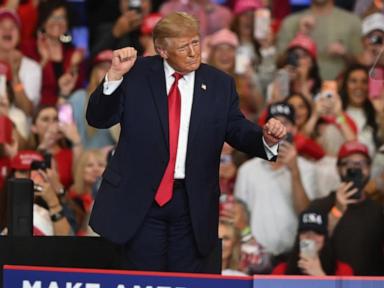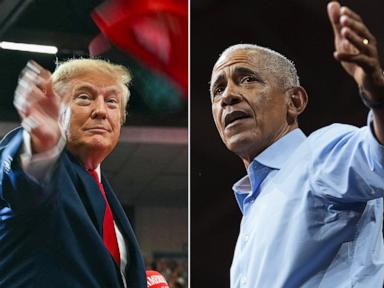
The rain in Dayton does not fall so much as it hangs, a gray, persistent mist that smells faintly of wet asphalt and old iron. Inside a cavernous airport hangar on the edge of town, ten thousand people are waiting for a man who is no longer on the ballot, yet somehow remains the only name anyone in the room actually came to vote for.
Five hundred miles south, under the heavy, humid twilight of an Atlanta suburb, another crowd is pressed shoulder-to-shoulder against steel barricades. They are waiting for a man who left the Oval Office a decade ago, yet whose voice still vibrates through their memories like a tuning fork struck against glass.
If you read the standard wire reports—the dry, breathless ticker-tape updates that flood your phone every eleven minutes during the final stretch of a midterm cycle—this is simply a scheduling note. Donald Trump heads to Ohio. Barack Obama rallies in Georgia. A box checked. A flight manifest logged. Two political titans deployed like heavy artillery to shore up vulnerable Senate seats and swing districts before the polls open on Tuesday.
That version of the story is accurate, and it is completely blind.
To understand what is actually happening in the final days of an American midterm election, you have to stop looking at the podiums and start looking at the folding chairs. You have to look at the calloused hands gripping plastic cups of lukewarm coffee in Ohio, and the tired eyes squinting against stadium floodlights in Georgia. Because when two former presidents barnstorm the country in an off-year election, they are not merely campaigning for candidates. They are fighting a proxy war over memory, identity, and the terrifying feeling that the country you recognize is slipping through your fingers.
The Architecture of a Proxy War
Midterm elections have always suffered from an enthusiasm problem. Without the grand, cinematic sweep of a presidential race, turnout historically plummets. Voters stay home. The mechanics of governance—committee chairmanships, judicial confirmations, razor-thin legislative majorities—feel too abstract to pull a exhausted parent away from Tuesday night dinner prep.
Think of a midterm election like the foundation of a house. Nobody invites the neighbors over to admire the poured concrete in the basement. Everybody wants to talk about the paint color in the living room or the view from the upstairs balcony. Yet if the concrete cracks, the entire structure tilts.
Political strategists know this. They know that raw policy rarely moves millions of people to stand in line at a local elementary school gymnasium on a rainy November morning. Fear moves them. Pride moves them. Belonging moves them.
And so, in the closing hours of the campaign, both parties reach for their ultimate trump cards—the men who define their modern eras.
Consider a hypothetical voter in Montgomery County, Ohio. Let’s call him Miller. Miller is fifty-eight, spent thirty years working logistics for a regional supplier, and watches his grocery bill climb every Friday afternoon while his 401(k) statement arrives in the mail like a report card he is afraid to open. Miller doesn't particularly care about the Senate candidate whose name is printed on the yard signs lining the highway. The candidate speaks in polished, focus-grouped cadences that sound like they were written by a committee in Washington.
Miller isn't driving forty minutes in the drizzle to hear a stump speech about subcommittee appropriations. He is going to the hangar because when Donald Trump steps up to the microphone, Miller feels seen. For two hours, the grievances he swallows at the dinner table—the sense that the rules changed mid-game, that the factories closed while the consultants got rich—are shouted back at him through a wall of speakers.
Now shift the camera south to DeKalb County, Georgia. Picture a twenty-nine-year-old middle school teacher—let’s call her Elena. Elena is buried under student debt, exhausted by culture-war battles bleeding into her classroom, and deeply anxious about the future of voting rights and reproductive freedom in her state. She likes the Democratic Senate nominee well enough, respects the resume, appreciates the steady temperament.
Still, fatigue is a heavy coat. After months of relentless text messages begging for five dollars and apocalyptic fundraising emails warning that democracy will end at midnight, Elena is numb. She needs a reason to believe that showing up actually bends the arc of anything. When Barack Obama walks onto that stage in Georgia, sleeves rolled up, cadence measured and warm, he isn't just reading off a teleprompter. He is selling Elena back her own hope—reminding her of a version of America that felt forward-looking, dignified, and expansive.
Neither Miller nor Elena is casting a ballot for the man on the stage. Yet without the man on the stage, neither of them might cast a ballot at all.
Why Ohio and Georgia Hold the Levers
There is nothing accidental about the geography of these final rallies. In American politics, maps are destiny, and the road to controlling the United States Senate runs directly through the industrial Midwest and the changing Sun Belt.
Ohio and Georgia represent two entirely different chapters of the same American story.
For decades, Ohio was the ultimate bellwether—a state that mirrored the nation’s demographic and economic center of gravity with eerie precision. If you won Ohio, you won the White House. Over the last ten years, however, the state has drifted rightward, pulled by a populist current that reshaped working-class communities from Toledo to the Appalachian foothills. Yet in a midterm year, when traditional Democratic voters are fired up and suburban moderates remain wary of Republican extremism, Ohio suddenly turns back into a knife fight. A Senate race here tests whether populist loyalty can be transferred from a charismatic leader to a hand-picked successor.
History shows that transferring political magic is notoriously difficult. In 2010 and 2014, Barack Obama watched his party suffer historic midterm losses precisely because the coalition that turned out for him in presidential years failed to materialize when his name wasn't at the top of the ticket. Charisma is not an heirloom; you cannot simply leave it to your political heirs in a will.
Georgia, meanwhile, is the mirror image of Ohio’s trajectory. Long a reliable pillar of the conservative South, the state has been transformed by rapid urbanization, a booming film and tech sector around Atlanta, and years of grassroots organizing that turned demographic shifts into political power. When Georgia flipped blue in 2020 and then delivered two Democratic Senate seats in a dramatic January 2021 runoff, it shattered the political calculus of the entire country.
Now, Georgia is the ultimate stress test. Can a newly minted battleground hold its ground when economic anxiety—inflation, gas prices, interest rates—weights down the party in power? Historically, the president’s party almost always takes a beating in the midterms. Since the Civil War, the party holding the White House has lost seats in the House of Representatives in nearly every single midterm election, with only rare exceptions like 1998 and 2002.
That historical gravity is brutal. It pulls down even the strongest candidates.
To defy gravity, you need thrust. You need an event massive enough to warp the local atmosphere.
The Mechanics of the Rally
I have stood inside those arenas and airport hangars more times than I care to count, and the physical sensation never quite leaves you. Long before the headliner arrives, the room becomes an ecosystem of its own.
Hours before the speeches begin, the playlist loops the same five or six anthems—classic rock in Ohio, soul and contemporary pop in Georgia—until the bassline vibrates inside your ribcage. Vendors work the perimeter selling twenty-dollar t-shirts and plastic flags. Strangers strike up conversations in the concession lines that skip right past small talk and dive straight into existential dread.
You realize quickly that a political rally is not a debate. Nobody comes to weigh policy white papers. It is a ritual of collective reassurance.
When you spend your days scrolling through an algorithm designed to keep you furious and isolated, standing in a room with ten thousand people who nod at the exact same sentences feels like coming up for air. The isolation breaks. For one evening, you are not a solitary screen-glowing speck of data; you are part of a crowd.
Trump understands this instinct at a cellular level. Watch him work a crowd in Ohio and you see a master of call-and-response. He wanders off the teleprompter for forty minutes at a time, riffing on local landmarks, mocking journalists sitting in the press pen ten yards away, turning complex geopolitical crises into punchlines. Critics call it rambling. Supporters experience it as intimacy. He makes a rally of thousands feel like a late-night conversation at the end of a diner counter.
Obama operates on an entirely different frequency, yet the underlying psychology is remarkably similar. Watch him take the stage in Georgia and the temperature in the venue shifts instantly. He leans into the cadence of a constitutional lawyer mixed with a Southern Baptist preacher—pausing just long enough for the applause to crest, lowering his voice to a near-whisper when he wants the arena to lean forward, calling out hecklers not with rage, but with a wry, knowing smile that tells the crowd: We are the adults in the room.
Both men are selling the exact same product in different packaging: certainty in an uncertain world.
The Invisible Stakes Beneath the Noise
It is easy to get swept up in the theater of it all—the motorcades, the Air Force One lookalike jets taxiing onto tarmacs, the cable news chyrons flashing BREAKING NEWS in crimson banners across the bottom of the screen. The spectacle is intoxicating.
It is also a distraction.
Because while the cameras track the helicopters lifting off from Ohio and Georgia, the actual consequences of Tuesday’s vote will play out in quiet, unglamorous rooms where no television crews ever set foot.
Control of the Senate determines who sits on federal appellate courts for the next thirty years—judges who will decide the fate of environmental regulations, labor disputes, and civil rights cases long after today’s headlines have turned to dust. Control of the House determines whether the next two years are spent passing bipartisan infrastructure and healthcare adjustments, or locked in an endless cycle of subpoenas, government shutdown standoffs, and debt-ceiling brinkmanship that sends tremors through global markets.
And down the ballot—in the races for governor, secretary of state, and state legislature in places like Ohio and Georgia—voters are deciding who certifies the next presidential election, how district maps are drawn for the next decade, and what kind of medical care is legal within state lines.
These are not abstract talking points. They are the guardrails of daily life.
When those guardrails bend, real people hit the ditch. A small business owner waiting on a federal loan guarantee feels it. A family trying to navigate Medicare prescription caps feels it. A young couple deciding whether to start a family in a state with shifting healthcare laws feels it.
Yet try explaining judicial confirmation math to someone who just worked a twelve-hour shift at a distribution warehouse. Try explaining debt-ceiling mechanics to a mother juggling two jobs and a broken transmission. You will lose them before you finish the first sentence.
And that is why the ghosts are summoned.
The Risk of Relying on Yesterday’s Heroes
There is a quiet vulnerability hidden inside this final-weekend strategy, though neither campaign will ever admit it on the record. Deploying former presidents is a high-wire act without a net.
Every time Trump takes a stage in Ohio, he energizes his base to a fever pitch—and simultaneously reminds swing voters in the Columbus and Cincinnati suburbs of every chaotic headline they hoped they had left behind. He turns a local referendum on inflation and the current administration into a referendum on himself. For Democrats struggling against economic headwinds, there is no greater gift than making the election a choice between two imperfect parties rather than a grade on the party in power.
Meanwhile, every time Obama steps up to a podium in Georgia, he illuminates a stark generational gap. He reminds Democratic voters of how electric politics used to feel—which can inadvertently highlight how flat current leadership sometimes sounds by comparison. You cannot run forever on nostalgia for 2008. Eventually, a movement has to stand on its own feet without leaning on its founding father.
Politics is merciless about nostalgia. Voters may love the greatest hits, they may sing along to every chorus in the arena, and they may buy the tour merchandise on the way out.
When they step behind the curtain on Tuesday morning, however, they are alone with a pencil and a piece of paper.
The Silence After the Engines Fade
Around midnight, the rallies end.
In Ohio, the hangar doors roll open to the damp chill. Tail lights snake out onto the two-lane highway in a slow, red ribbon as thousands of pickup trucks and sedans head back toward dark neighborhoods and alarm clocks set for 5:30 a.m. Inside the empty building, crews begin rolling up miles of black audio cable while trash cans overflow with crushed water bottles and discarded rally signs.
In Georgia, the stadium floodlights click off one by one with a heavy metallic clunk. The chants fade into the hum of cicadas and distant highway traffic. Volunteers pack up folding tables, their voices hoarse from shouting over the crowd, their feet aching on the concrete.
The planes lift off into the dark, climbing above the cloud deck toward the next tarmac, the next state, the next breathless live update.
Down below, the noise stops. The speeches dissolve into the night air. What remains is an ordinary house on a quiet street, a kitchen light glowing softly through the blinds, and a single citizen sitting at the table with a sample ballot spread out beside a cold cup of tea, trying to decide who gets to hold the keys.