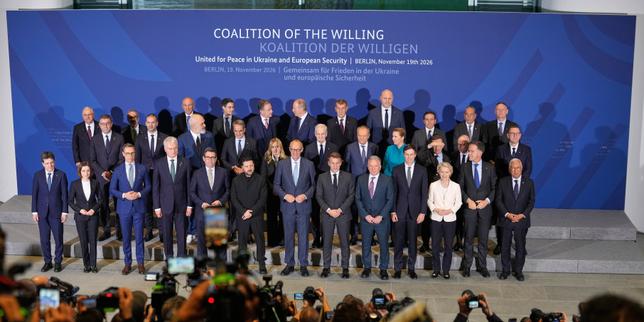
On November 19, 2026, two diplomatic gatherings separated by five thousand miles exposed a stark fault line in global power. In Shenzhen, Chinese President Xi Jinping hosted Donald Trump and Vladimir Putin on the sidelines of the Asia-Pacific Economic Cooperation summit, staging a trilateral meeting that treated the world’s security architecture as a three-way negotiation among superpowers. Hours later in Berlin, roughly three dozen governments assembled for the Coalition of the Willing alongside Ukrainian President Volodymyr Zelensky, NATO Secretary General Mark Rutte, and European Commission President Ursula von der Leyen to hammer out air defense deliveries, winter ballistic missile protection, and a €45 billion loan package for 2027.
The split screen was unmistakable. While Shenzhen produced a sweeping, five-paragraph "declaration toward peace" that managed to avoid mentioning the war in Ukraine altogether, Berlin functioned as an emergency triage room for a European continent trying to ensure it is not carved up in absentia.
The Architecture of a Diplomatic Split Screen
German Chancellor Friedrich Merz stated the anxiety in Berlin without diplomatic hedging. "A Yalta format will not bring peace," Merz told reporters, invoking the 1945 conference where Joseph Stalin, Franklin D. Roosevelt, and Winston Churchill redrew European borders while the continent’s smaller nations waited outside the room.
For years, Western capitals insisted that nothing about Ukraine would be decided without Ukraine. The November 19 trilateral in Shenzhen tested that principle to its breaking point. By sitting down with Xi and Trump in a format that excluded both Kyiv and Brussels, Putin achieved a primary strategic objective that had eluded him since the full-scale invasion began in February 2022: visual and diplomatic rehabilitation as an equal arbiter of global order.
Yet calling Berlin a simple "inverted mirror" of Shenzhen misses the more complicated reality happening behind closed doors. Washington did not abandon the European table to attend the Chinese one. Instead, the Trump administration played both rooms simultaneously.
Trump’s special envoys, Steve Witkoff and Jared Kushner, sat inside the Berlin chancellery, briefed Merz directly on the discussions in China, and insisted that Washington had no intention of imposing a unilateral settlement. Trump himself joined the Berlin gathering briefly by video link, later telling reporters that he agreed decisions on Ukraine should not be made behind Kyiv’s back—even as he rated his sit-down with Xi and Putin a "12 out of 10."
This dual-track diplomacy reveals a fundamental divergence in how Washington and European capitals define success. The White House increasingly evaluates Ukrainian actions and Western aid through a single metric: whether they accelerate a negotiated ceasefire. European governments, staring down a land war on their eastern border, evaluate every decision through a different lens: whether Ukraine survives as a sovereign, defensible state capable of deterring future Russian aggression.
What Shenzhen Actually Delivered
Strip away the choreographed handshakes in southern China, and the substance of the Shenzhen summit looks far thinner than Kremlin state television portrayed.
The three leaders issued a joint text praising dialogue, pledging to reduce nuclear risks, and endorsing non-proliferation. There were no breakthroughs on trade tariffs, no binding arms control treaties, no resolution on Taiwan, and no framework for ending the fighting in Donbas. On the first day of the APEC meetings, Trump publicly asked Beijing to purchase more American agricultural products—a transactional overture that analysts at the European Union Institute for Security Studies noted placed the American president in the posture of a supplicant while giving Xi and Putin room to reinforce their shared narrative against Western alliances.
For Moscow, however, symbolism is currency. Earlier in November, during U.S.-mediated talks in Abu Dhabi on November 10 and 11, Russia’s chief negotiator Vladimir Medinsky had explicitly argued that ending the war in Ukraine required redesigning the entire European security order along lines modeled on 1945. Shenzhen gave Putin the stage to project that exact hierarchy. Flanked by the leaders of the world’s two largest economies, the Russian president did not look like an isolated autocrat under Western sanctions. He looked like a peer managing global affairs.
Beijing’s calculus was equally clear. By convening Trump and Putin on Chinese soil, Xi positioned China as the indispensable broker capable of bringing Washington and Moscow into the same room while keeping the focus away from Chinese industrial support for Russia’s defense sector.
Inside the Berlin Triage Room
While Shenzhen traded in grand abstractions, Berlin dealt in hardware, balance sheets, and fractured political will. The Coalition of the Willing—formed in early 2025 as European leaders realized they could no longer rely automatically on American leadership—spent the day confronting three immediate operational bottlenecks:
- Air defense replenishment: Through NATO’s Prioritized Ukraine Requirements List (PURL) mechanism, which pools European funds to purchase American-made interceptors and defense systems for Kyiv, Germany and Norway each committed $300 million during the Berlin session.
- Macro-financial survival for 2027: Delegates debated the European Commission’s proposed €45 billion loan package intended to keep the Ukrainian state solvent through the coming year, an issue scheduled for a decisive European Union leaders' vote the following week.
- Post-ceasefire deterrence: Planners reviewed drafts for legally binding security guarantees, including the thorny question of a European-led multinational reassurance force that would deploy only after hostilities cease.
The ledger from Berlin also exposed the limits of European solidarity. Even with Russian drones and ballistic missiles battering Ukrainian energy infrastructure ahead of winter, burden-sharing remained uneven. Poland, one of Kyiv’s most vocal champions since 2022, declined to pledge new funds to the PURL mechanism in Berlin. Bulgaria indicated it could offer humanitarian assistance rather than weapons from its depleted stockpiles. Slovakia’s Prime Minister Robert Fico boycotted the coalition altogether, declaring that his government "wasn't, isn't, and won't be" part of the initiative.
These internal divisions explain why Merz and his counterparts pushed so aggressively to formalize Europe’s diplomatic representation before the Shenzhen meeting even took place. At an informal EU summit in Dublin on November 13, European Council President António Costa secured agreement on a seven-member negotiating delegation combining European Commission and Council leadership with representatives from Germany, France, Italy, Poland, and the United Kingdom. Europe finally had a phone number and a roster. What it lacked was guaranteed entry into the room where the final terms might be drafted.
Putin’s Moscow Gambit
Within forty-eight hours of the twin summits, the Kremlin moved to exploit the gap between Europe’s desire for relevance and its reluctance to escalate. Through quiet diplomatic channels, Moscow extended an invitation to European leaders to visit the Russian capital for direct talks on ending the war.
Kremlin spokesman Dmitry Peskov confirmed the outreach while refusing to name which capitals had been contacted, noting pointedly that Europe’s newly appointed negotiators had not yet reached out to Moscow. The logic behind the invitation was classic Russian statecraft: argue publicly that European security cannot be discussed without Europe, while offering a bilateral or selective Moscow venue that comes with zero commitment to grant Europeans a formal seat in the primary peace negotiations.
The trap for Berlin, Paris, and London is obvious. Accepting a trip to Moscow without pre-agreed terms or a binding role in the main negotiating track risks handing Putin another diplomatic coup—fracturing EU consensus, legitimizing Kremlin framing, and undercutting Kyiv—without securing a single concession on Ukrainian territory or security guarantees. Refusing the invitation, conversely, allows Moscow to tell Washington and the Global South that European leaders are the ones obstructing dialogue.
The Hard Math Facing Europe
For more than a decade covering European security and defense procurement, one pattern has remained constant: rhetoric in Brussels and Berlin moves at the speed of news cycles, while ammunition production and troop readiness move at the speed of industrial permitting.
Europe’s pushback against a "new Yalta" rests on a legitimate historical grievance and an undeniable geographic reality. A ceasefire negotiated over the heads of Europeans will still require European money to reconstruct Ukraine, European borders to absorb millions of displaced people if the peace collapses, and European armies to deter Russia along a 1,500-mile frontier from the Arctic to the Black Sea.
Yet diplomatic seats are rarely awarded on moral entitlement alone. They are earned through military capacity and financial risk-taking. If EU leaders stall on the €45 billion loan package or allow national budgets to hollow out commitments like the PURL air defense fund, no seven-person negotiating team will carry decisive weight against a Washington eager for a quick deal and a Moscow backed by Beijing’s industrial base.
The Shenzhen declaration proved that great powers can still draft sweeping statements about global stability while ignoring the war burning in Europe’s backyard. Berlin proved that Europe recognizes the danger, even if it has not yet fully paid the price to prevent it. Until European capitals match their diplomatic demands with irreversible financial and military commitments on the ground, the continent will remain stuck reacting to agendas set thousands of miles away.