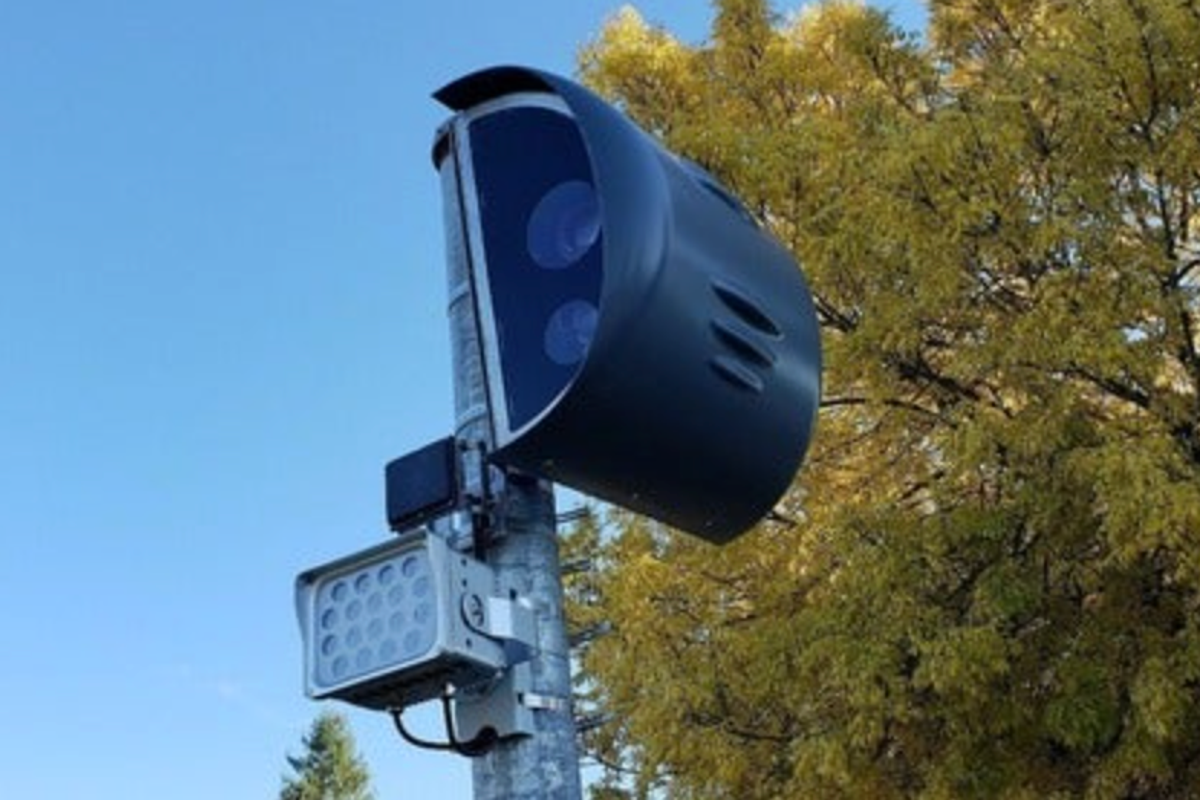
The flash comes at night. It is bright, sharp, and entirely artificial. One moment, you are behind the wheel, navigating the familiar, rain-slicked asphalt of a city street. The next, a sudden, blinding burst of light erupts from the periphery. You think, for a split second, that you hit a patch of sunlight or a reflection from a window.
Then comes the envelope. Two weeks later. A dull, beige windowed envelope sitting in your mailbox, smelling faintly of paper and bureaucracy. Inside, the proof. A grainy, high-contrast photo of your sedan, your license plate, and the grim reality of your speed recorded in cold, immutable numbers.
You have just joined a very large, very frustrated club. Sixty-nine thousand people in just over half a year have shared this experience in Portland.
Think about that number for a moment. Sixty-nine thousand. That isn’t just a statistic buried in a municipal spreadsheet. It is nearly the population of a small city. It represents sixty-nine thousand instances where a driver looked at the road, judged the flow of traffic, and—for whatever reason, whether haste, distraction, or a misunderstanding of a changing speed limit—found themselves on the wrong side of the law.
Take Elena, for instance. She works the late shift at a hospital near the inner city. She knows the roads. She drives them every night at three in the morning when the streets are empty and the world is quiet. She is a cautious driver, usually. But one evening, navigating a stretch where the speed limit drops abruptly from thirty-five to twenty-five, she didn't hit her brakes hard enough. The flash went off.
Weeks later, the fine arrived. It wasn't just the money, though a hundred-plus dollar ticket hurts when you are paying off student loans. It was the feeling of being hunted by an algorithm.
This is the shift occurring on our roads. We are moving away from the era of the human officer—a person who could see the context, who could understand the difference between a dangerous driver and someone who simply crested a hill a few miles too fast. We are entering the era of the machine, where judgment is outsourced to a lens that does not understand nuance. It only understands data.
The city argues this is about safety. They point to the grim reality of traffic fatalities. They talk about Vision Zero, about the need to calm the frantic pace of urban life. And, logically, they are not wrong. Excessive speed kills. We know this. We see the wreckage, the twisted metal, the heartbreak on the evening news. If cameras force people to slow down, if they turn the frantic race of a commute into a sedate crawl, there is a tangible benefit. Lives are saved.
But the friction remains. The resentment grows.
When you increase the volume of enforcement to this magnitude—69,000 tickets in such a brief window—you stop being a guardian of public order and start becoming a revenue stream. There is a psychological tipping point where the citizenry stops respecting the law and starts looking for the traps. You stop watching the road for hazards, for pedestrians, for cyclists. You start watching the road for the cameras. Your eyes dart to the poles, the strange boxes, the reflective glass. You become a paranoid driver.
Is a paranoid driver a safer driver?
The city is planning to add more of these eyes. They are proliferating, spreading through the corridors and the arterials. They are the new architecture of our movement.
Consider the economics of this. When an officer pulls you over, the cost is high—wages, pensions, the time spent on the side of the road. It is inefficient. But it is human. When a camera does the work, the cost is negligible. It is a set-and-forget mechanism that generates constant, automated feedback. There is no off-switch for an algorithm. It is always awake. It is always hungry for the next capture.
There is a hollow quality to this type of enforcement. It doesn't teach better habits; it teaches avoidance. You learn where the boxes are, and you slow down for them, then speed up again the moment you are out of range. You learn to play the system, not to drive with care.
There is an old saying that the map is not the territory. In Portland, the data is not the road.
The data says the city is safer because there are fewer cars breaking the law. The residents say they are living in a city that feels increasingly hostile, a place where the infrastructure is being turned against them. There is a deep, quiet anger simmering in the suburbs and the city centers alike. It is the anger of being watched, of being managed like cargo on a conveyor belt rather than citizens navigating a community.
I remember when the act of driving was different. It was an exercise in autonomy. You assessed the conditions, you accounted for the weather, you respected the shared space of the road. It was a social contract. You didn't drive fast near schools because you cared about the kids, not because there was a machine waiting to mail you a bill.
We have broken that contract, or perhaps it has been stripped away. We replaced trust with surveillance.
Now, look at what happens next. The expansion is already planned. More poles. More flashes. More beige envelopes in the mail. The city will grow tighter, the net finer. We will see the numbers climb from sixty-nine thousand to something much higher.
Is this the version of urban life we signed up for? A place where every turn is documented, every acceleration a potential infraction? We are becoming experts at being watched. We are learning to exist in the glare of the machine.
Maybe the safety is worth the cost. Maybe the trade-off—our privacy and our peace of mind for the promise of a safer commute—is the only rational choice in an era of reckless speed. But as you drive home tonight, watch the road. Look for the flash. Feel that prickle on the back of your neck. That is the feeling of modernity.
The camera is waiting. It doesn't have a conscience. It doesn't have a memory of your long shift at the hospital or the groceries you need to pick up before the store closes. It has a sensor, a shutter, and a bill that will find you, no matter what.
The light hits the windshield. You drive on, into the night, waiting for the mail.


