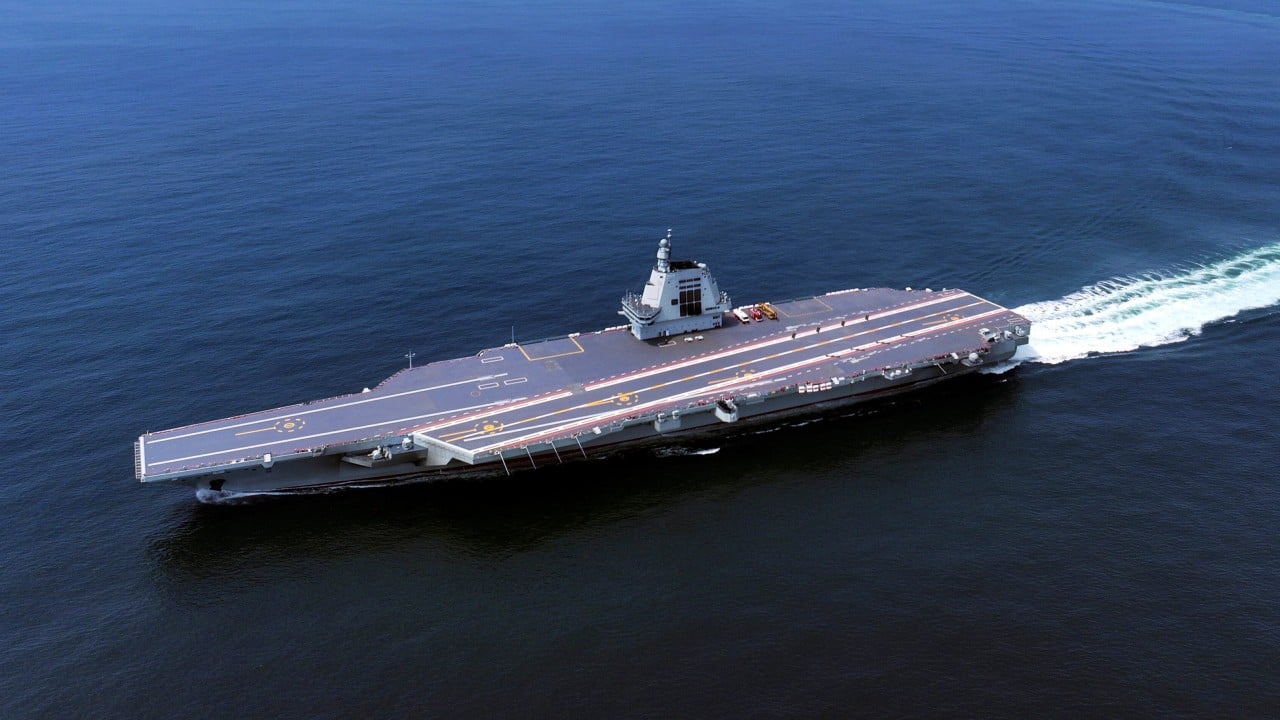
The commissioning of the Type 003 Fujian marks the official arrival of the People’s Liberation Army Navy into the elite club of blue-water supercarriers. Armed with an electromagnetic aircraft launch system and a displacement exceeding 80,000 tonnes, the vessel represents Beijing’s most ambitious attempt to challenge Western maritime dominance in the Western Pacific. Yet, as the hull cutouts and specialized launcher ports observed during its extensive sea trials suggest, China’s newest flagship is haunted by an old, silent adversary. Western hunter-killer submarines remain the most lethal threat to the vessel, prompting Beijing to outfit the carrier with an experimental hard-kill anti-torpedo defense system that even the United States Navy abandoned after years of frustrated testing.
Naval warfare analysts have closely monitored the distinct hull apertures near the stern and quarters of the Fujian. These ports do not match standard close-in weapons systems or anti-ship missile decoys. Instead, they point toward a dedicated, rapid-firing architecture designed to intercept incoming heavyweight torpedoes. The strategic calculus behind this addition is straightforward. While China has spent decades constructing an integrated air defense umbrella capable of swamping incoming cruise missiles with layered surface-to-air missile batteries and rotary cannons, its capabilities beneath the waves remain dangerously thin.
The deep waters beyond the First Island Chain are the natural hunting grounds of the United States Navy Seawolf and Virginia-class fast attack submarines. These vessels are quiet enough to slip through the PLAN surface screen, and their primary weapon, the Mark 48 ADCAP heavyweight torpedo, is engineered to snap the keel of large surface combatants from beneath. For the Fujian, a single successful torpedo strike would not merely represent mechanical damage. It would mean the catastrophic disruption of its flight deck operations, effectively neutralizing China’s power projection asset in the opening hours of a conflict.
The Technological Ghost of an Abandoned American Ambition
To understand why China is pursuing a hard-kill anti-torpedo system, one must examine the wreckage of a similar American project. In the early 2010s, the United States Navy initiated the Surface Ship Torpedo Defense program. The core of this effort was the Countermeasure Anti-Torpedo, a miniature, highly agile torpedo designed to intercept incoming threats in a literal underwater dogfight. The American military deployed these systems on several Nimitz-class aircraft carriers, hoping to create an impenetrable shield against foreign wake-homing torpedoes.
By 2018, the Pentagon quietly mothballed the initiative. The reason was an intractable engineering obstacle involving the sensing and processing architecture. The ocean is an incredibly noisy environment, filled with biological clicks, shifting thermal layers, and the deafening acoustic signature of a carrier’s own multi-shaft propulsion system. The Torpedo Warning System struggled to differentiate between actual incoming threats and false alarms. Firing a live, explosive countermeasure into the water on a false alarm creates a massive acoustic blackout, blinding the carrier’s escort ships and potentially tracking toward friendly anti-submarine assets.
China believes its industrial processing capability and domestic technology can overcome these exact limitations. Chinese research papers published by institutions tied to the Harbin Engineering University indicate a heavy academic focus on machine-learning algorithms designed to filter out the self-noise of large surface ships. The system reportedly installed on the Fujian relies on a combination of towed acoustic arrays and hull-mounted high-frequency sonar to identify the specific cavitation profile of Western torpedoes. Once verified, the ship fires a salvo of small, reactive projectiles or micro-torpedoes to detonate within meters of the incoming weapon.
This approach carries immense operational risk. If the system is too sensitive, the carrier risks exhausting its defensive magazine against phantom acoustic returns or biological anomalies during high-speed maneuvers. If the system is calibrated to be too conservative, the reaction window narrows to a point where interception is mathematically impossible. A heavyweight torpedo traveling at over 40 knots leaves a defensive system with less than a minute to detect, classify, track, and engage the threat after it breaks through the outer escort screen.
The Asymmetric Nightmare of the Wake-Homer
The Western submarine fleet relies on sophisticated guidance systems that complicate any hard-kill defensive strategy. Modern acoustic torpedoes do not simply run in a straight line toward a noise source. They execute complex search patterns, communicate with the launching submarine via fiber-optic wires, and employ advanced counter-countermeasures to ignore standard acoustic decoys.
Among the most difficult threats to counter is the wake-homing torpedo. These weapons are designed to ignore acoustic lures entirely. Instead, they steer a zigzag course across the churning, bubbly wake left behind by a massive vessel like the Fujian. Once the sensor detects the thermal and acoustic boundaries of the ship's wake, the torpedo locks onto the trail and follows it directly into the vulnerable propellers and rudders at the stern.
Intercepting a wake-homing torpedo requires a defensive weapon that can operate effectively within the highly turbulent, aerated water of a carrier's wake. This environment is an acoustic dead zone. Sonar signals refract wildly off the millions of micro-bubbles generated by the ship's four massive screws. For the Fujian’s experimental system to work under these conditions, its interceptors must rely on alternative guidance mechanisms, such as active optical sensors or electromagnetic proximity fuzes, rather than traditional acoustic homing.
Escort Limitations and the Tyranny of the First Island Chain
A carrier never operates in isolation, and the true measure of the Fujian's underwater survivability lies in the capabilities of its strike group. The PLAN has built a formidable surface escort fleet, anchored by the Type 055 guided-missile destroyer. These large combatants possess modern anti-submarine warfare suites, including variable depth sonars and light anti-submarine helicopters.
The geography of the Western Pacific severely undermines these advantages. The waters of the East and South China Seas are shallow, crowded, and acoustically chaotic. This topography favors a patient, silent submarine sitting on a thermal layer over a surface ship trying to ping its way through active shipping lanes. Western submarines operating in these choke points do not need to hunt the carrier. They merely need to wait along the predictable geographic corridors the Fujian must navigate to exit the First Island Chain and reach deep water.
Furthermore, the PLAN’s anti-submarine warfare doctrine remains an area of active development rather than proven mastery. While Chinese crews have grown adept at surface-to-air and surface-to-surface engagements, tracking a nuclear-powered fast attack submarine requires thousands of hours of operational experience that China's young navy simply lacks. The decision to bolt an experimental, last-line-of-defense hard-kill system directly onto the hull of the Fujian is a tacit admission that the outer escort ring cannot be fully trusted to keep Western submarines at bay.
The Cost of Conventional Propulsion under the Surface
A critical factor that separates the Fujian from its American counterparts is its propulsion system. Unlike the nuclear-powered Ford and Nimitz classes, the Fujian relies on conventional steam turbines. While the integration of a medium-voltage direct-current electrical grid allows the ship to power its electromagnetic catapults efficiently, the conventional power plant imposes severe tactical constraints when dealing with an undersea threat.
A nuclear carrier can sustain maximum speeds of over 30 knots indefinitely. This sustained speed is a primary defense against submarines, as it allows the carrier to outrun many older torpedo designs and severely limits the intercept geometry available to an attacking submarine. A conventionally powered carrier cannot maintain maximum sprint speeds for extended periods without rapidly exhausting its fuel oil reserves and placing immense strain on its boilers.
When the Fujian slows down to conserve fuel or to conduct prolonged flight operations, its vulnerability to underwater ambush increases exponentially. A slower carrier creates a smaller, less turbulent wake, which may make it slightly easier for defensive systems to detect an incoming weapon, but it gives an attacking submarine a much wider window to calculate a perfect firing solution. The constant need for replenishment at sea also forces the carrier into highly predictable, low-speed straight-line courses, creating an ideal scenario for a coordinated submarine ambush.
The Myth of the Unsinkable Supercarrier
Naval commentators frequently debate whether a single torpedo can sink a modern supercarrier. The consensus among naval architects is that breaking an 80,000-tonne armored hull requires an immense amount of explosive force applied directly to the keel. The specialized compartmentalization and extensive damage control systems built into the Fujian are designed to absorb underwater explosions without causing the ship to capsize.
Sinking the ship is not the primary objective of a Western submarine commander. A mission kill is entirely sufficient. If a Mark 48 torpedo detonates beneath the stern, the resulting shockwave can warp the propeller shafts, shatter the rudder linkages, and knock out the delicate calibration of the electromagnetic catapults on the deck above. A supercarrier that cannot launch or recover its aircraft is nothing more than a highly expensive, floating target.
The installation of an anti-torpedo system on the Fujian highlights the shifting priorities within the Chinese naval hierarchy. It shows an awareness that the greatest threat to Chinese maritime ambition is not the highly visible anti-ship missiles or carrier air wings of the United States Navy, but the invisible force operating beneath the waves. Beijing's willingness to invest heavily in an unproven, high-risk technology underscores the desperation to patch a critical vulnerability before the Fujian is called upon to project power in a high-intensity conflict.
Whether this experimental system will succeed where the United States Navy failed remains a question that can only be answered under the brutal reality of actual combat. If the processing power and acoustic filtration algorithms developed by Chinese engineers fail to deliver under stress, the Fujian will remain an imposing but fundamentally fragile symbol of national prestige, permanently vulnerable to the quietest predators of the deep.
For a deeper look into how the United States Navy evaluated and ultimately discarded its own hard-kill counter-torpedo systems, this detailed analysis provides critical context on the engineering failures that China is now trying to solve.
Understanding US Navy Surface Ship Torpedo Defense Failures
This video breaks down the specific technical hurdles and false-alarm issues that plagued early Western attempts at building active hard-kill torpedo shields for capital ships.


