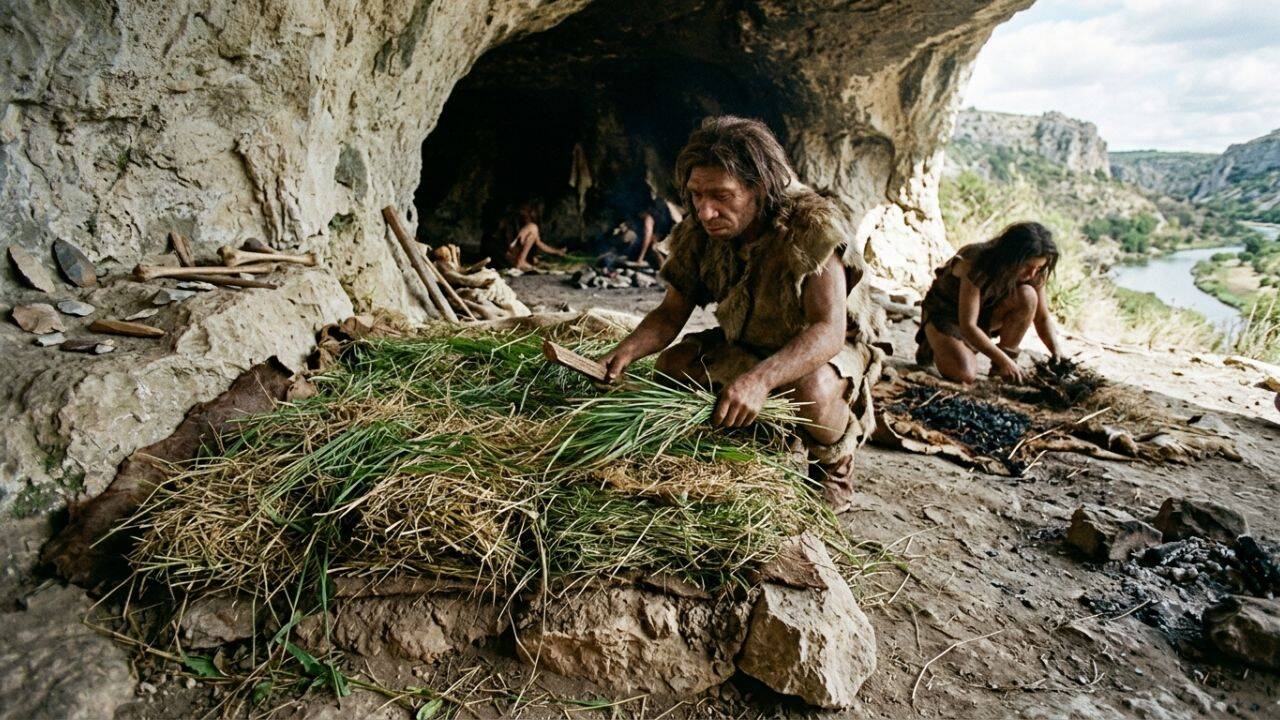
Two hundred thousand years ago, the darkness inside a sandstone cave in Southern Africa was complete, heavy, and loud. Outside, predators stalked the high cliffs of the Lebombo Mountains. Inside, a small family huddled together on the dirt floor, listening to the wind scrape against the rock.
They were exhausted. But sleep did not come easily. In similar updates, read about: Why The Connaught Bar Is The Most Overrated Experience In Luxury Hospitality.
It was not just the cold or the terror of the dark that kept them awake. It was the biting. Countless unseen parasites—ticks, fleas, lice—crawled through the dirt, biting exposed skin, spreading infection, and turning rest into a torturous endurance test.
Then, someone had a thought. It was a subtle spark of problem-solving that would reverberate through two hundred millennia. They reached out, gathered broad-leaved grass, and laid down a bed. Vogue has analyzed this fascinating subject in extensive detail.
The Fire Beneath the Sheets
We tend to think of bed-making as a modern chore, a tedious routine drummed into us during childhood. We picture crisp cotton sheets, memory foam mattresses, and laundered duvet covers. But stripping away our modern luxury reveals a stark truth: making a bed was never about comfort. It was about survival.
Archaeologists excavating Border Cave, a rock shelter perched near the border between South Africa and Eswatini, uncovered evidence of human ingenuity that rewrites our understanding of prehistoric life. Deep beneath layers of dust, preserved in dirt two hundred thousand years old, sat the silicified remains of woven plant mats.
These were not random piles of brush tossed onto the ground. They were deliberately constructed sleeping pads.
Consider the mechanics of what these early humans built. They gathered stalks of grass belonging to the Panicoideae subfamily, carrying bundle after bundle into the shelter. They laid these plants over a delicate layer of wood ash.
That layer of ash was not an accident. It was an ancient chemical weapon.
Ash contains natural compounds that dry out the waxy outer coatings of crawling insects, suffocating ticks and lice before they can find a human host. By spreading fresh grass over spent ash, early humans created a primitive insect-repelling mattress. They were practicing pest control and domestic hygiene long before the invention of agriculture, writing, or permanent houses.
Dirt, Smoke, and the Art of Cleaning House
To understand how profound this is, imagine living in that cave.
When you spend every night in the exact same spot, organic waste builds up fast. Food scraps decay. Old grass turns into dust. Ticks multiply exponentially in the warm microclimate of a shared sleeping area. Left unchecked, a cave quickly becomes unlivable, turning a sanctuary into a breeding ground for disease.
How did early humans solve a pest infestation without chemical sprays or hot water washes?
They used fire.
The stratigraphy inside Border Cave reveals a repeating pattern. The human inhabitants would sleep on their grass beds until the bedding grew dirty or infested. Then, rather than attempting to pick out the bugs one by one, they set the entire bed on fire.
The flame burned fast and hot, consuming the dried grass along with every parasite, egg, and flea hiding inside it. It sterilized the ground in seconds. Once the fire burned down to a fine, white powder, the residents swept away the largest cinders, leaving behind a fresh, sterile layer of ash.
Over top of that ash, they laid a brand-new layer of green grass.
This was not a chaotic struggle against nature. It was a routine. A domestic rhythm. Burn, clear, ash, lay, sleep. Repeat.
A Chemical Shield Gathered by Hand
The intelligence required to maintain this cycle goes deeper than simple fire control.
In some layers of the site, researchers identified trace remains of Tarchonanthus camphoratus—a plant commonly known as the camphor bush. Even today, indigenous communities across Africa use the crushed leaves of this bush as an insect repellent and medicinal treatment. Its strong, aromatic oils drive off pests and leave behind a fresh scent.
Two hundred thousand years ago, an early human walked out of the cave shelter, scanned the hillsides, and intentionally selected specific leaves to weave into their bedding.
They knew which plants repelled bugs. They knew which ashes dried up crawling pests. They understood that a clean home meant a healthy family.
Metaphorically speaking, these early ancestors were designing the very first domestic micro-environments. They were manipulating chemistry and biology to carve out a tiny, safe zone inside an indifferent wilderness.
It changes how we view our ancestors. They were not dirty, unthinking creatures shivering in damp caves, waiting around for millions of years to become smart. They were observant, practical designers. They felt the same annoyance at a bug bite that you feel on a summer night. They felt the same relief when laying down on a fresh, clean surface after a exhausting day.
The Deep History of Home
There is a quiet intimacy in this discovery.
When we look at ancient stone tools—spearheads, hand axes, scrapers—we see the machinery of hunting and butcher work. We see the violence of survival. But when we look at a two-hundred-thousand-year-old layer of ash and preserved grass, we see the domestic side of human history. We see the origin of home.
A home is not just a roof that keeps out the rain. A home is a controlled space. It is a place where we manage our environment so that we can drop our guard, close our eyes, and rest.
Every time you pull back your blanket, sweep a floor, or toss dirty sheets into a washing machine, you are continuing a line of behavior that stretches back through thousands of generations. You are executing a instinct refined over two hundred millennia in the dark of a sandstone cave.
The fire is gone, replaced by modern plumbing and synthetic fabrics. But the core urge remains entirely unchanged: to clear away the grit of the outside world, to drive away the things that bite in the night, and to make a clean, safe place to lay down our heads.