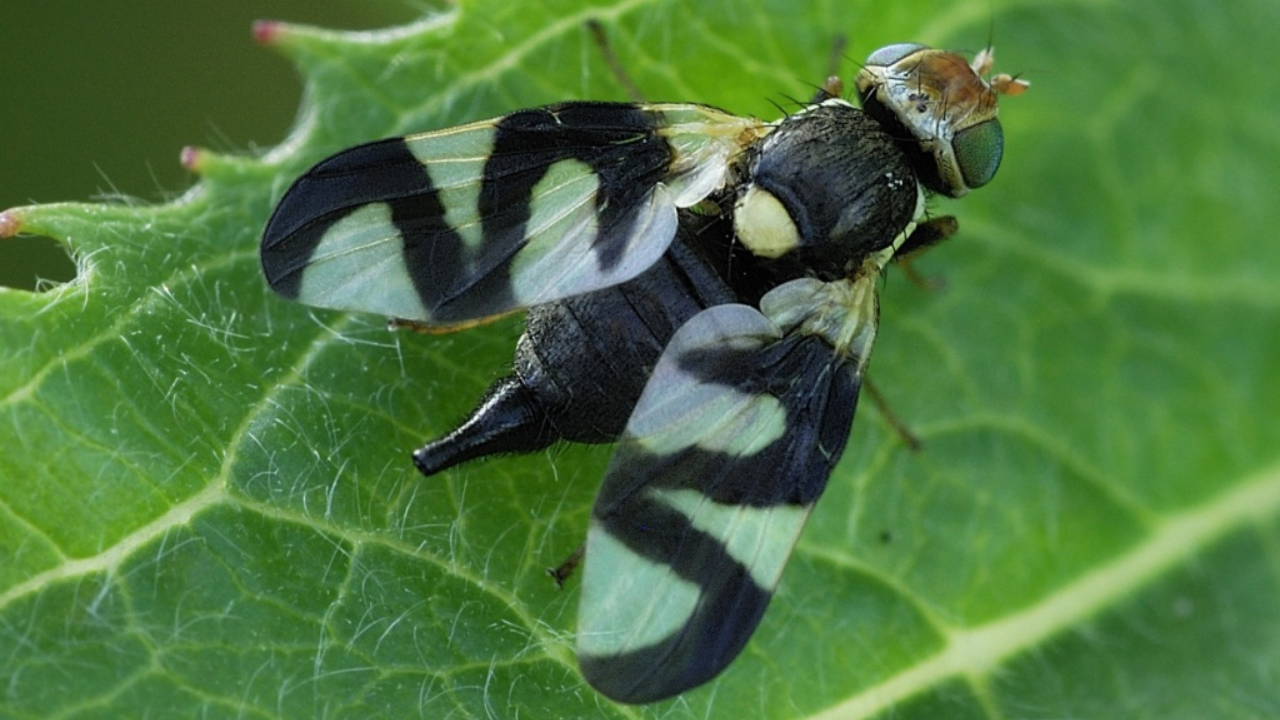
In 1973, state agricultural scientists and wildlife managers in Montana released thousands of European gall flies (Urophora affinis and Urophora quadrifasciata) across the Northern Rockies to combat the relentless spread of spotted knapweed. Decades later, that well-intentioned classical biological control program triggered an ecological feedback loop that ultimately multiplied the population of hantavirus-positive deer mice threefold in infested zones.
The introduction of non-native species to solve agricultural crises carries a profound structural hubris. Modern ecological management frequently treats ecosystems as static engineering problems rather than deeply dynamic networks. When humans insert a single foreign variable into a complex native food web, the resulting cascade rarely aligns with the original blueprint. The gall fly project serves as a textbook study in reductionist environmental management.
The Mechanics of an Invasion
Spotted knapweed (Centaurea stoebe) arrived in North America from Eurasia late in the nineteenth century. Devoid of its native predators, pathogens, and specialized herbivores, the aggressive perennial plant expanded across millions of acres of western rangeland. It choked out native bunchgrasses, accelerated topsoil erosion, and decimated livestock grazing land. Chemical herbicides offered a temporary remedy, but treating millions of acres of rugged terrain with synthetic sprays proved economically unfeasible and environmentally precarious.
Agricultural entomologists turned their attention toward classical biological control. The core premise relied on host specificity. Find an insect that feeds exclusively on the target weed in its native habitat, import it, and let natural predation starve the invasive plant of its reproductive capacity.
The European gall flies fit these criteria during laboratory screening. Female flies deposit eggs inside the flower buds of spotted knapweed. Upon hatching, the larvae burrow into the seed heads and induce the plant to form a hard, woody chamber known as a gall. Feeding on plant nutrients within this protective casing, the larvae develop while directly decreasing the quantity of viable seeds the plant can scatter.
Initial field monitoring suggested success. Millions of seed heads bore the signature galls. Entomologists checked boxes, wrote favorable reports, and assumed the system was working.
They fundamentally misunderstood how opportunistic native generalists would exploit the new resource.
The Winter Buffet for Rodents
The flies did not eradicate spotted knapweed. Instead, the plant adapted by maintaining dense, widespread infestations while hosting staggering densities of fly larvae. These larvae overwinter safely inside the dry, rigid seed heads standing tall above the winter snowpack.
For the native deer mouse (Peromyscus maniculatus), this agricultural miscalculation represented an unprecedented evolutionary windfall. Winter in the Northern Rockies historically enforced a strict bottleneck on rodent populations. Cold temperatures and deep snow buried native seeds and dormant insects, causing widespread starvation and keeping mouse numbers naturally suppressed.
Research led by United States Forest Service ecologist Dean Pearson and university colleagues revealed a drastic behavioral shift. Deer mice discovered that they could easily chew open the dry knapweed seed heads during the coldest months of the year. Inside lay a rich, lipid-dense protein source: dormant gall fly larvae.
In heavily infested zones, these larvae comprised up to eighty-five percent of a deer mouse's winter diet. The seasonal food shortage vanished. Mice overwintering in knapweed patches survived at vastly higher rates and entered the spring breeding season in peak physical condition. Consequently, local rodent densities inside knapweed-dominated landscapes doubled and occasionally tripled compared to native grasslands.
Amplifying Pathogen Transmission
Abundant mice change local epidemiological baselines. Deer mice serve as the primary reservoir host for the Sin Nombre hantavirus, a pathogen capable of causing hantavirus pulmonary syndrome in humans, a severe respiratory illness with a high fatality rate.
The virus spreads among rodents primarily through aggressive contact, territorial fights, and airborne transmission from dried urine, droppings, or saliva. When rodent populations artificially inflate due to a subsidized winter food supply, animal density spikes. Higher population density drives higher contact rates among individuals.
Field data collected across Western Montana demonstrated the downstream human health cost of this ecological subsidy. Areas overrun by spotted knapweed and populated by swarms of gall-fly-fed mice harbored more than three times the density of hantavirus-positive deer mice found in adjacent native grassland ecosystems. While the virus had always existed locally in wild rodent populations, the biological control program acted as an accidental amplifier, increasing human exposure risk across public lands, ranches, and rural developments.
The Fallacy of Single-Target Solutions
The gall fly oversight stems from a persistent blind spot in ecological intervention. Agencies evaluate biocontrol agents based almost exclusively on a binary metric: Does the insect damage the target weed?
They rarely ask what happens when a native predator or scavenger incorporates the biocontrol agent into its regular diet. An insect that fails to eradicate an invasive plant may still succeed wildly as a prey item, altering secondary trophic levels in ways that ripple outward through the entire ecosystem.
Spotted knapweed remains deeply entrenched across western landscapes. The gall flies are permanent residents. And the enhanced rodent populations continue to cycle zoonotic pathogens through the rangelands.
Future containment strategies must account for whole-system dynamics before releasing non-native organisms. When managers treat complex ecological webs as simple input-output equations, nature invariably writes the correction factor in blood, disease, and unintended persistence.