The rain in Brussels does not fall; it hangs. It coats the gray stone of the European Quarter in a permanent, slick film, reflecting the taillights of idling sedans and the exhausted faces of low-tier diplomats dragging rolling suitcases across the cobblestones. Inside the Justus Lipsius building, the air smells faintly of damp wool and institutional floor wax.
Three thousand miles away, in a glass tower overlooking the Huangpu River in Shanghai, a logistics manager named Chen looks at a digital dashboard flashing amber. A container ship carrying lithium-iron-phosphate battery cells is delayed at the port. It is waiting for a customs clearance that used to take forty-eight hours but now takes twelve days. Chen reaches for his tea. It has gone cold.
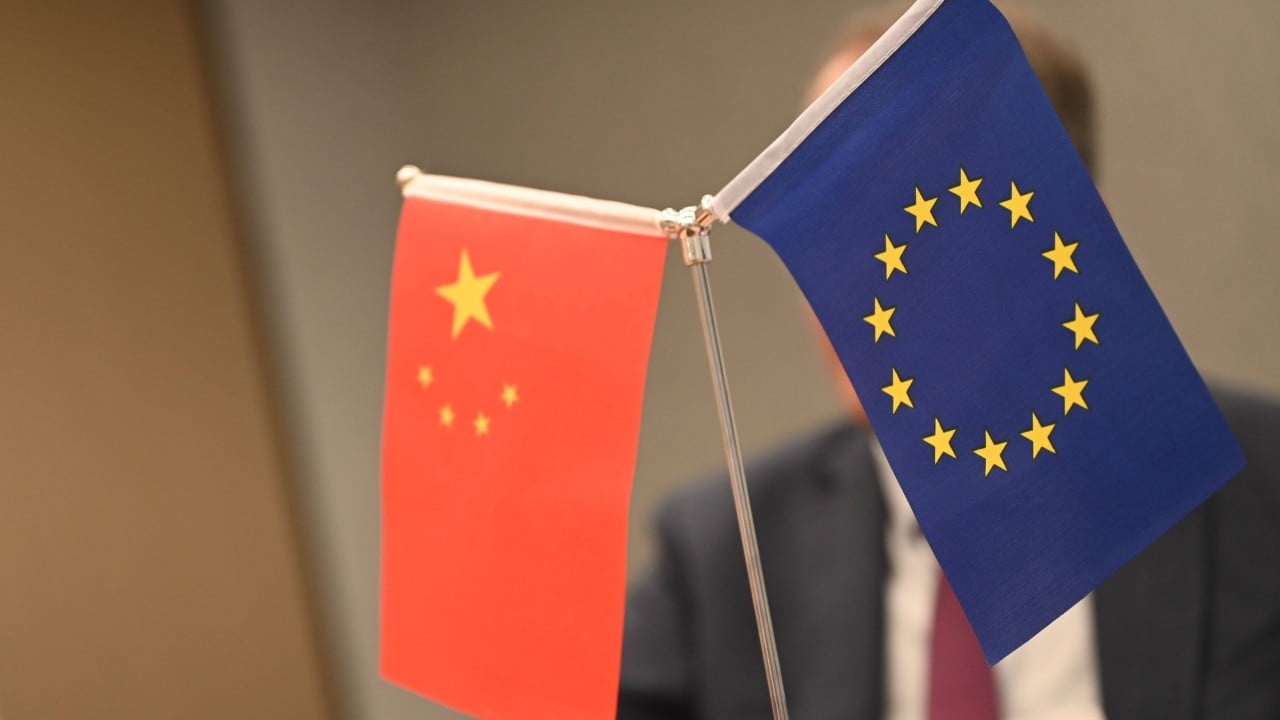
These two worlds, separated by continents and cultures, are bound by an invisible web of supply chains, tariffs, and political calculations. When the European Union and China issue a joint statement on trade, the public reacts with a collective yawn. The headlines are predictably numbing. Writers talk of "level playing fields," "market access," and "subsidy investigations." The eyes glaze over. The brain shuts down.
But behind the numbing prose of international diplomacy lies a high-stakes economic thriller. It is a story about survival, desperation, and the fragile peace that keeps our modern lives affordable. This is not about abstract balance sheets. It is about whether the factory worker in Stuttgart can keep his job, and whether the tech graduate in Shenzhen can afford rent.
The Paper Fortress
Diplomacy is an exercise in saying everything while revealing nothing. When representatives from the European Commission sit across from Chinese trade officials, they are not just talking about solar panels or electric vehicles. They are fighting over the blueprint of the global economy.
The standard narrative tells us that free trade is an unalloyed good. We are taught that goods flow where they are produced most efficiently, lowering costs for everyone. That was the dream of the early 2000s. It was a comfortable fiction.
Consider the modern electric hatchback parked on a street in Lyon. To the consumer, it is a sensible purchase, an environmentally conscious choice that hits a sweet spot in their budget. To European policymakers, that car is a trojan horse. It represents billions of euros in state subsidies from Beijing, designed to underprice local manufacturers and hollow out the European automotive sector—the very spine of the continental economy.
China sees it differently. From the Shanghai tower, Europe looks like a stagnant country club trying to change the rules of the game because it can no longer compete. Chinese engineers worked eighty-hour weeks for a decade to master battery chemistry. They built supply chains from the ground up, securing raw materials in Africa and South America while Western boards of directors were focused on quarterly stock buybacks. Now that the investment is paying off, the country club wants to put up a wall.
When a joint statement is issued, it represents a temporary truce in this undeclared war. It is a paper fortress. Both sides agree to talk about talking, to establish working groups, and to look into disputes. They sign the document with heavy fountain pens, smile for a fraction of a second for the cameras, and return to their hotels to plan their next economic counter-offensive.
The Microchip and the Olive Tree
To understand the tension, you have to look at the mismatch in what these two titans value. Europe is obsessed with rules, standards, and the preservation of its social model. It wants to protect its workers, its environment, and its data privacy. This is noble. It is also incredibly expensive.
China is obsessed with scale and speed. The state operates not as a referee, but as the captain of the economic team. If a specific sector is deemed vital for national survival—like green technology or advanced computing—the state opens the financial floodgates. Capital flows like water. Factories rise in months, not years.
This creates a structural imbalance that no joint statement can truly fix. Let us use an analogy. Imagine a bicycle race where one rider is bound by strict dietary guidelines, mandatory rest periods, and rigorous equipment safety checks. The other rider is backed by a multi-billion-dollar sports science program funded by the state, focused solely on winning at any cost. The first rider complains about fairness. The second rider points at the scoreboard.
But the race cannot stop. Europe cannot survive without China's manufacturing might. Try building a wind turbine or a hospital ventilator without Chinese components. You will find yourself staring at an empty factory floor. Conversely, China cannot survive without Europe’s affluent consumers. The Chinese economic engine is built on export-led growth; if the European consumer stops buying, the factories stop hummimg, and the social contract between the Chinese populace and the state begins to fray.
They are locked in a toxic embrace. They despise their dependency, yet they are terrified of isolation.
The Human Collateral
We lose sight of the people when we talk about trade blocks. We forget about Maria, who runs a small precision engineering firm outside Milan. Her family has made high-end valves for industrial machinery for three generations. She employs forty people. Lately, her clients have been asking if she can match the prices of a competitor based in Zhejiang. She cannot. Not without cutting her employees' healthcare or dumping waste into the local river. She lies awake at 3:00 AM wondering which of her workers she will have to lay off first.
Then there is Zhou, a twenty-four-year-old software tester in Chengdu. He has a degree from a top university and a mountain of expectations from his parents, who sacrificed their savings for his education. He works under the infamous "996" system—9:00 AM to 9:00 PM, six days a week. His eyes are perpetually bloodshot. He knows that if his company loses its access to the European market, his department will be downsized. There are ten thousand graduates waiting to take his desk for half the pay.
These are the real stakes of the joint statement. Every comma, every sub-clause, every bureaucratic turn of phrase in that document dictates whether Maria can pay her mortgage and whether Zhou can sleep more than five hours a night.
When the document mentions "intellectual property protection," it means Maria’s designs won't be copied overnight by a factory across the world. When it mentions "remedial trade measures," it means Zhou’s employer might face a 35% tariff at the port of Rotterdam, turning their competitive edge into a liability.
The Fiction of Neutrality
We like to think that international trade operates on cold, hard logic. We believe that numbers do not lie. This is the biggest myth of all. Economics is deeply psychological. It is driven by fear, pride, and the ancient human instinct to protect one's tribe.
The current friction is amplified by a profound cultural misunderstanding. European negotiators often arrive with stacks of legal precedents and regulatory frameworks, expecting to debate the finer points of administrative law. They view the market as a machine that needs tuning.
Chinese negotiators often view trade through a historical lens, remembering a century of national humiliation when foreign powers dictated terms to their country. They do not see European regulations as objective standards; they see them as weaponized bureaucracy designed to keep China in its place.
This creates a dialogue of the deaf. One side talks about the rule of law. The other talks about national sovereignty and economic dignity.
The joint statements are designed to mask this chasm. They use vague, soaring language to create an illusion of consensus. They are diplomatic morphine, dulling the pain of systemic conflict without curing the underlying disease.
The Ripple in the Cup
You can feel the tremors of this conflict in your daily life, even if you never read the financial news. It is there in the price of the smartphone in your pocket. It is there in the delivery estimate for your new refrigerator. It is there in the cost of the espresso you buy on the way to work.
The machinery that roasts the coffee beans requires specialized German components that rely on rare earth minerals processed in Inner Mongolia. The ship carrying those minerals had to detour around geopolitical choke points because trade tensions have spilled over into maritime security. The insurance premium for that ship tripled over the summer. All of this adds a few cents to the cost of your morning cup.
The world is too interconnected to be neatly divided into rival camps. The clean lines of the cold war do not apply to an era where Apple designs products in California, sources components from Taiwan, assembles them in Zhengzhou, and sells them in Berlin.
To sever these ties would not just be difficult; it would be catastrophic. It would mean a collapse in living standards across the West and mass unemployment across the East.
So the diplomats will continue to meet in the gray rain of Brussels. The logistics managers will continue to watch their amber dashboards in Shanghai. They will bicker, they will threaten, and they will occasionally sign joint statements that promise cooperation while preparing for competition.
The documents themselves will gather dust in government archives, forgotten by the public and ignored by history. But the fragile, tense equilibrium they maintain is the only thing standing between the world we know and an economic winter that no one is prepared to endure.