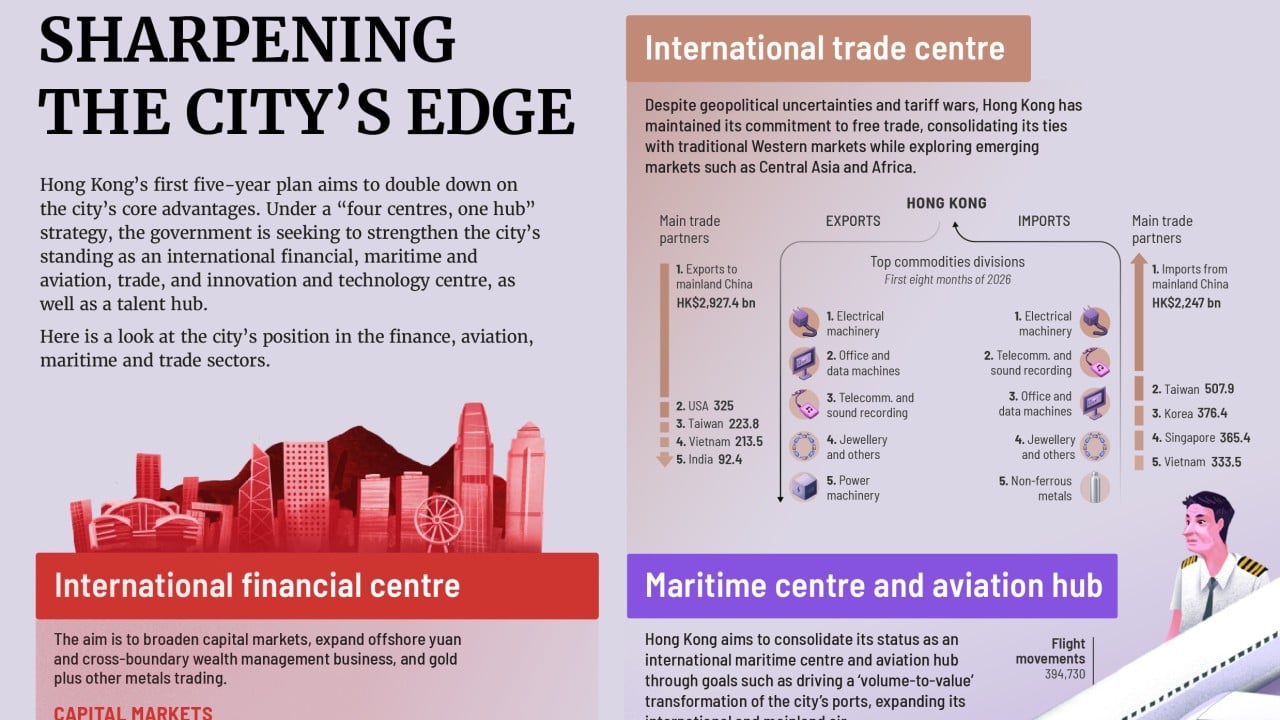
State-directed five-year planning in an open financial hub solves coordination problems at the risk of slowing market repricing. The October 16, 2026 factsheet titled Sharpening the city’s edge, published in the South China Morning Post series on Hong Kong’s debut five-year plan (2026–2030) and 2026 policy address, frames urban competitiveness around doubling down on established pillars—finance, maritime and aviation logistics, trade, and innovation—across capital markets, offshore renminbi liquidity, gold, shipping, and air transport.
A factsheet enumerates targets and sector metrics, but it rarely tests the causal mechanics linking those targets. Turning a policy list into a durable competitive advantage requires separating three distinct analytical layers:
- The Institutional Arbitrage Engine: How common-law contract enforcement, convertible capital accounts, and offshore currency pools monetize cross-border frictions between Mainland China and global markets.
- The Value-Density Transition: Why physical throughput volume (container TEUs or raw tonnage) stops predicting economic rent in high-cost land markets, forcing a shift toward maritime legal/insurance services, commodity clearing, and higher-yield air cargo.
- The Coordination-Rigidity Trade-Off: How multi-year public targets mobilize land, infrastructure, and institutional capital while risking misallocation if external trade or rate regimes shift mid-cycle.
How the Factsheet Logic Maps onto Urban Economics
Standard city-competitiveness coverage treats sector rankings as proof of durable superiority. In Sharpening the city’s edge, metrics across IPO fundraising, offshore renminbi settlement, gold trading, registered shipping tonnage, and passenger/cargo throughput are presented side by side as evidence of an enduring hub.
That aggregation conflates flow volume with defensible economic rent. High IPO proceeds or shipping registry tonnage can spike during cyclical windows or regulatory routing shifts without raising local value-added per square meter. Conversely, a city can lose raw container volume while increasing high-margin maritime arbitration, marine insurance, and ship-finance advisory.
Distinguishing known facts from educated hypotheses clarifies where the policy thesis holds and where execution risk concentrates:
- Known fact: Hong Kong operates an open capital account, a common-law legal system, the largest offshore renminbi liquidity pool, and top-tier rankings in IPO fundraising and registered shipping tonnage.
- Known fact: The 2026–2030 five-year plan explicitly targets a "volume-to-value" shift in maritime logistics, deeper offshore RMB and gold clearing/storage infrastructure, and expanded air and trade connectivity.
- Educated hypothesis: Expanding physical gold storage capacity, RMB-denominated instruments, and high-value supply-chain services will compound fee income only if clearing settlement costs, counterparty risk rules, and cross-border regulatory friction remain lower than in competing hubs.
- Educated hypothesis: Five-year state-led roadmaps will accelerate multi-agency infrastructure alignment in a market economy, but multi-year targets can become stale if global tariff structures, interest-rate differentials, or supply-chain routing change faster than five-year review cycles.
The Institutional Arbitrage Engine in Capital, RMB, and Gold
Financial hubs thrive on friction differentials—differences in currency convertibility, legal jurisdiction, tax treatment, and market depth between counterparties. When two large economic spheres trade or invest across different regulatory regimes, an intermediary hub captures economic rent by compressing transaction, legal, and settlement friction.
Consider a mainland enterprise issuing offshore debt or settling cross-border trade, or an international asset manager allocating capital into Asia. The hub's value is not merely holding liquidity; it is offering fungible legal and settlement rails that neither side can replicate unilaterally without friction. In offshore renminbi and gold markets, liquidity depth interacts with clearing efficiency: deeper pools lower bid-ask spreads, which attracts more participants, which further deepens liquidity.
The second limitation in financial-hub upgrades is balance-sheet and regulatory dependency. Liquidity pools and IPO pipelines respond sharply to global interest rates, domestic credit conditions, and cross-border compliance rules. Adding new product lines—such as expanded offshore RMB offerings or physical gold storage and clearing—broadens addressable demand, yet product breadth alone does not guarantee market share if foreign institutional risk limits or settlement costs constrain participation.
The Cost Function of Value Density in Maritime and Aviation
In land-constrained cities, urban land rent acts as a continuous filter on industrial survival. Low-margin, space-intensive activities cannot pay high urban land rents indefinitely unless subsidized or automated into negligible footprint.
This creates a structural cost function for transport hubs:
$$\text{Net Hub Value} = \sum (\text{Margin per Unit} \times \text{Volume}) - (\text{Land Opportunity Cost} + \text{Congestion & Compliance Cost})$$
When physical cargo volume faces high land costs and regional port competition, chasing raw tonnage yields diminishing returns. Moving from a "volume game" toward high-value maritime services—such as ship management, marine insurance, chartering, and dispute resolution—changes the numerator. Knowledge-intensive services scale on human capital and legal/financial ecosystems rather than berth acreage.
Aviation follows a parallel but time-sensitive logic. Passenger and air-cargo hubs depend on network centrality (direct origin-destination pairs and transfer connectivity) and turnaround speed. A single missed connection or customs bottleneck imposes high time costs on high-value electronics, pharmaceuticals, and precision components, making reliability a primary pricing variable rather than a secondary perk.
Why Trade Connectivity Depends on Non-Tariff Friction
Trade hub metrics often highlight headline trade volumes, commodity categories, and geographic partner lists. In practice, modern supply chains are constrained less by headline tariff rates alone than by rules-of-origin verification, customs clearance predictability, financing cost, and logistics visibility.
Expanding trade ties across traditional Western markets alongside ASEAN, the Middle East, Central Asia, and Africa introduces divergent regulatory and payment standards. A city positioned as a supply-chain services hub creates real value when it standardizes documentation, trade finance, and risk hedging across those corridors. Without lower end-to-end transaction friction, trade routing simply bypasses intermediate nodes whenever direct shipping or digital settlement becomes cheaper.
Operationalizing Hub Strategy Without Market Distortion
Turning a five-year strategic blueprint into measurable economic performance requires treating policy goals as systems-engineering constraints rather than aspirational slogans. Practitioners evaluating or executing urban competitiveness programs can apply a five-step operational sequence:
- Audit Revenue Concentration by Margin Tier: Separate headline activity metrics (listings, tonnage, cargo weight, trade value) from local fee capture, tax yield, and high-skill employment per unit of scarce land or capital.
- Map End-to-End Bottleneck Latency: Measure dwell times, settlement clearing cycles, licensing approval lead times, and cross-border compliance handoffs across each target sector to find the single slowest link.
- Align Infrastructure Delivery with Demand Readiness: Sequence physical capacity additions (such as storage vaults, port terminals, or air corridors) against anchor user commitments so capital is not stranded waiting for ecosystem demand.
- Enforce Standardized Interoperability: Ensure legal contracts, digital trade/settlement standards, and regulatory disclosures work smoothly across both domestic/regional partners and international counterparties.
- Run Rolling Stress Tests Against Regime Shifts: Stress-test five-year assumptions against adverse shocks—higher funding costs, supply-chain rerouting, or tightening cross-border rules—and define explicit recalibration triggers rather than waiting for the end of the five-year cycle.
Structural Trade-Offs and Limits of Planning
No planning framework eliminates fundamental economic trade-offs. First, multi-year targets can anchor capital in yesterday's thesis. If technology, trade corridors, or financial market structures shift in year two of a five-year cycle, rigid adherence to initial KPIs can waste public and private capital.
Second, state guidance in a market hub risks blurring price signals. When policy strongly favors designated sectors or corridors, capital may chase subsidies or policy alignment rather than risk-adjusted return on invested capital. Sustaining market discipline requires keeping entry, exit, and pricing governed by commercial viability rather than administrative protection.
Third, rankings lag structural erosion. Composite indices and historical league tables measure past momentum, not forward resilience. A city can top a metric today while losing underlying talent or institutional trust if living costs, regulatory complexity, or execution friction compound unchecked.
Strategic Play for the Next Five-Year Cycle
Treat the five-year plan strictly as a bottleneck-removal contract—commit public capital and institutional reform exclusively to lowering cross-border settlement, legal, and logistics friction where private markets cannot coordinate alone, while letting commercial return on capital govern every downstream investment decision.